

Kingsgrove Branch:


Send us a photo and our team will help identify it.

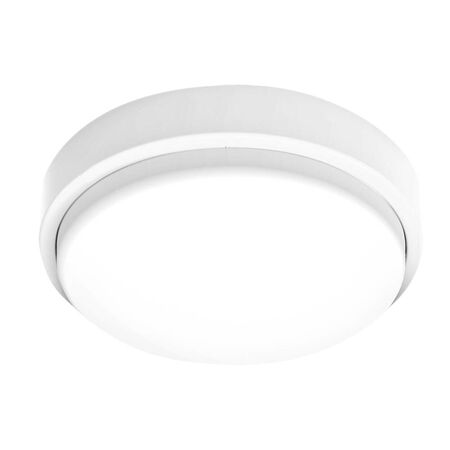
An electrician wiring the common corridor of a new townhouse block installs a standard PIR sensor oyster light at each end, only to have the lights blink off mid-stride every time a resident walks the full length of the hallway. The fixture works exactly as designed — it's just the wrong sensor mode for a corridor. Picking between a standard PIR sensor and a corridor-hold sensor is one of the few oyster light decisions that actually changes how a space behaves once tenants move in, and getting it wrong usually only shows up after the building is occupied.
NCC Section J (Energy Efficiency) generally pushes multi-residential and commercial common areas — stairwells, corridors, carparks, foyers — toward lighting that switches off automatically once a space isn't in use, rather than running on a timer or a manual switch alone. The exact trigger depends on building classification and floor area, so the energy assessor's report for that specific job is what actually confirms whether a given corridor or carpark run needs sensor control. What matters once it's specified is that the fixture chosen matches how people actually move through the space.
A standard PIR sensor oyster light, like the SAL Sensor Oyster Light 20W Tri-CCT Mode 1 IP65, detects movement in a roughly circular zone around the fixture and switches off once that zone has been clear for a set hold time. That works well at a stairwell landing or a carpark bay, where someone passes through and moves on. It works badly in a long corridor, because a single fixture's detection zone often can't cover the full length someone is walking, and the light behind them switches off before they've cleared it.
A corridor-hold sensor, like the SAL Corridor Sensor Oyster Light 24W Tri-CCT IP65, is built for that exact scenario — its detection pattern is stretched along the direction of travel rather than circular, and adjacent fixtures on the same run typically hand off to each other in sequence as someone walks through, rather than each one timing out independently.
| Sensor Type | Detection Pattern | Best For | Common Failure If Misapplied |
|---|---|---|---|
| Standard PIR | Circular zone, fixed hold time | Stairwell landings, carpark bays, short runs | Light drops out mid-corridor as person keeps walking |
| Corridor-Hold | Directional, fixtures hand off in sequence | Long corridors, hallways with multiple fixtures | Over-specified and unnecessary on very short runs |
Stairwells usually sit fine with a standard PIR unit — dwell time on a landing is short, and the circular detection zone comfortably covers someone climbing or descending. Carpark bays behave the same way in most cases, provided sightlines are reasonably open and fixtures are spaced to the manufacturer's coverage spec. A corridor is the space that actually forces the corridor-hold decision, because it's the one layout where a person's direction of travel outruns a single fixture's zone.
If the carpark or corridor run includes any semi-outdoor or fully exposed sections, the sensor decision also has to account for weatherproofing — that's a separate call from the sensor mode itself, closer to choosing the right outdoor oyster light for an exposed carpark deck than to indoor corridor coverage.
The most common mix-up is defaulting every common-area fixture to standard PIR because it's what's on the truck, then finding out at handover that the corridor run has dead spots. Walking the actual space before ordering — not just measuring it on plan — is usually enough to catch this before the switchboard schedule is locked in.
The second is skipping the manual override question. Cleaners and maintenance staff often need a way to hold lighting on regardless of movement, and not every sensor oyster light supports that the same way — check the fixture's wiring diagram before assuming an override switch will simply work in-line.
It's also worth checking early whether any fixture on that same common-area run needs to double as emergency lighting — a corridor or stairwell that requires sensor control under Section J is often also a candidate for meeting AS 2293 requirements for emergency lighting, and the two circuits need to stay separate at the switchboard rather than combined onto one run.
Does NCC Section J require sensor control on every common-area oyster light?
Not automatically — it depends on the building's classification and the energy assessor's report for that specific space. Corridors, stairwells and carparks are the areas most commonly affected, but the sign-off document is what confirms whether a given run actually needs automatic shut-off.
Do I need a licensed electrician to install a sensor oyster light?
Yes — wiring a hardwired sensor oyster light into a lighting circuit is electrical work and needs to be carried out and certified by a licensed electrician, the same as any other hardwired fixture.
What's the difference between sensor mode 1 and mode 2 on a PIR oyster light?
It varies by manufacturer, but on the SAL range the two modes typically set different combinations of hold time and sensitivity — the SAL Sensor Oyster Light 20W Tri-CCT Mode 2 IP65 is generally the longer hold-time setting, which suits spaces with slower foot traffic than a mode 1 default. Check the fixture's spec sheet before locking in a mode on the switchboard schedule.
Is a corridor-hold sensor always the right choice for a long hallway?
Usually, but not always — a shorter corridor with good sightlines can sometimes get adequate coverage from closely spaced standard PIR fixtures like the Martec Sensor Oyster Light 18W Tri-CCT IP54 instead. Corridor-hold becomes the safer default once the run gets long enough that a single PIR zone can't reasonably cover someone's full walking speed.
Can a sensor oyster light still be manually switched for cleaning or maintenance?
Yes, with the right wiring — a manual override typically sits ahead of the sensor circuit rather than replacing it. Confirm the override method against the fixture's wiring diagram before running cable, since not every sensor oyster light supports the same approach.
What happens if a sensor oyster light and an emergency oyster light share the same common-area run?
They need separate circuits even if they're mounted close together — a sensor timing out isn't the same event as a mains outage, and mixing the two circuits can leave a space with no clean test path for the emergency function. This is covered in more detail in the common mistakes section above.
Trade pricing applies across the range below, in Schnap's Oysters range, with same-day dispatch from Kingsgrove NSW on in-stock orders.
Standard PIR Sensor Oyster Lights
Corridor-Hold Sensor Oyster Lights
Twist-Lock Sensor Oyster Light
Need the right sensor oyster light for the job? Browse the range at Schnap.

SCHNAP Electrical Wholesaler - clear, upfront pricing that professional electricians trust

Get what you need in seconds. SCHNAP electrical wholesaler makes ordering quick and simple

Fast delivery anywhere - that's guaranteed. SCHNAP electrical wholesalers ship nationwide with same-day dispatch

Track your order every step of the way. SCHNAP electrical wholesale keeps you updated from click to delivery

SCHNAP is Australia's premier electrical wholesaler and electrical supplies, marketing thousands of quality products from leading brands. Trusted for nearly two decades by licensed electricians, contractors, and engineers, our range covers everything from basic electrical components to complex industrial electrical equipment
Our key categories include: LED lighting, designer switches, commercial switchboards, circuit protection, security systems & CCTV, and smart home automation
All products are certified to Australian standards (AS/NZS), backed by our 30-day, no-questions-asked return policy. Our expert technical team helps you quickly source the right solution for any residential, commercial, or industrial project, with daily dispatch from our Sydney electrical warehouse delivering Australia-wide
SCHNAP offers the most comprehensive electrical product range, with full technical specifications, application details, installation requirements, compliance standards, and warranties — giving professionals total confidence in every purchase


Kingsgrove Branch:
Opening hours:
Mon - Fri: 6:30 AM to 5 PM
Saturday: 8:00 AM to 2:00 PM
Sunday: 9:00 AM to 2:00 PM
Closed on public holidays
Jannali Branch:
Closed for Renovations
© 2004 - 2026 SCHNAP Electric Products