

Kingsgrove Branch:


Send us a photo and our team will help identify it.

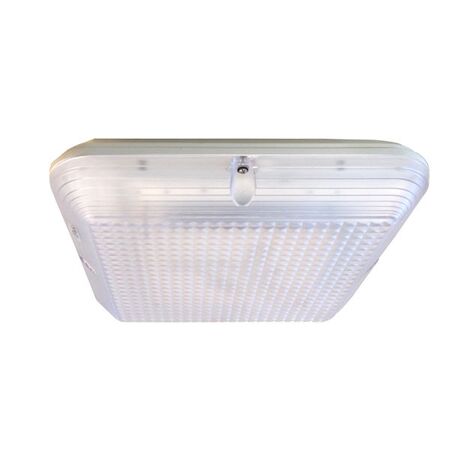
A carport light that fails within eight months of install usually isn't a wiring fault — it's condensation sitting inside a housing rated for a covered porch, not an open driveway. Outdoor oyster lights all look similar on a supplier page, but the gap between IP54 and IP65 decides whether a fixture survives its first wet season on an exposed eave.
This guide breaks down when a covered IP54 fixture is genuinely enough, when full IP65 weatherproof protection is required, and the installation mistakes that turn a correctly-specced fixture into a callback anyway.
Both ratings protect against dust ingress, but the second digit is where they split. IP54 protects against water splashing from any direction — fine for a fixture sitting under a genuine roof overhang. IP65 protects against low-pressure water jets from any direction, which is what an exposed eave, open carport, or unshielded wall actually experiences in wind-driven rain.
| Rating | Protection Level | Typical Location | Example Fixture |
|---|---|---|---|
| IP54 | Dust protected, splashing water from any direction | Covered porch, verandah, alfresco with roof overhang | 12W Tri-CCT Dimmable IP54 |
| IP65 | Dust-tight, low-pressure water jets from any direction | Open carport, exposed eave, unshielded exterior wall | 22W Square IP65 Weatherproof |
If the mounting point sits under a solid roofline that actually blocks rain from reaching the fixture — not just an eave that shields the wall below it in a light drizzle but leaves it exposed in a storm — IP54 is a correct, not a corner-cut, choice. Matching oysters to the right IP rating for the specific eave depth and prevailing wind direction, rather than defaulting to whatever's cheapest, avoids both over-speccing indoors and under-speccing outdoors.
An open carport, a courtyard wall with no roof above it, or an eave shallow enough that horizontal rain still reaches the fixture all call for IP65 as a minimum. Coastal sites add another factor — even a technically-shielded fixture can take on moisture through condensation cycling if it's a poor-quality IP54 unit in a humid, salt-laden environment. Where there's genuine doubt about exposure, checking the manufacturer's datasheet and the site's specific wind-driven rain pattern is worth the five minutes before ordering.
Mistake 1: Trusting the eave, not the wind. An IP54 fixture goes under an overhang that blocks vertical rain but not the horizontal rain a storm front pushes sideways. Consequence: water tracks in through the diffuser seal within a season. Correction: check exposure at the fixture's actual mounting height and orientation, not just whether there's a roof above the wall.
Mistake 2: Treating "outdoor" as one compliance box. Weatherproofing and emergency lighting compliance are separate questions. A fixture on an external stairwell or carpark exit path can be correctly rated IP65 and still fail sign-off if it also needs to satisfy egress lighting requirements. That side of the assessment is covered in the emergency oyster light compliance guide, which walks through standalone versus maintained requirements under AS 2293.
Mistake 3: Assuming the sensor shares the housing's rating. On combined sensor-oyster fixtures, the PIR lens is sometimes rated lower than the main housing — a detail that's easy to miss when the datasheet only headlines the body's IP rating. Consequence: the sensor fails first, well before the fixture itself. Correction: check both ratings separately before installing outdoors, a point covered in more detail in the sensor oyster light guide.
Is IP54 enough for a covered alfresco light?
Yes, provided the roofline genuinely blocks rain reaching the fixture from any angle a storm might push it — not just straight-down drizzle.
What IP rating do I need for an open carport?
IP65 as a minimum. A fixture like the 20W Tri-CCT IP65 oyster light is built for exactly this exposure.
Do I need a licensed electrician to install an outdoor oyster light?
Yes — fixed outdoor lighting wiring work in Australia requires a licensed electrician, and outdoor circuits typically need RCD protection under AS/NZS 3000.
Does the IP-rating logic for oyster lights apply to other outdoor electrical gear too?
Yes — the same covered-vs-exposed assessment applies to anything wired or plugged in outdoors, as covered in the outdoor extension lead guide.
Can an IP54 fixture be relocated to a fully exposed wall later?
Not recommended — the housing and seals aren't built for direct water jets, and swapping the fixture out is cheaper than dealing with a failure down the line.
What oyster light size suits a standard double carport?
A 24W Tri-CCT IP65 oyster light generally covers a double carport's footprint without needing a second fixture.
Trade pricing applies across the range, with same-day dispatch from Kingsgrove NSW on stocked lines.
IP65 — Fully Exposed
IP54 — Covered Outdoor
Find the right outdoor oyster light for your installation at Schnap.

SCHNAP Electrical Wholesaler - clear, upfront pricing that professional electricians trust

Get what you need in seconds. SCHNAP electrical wholesaler makes ordering quick and simple

Fast delivery anywhere - that's guaranteed. SCHNAP electrical wholesalers ship nationwide with same-day dispatch

Track your order every step of the way. SCHNAP electrical wholesale keeps you updated from click to delivery

SCHNAP is Australia's premier electrical wholesaler and electrical supplies, marketing thousands of quality products from leading brands. Trusted for nearly two decades by licensed electricians, contractors, and engineers, our range covers everything from basic electrical components to complex industrial electrical equipment
Our key categories include: LED lighting, designer switches, commercial switchboards, circuit protection, security systems & CCTV, and smart home automation
All products are certified to Australian standards (AS/NZS), backed by our 30-day, no-questions-asked return policy. Our expert technical team helps you quickly source the right solution for any residential, commercial, or industrial project, with daily dispatch from our Sydney electrical warehouse delivering Australia-wide
SCHNAP offers the most comprehensive electrical product range, with full technical specifications, application details, installation requirements, compliance standards, and warranties — giving professionals total confidence in every purchase


Kingsgrove Branch:
Opening hours:
Mon - Fri: 6:30 AM to 5 PM
Saturday: 8:00 AM to 2:00 PM
Sunday: 9:00 AM to 2:00 PM
Closed on public holidays
Jannali Branch:
Closed for Renovations
© 2004 - 2026 SCHNAP Electric Products