

Kingsgrove Branch:



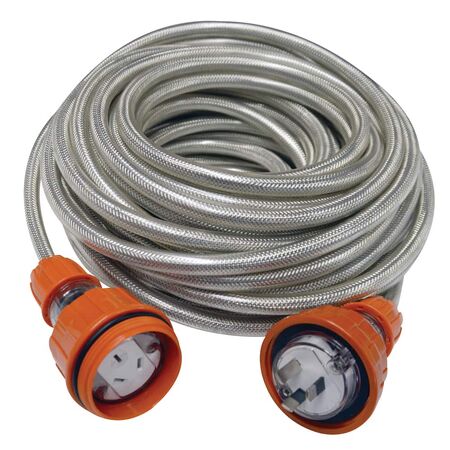
A driveway resurfacing job on a wet Tuesday morning is a common enough scene -- powering an angle grinder off a standard household extension lead that's been coiled on damp concrete since the last job. Within twenty minutes the RCD trips, the plug pins show the first signs of corrosion, and the lead gets binned by lunchtime. Most extension leads sold for indoor use simply aren't built to sit in water or cop direct weather, and that gap between IP20 and IP66 is where a lot of avoidable site delays start. If the job is landscape lighting rather than power tools, the garden lighting cable guide covers that scenario instead.
Standard extension leads -- the white ones most sites have a drawer full of -- are rated IP20. That rating covers protection against fingers and small objects getting into the socket, but it says nothing about water. Sitting one on a damp slab, running it through a puddle, or leaving it out in drizzle overnight is enough to get moisture into the plug or socket body over time, and that's usually what's behind an RCD that keeps tripping for no obvious reason on an otherwise fine tool.
It's rarely a single dramatic failure. More often it's a lead that keeps working, just less reliably, until someone notices the pins have gone green or the sheath has gone brittle where it sat in the sun. By the time that's obvious, the lead has usually already been the reason for a couple of unexplained trips or a callback.
IP66 is the rating that actually matters for exterior and wet-area work. It means the lead is dust-tight and rated against powerful water jets from any direction -- in practice, that's the difference between a lead that shrugs off rain and hose-down conditions and one that quietly degrades every time it's used outside its intended environment.
| Rating | What It Protects Against | Best Suited For |
|---|---|---|
| IP20 | Fingers and small solid objects only -- no water protection | Indoors, dry workshops, covered areas |
| IP66 | Dust-tight, protected against powerful water jets | Exterior sites, wet slabs, wash-down areas |
There's no in-between rating worth stocking for site work -- an IP66 lead handles the wet-area cases an IP20 lead can't, so once a job moves outside, the decision is really just about length and current from here.
Related Reading
Once the rating's sorted, the next decision is reach and current. A 5m or 10m lead covers most single-tool jobs close to a power point, while 20m-30m leads suit sites where the source is further from the work area -- a shed, a site shed, or a distribution board at the front of the block. As a general rule, running a long, thin lead at full load over its whole length introduces more voltage drop than a shorter run of the same rating, so for anything past 20m it's worth stepping up the current rating rather than pushing a 10A lead to its limit end to end.
Current rating matters more than most people budget for. A single grinder or drop saw sits comfortably on 10A, but running two tools off the same lead, or powering something with a higher startup draw, is where a 15A or 20A lead earns its place -- it's not just about the plug fitting, it's about not derating the lead under real load.
On sites with a lot of foot traffic or multiple trades working close together, a high-visibility orange lead is worth the small premium over a standard grey one -- it's one less trip hazard that gets missed in a walkaround, and it's the kind of thing a site supervisor notices during an induction check.
Grabbing whatever lead's in the van. The IP20 lead and the IP66 lead often look similar coiled up -- the difference only shows once one of them's sitting in a puddle for a few hours.
Coiling a hot lead straight after use. A lead that's been run at or near its rated current gets warm, and coiling it tight while still warm can accelerate wear on the outer sheath over time -- let it cool flat first where possible.
Undersizing for the actual load. Two tools daisy-chained off one 10A lead is a common shortcut on smaller jobs, but it's exactly the scenario that trips an RCD or causes the lead to run hotter than it should.
Leaving connections lying in standing water. Even an IP66 rated lead is rated for water jets, not permanent submersion -- a plug or socket sitting in a puddle for an extended period is still worth avoiding where it can be.
Assuming grey means indoor and orange means outdoor. Colour is a visibility choice, not a rating indicator -- always check the IP rating printed on the lead itself rather than going by colour alone.
Can I use a normal extension lead outside if it's under cover?
A covered area reduces direct rain exposure, but it doesn't stop moisture from ground contact, splashback, or humidity -- for anything genuinely outdoors, an IP66-rated lead is the safer default rather than relying on cover alone.
What length outdoor extension lead do I need for a driveway job?
It comes down to how far the power point is from the work area -- a 20m high-visibility lead covers most driveway or front-of-house jobs where the source is a garage or front power point.
Is a high-vis orange lead worth it for site work?
On any site with multiple trades or foot traffic, yes -- a high-visibility orange lead is easier to spot during a walkaround and reduces the chance of it becoming a trip hazard.
Do outdoor extension leads need to be on an RCD?
Yes -- portable leads used outdoors should generally be run through RCD protection regardless of their IP rating, and on many sites this is a standard induction requirement rather than optional practice.
What does IP66 actually mean on an extension lead?
It means the lead's plug and socket housings are dust-tight and protected against powerful water jets from any direction -- a braided IP66 lead is built to that standard specifically for exterior and wash-down conditions.
Can I leave an IP66 extension lead out in the rain overnight?
Short-term rain exposure is what IP66 is designed for, but as a general rule it's still worth disconnecting and coiling leads when a site is left unattended overnight, mainly to avoid trip hazards and reduce unnecessary wear rather than because the rating itself is inadequate.
Trade pricing and same-day dispatch from Kingsgrove NSW on the full range of extension leads below.
Find the full outdoor extension lead range at Schnap -- trade pricing and same-day dispatch from Kingsgrove NSW.

SCHNAP Electrical Wholesaler - clear, upfront pricing that professional electricians trust

Get what you need in seconds. SCHNAP electrical wholesaler makes ordering quick and simple

Fast delivery anywhere - that's guaranteed. SCHNAP electrical wholesalers ship nationwide with same-day dispatch

Track your order every step of the way. SCHNAP electrical wholesale keeps you updated from click to delivery

SCHNAP is Australia's premier electrical wholesaler and electrical supplies, marketing thousands of quality products from leading brands. Trusted for nearly two decades by licensed electricians, contractors, and engineers, our range covers everything from basic electrical components to complex industrial electrical equipment
Our key categories include: LED lighting, designer switches, commercial switchboards, circuit protection, security systems & CCTV, and smart home automation
All products are certified to Australian standards (AS/NZS), backed by our 30-day, no-questions-asked return policy. Our expert technical team helps you quickly source the right solution for any residential, commercial, or industrial project, with daily dispatch from our Sydney electrical warehouse delivering Australia-wide
SCHNAP offers the most comprehensive electrical product range, with full technical specifications, application details, installation requirements, compliance standards, and warranties — giving professionals total confidence in every purchase


Kingsgrove Branch:
Opening hours:
Mon - Fri: 6:30 AM to 5 PM
Saturday: 8:00 AM to 2:00 PM
Sunday: 9:00 AM to 2:00 PM
Closed on public holidays
Jannali Branch:
Closed for Renovations
© 2004 - 2026 SCHNAP Electric Products