

Kingsgrove Branch:



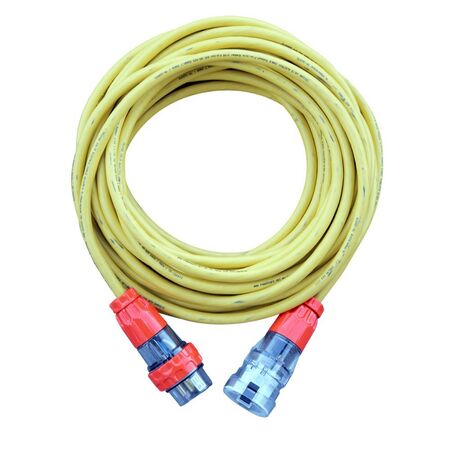
A contractor rolls out what looks like a solid heavy-duty lead to power a welder or a site compressor, plugs in, and the breaker trips within minutes. Nine times out of ten the cable itself was fine — the lead was rated 32A when the equipment was pulling closer to a 63A load. Getting a 3 phase extension lead right on site comes down to matching current rating to the machine, not just picking the longest or thickest-looking option on the shelf.
Most buyers start by asking how many metres they need. That's the wrong first question. A 3 phase extension lead is built around a current rating — 32A or 63A — and that number needs to match the equipment's rated draw with some headroom, not just cover the distance from the distribution board to the machine. Undersize it and you get nuisance tripping, or worse, a plug and socket running hot under sustained load. Oversize it unnecessarily and you're paying for cable and connectors you don't need.
The two common ratings differ in more than just amperage — the plug and socket format changes too, which is where mismatches often happen on a busy site.
| Rating | Plug/Socket | Typical Use | IP Rating |
|---|---|---|---|
| 32A | 5-pin, 6mm cable | Portable tools, smaller compressors, temporary lighting towers | IP66 |
| 63A | 5-pin, 16mm CEE cable | Welding plant, larger machinery, temporary switchboard feeds | IP67 |
A rough rule that holds up in practice: check the equipment's data plate for actual full-load current, not just the horsepower or kW rating printed on the side, before locking in 32A vs 63A. Machines with high inrush current — compressors and some welding sets — can trip a marginal 32A lead even if the running current looks fine on paper.
Related Reading
Before the extension lead question comes the supply question: what's actually feeding the temporary distribution point? Sites running on a genuine 3-phase supply — whether from a permanent switchboard or a temporary generator — need extension leads rated to carry that supply's output safely to the point of use, not the other way around. This is the same sizing logic that comes up when specifying a three phase EV charger connection — the supply capacity has to be confirmed first, and the cable or lead sized to match it, rather than assuming a standard lead will handle whatever's plugged into it.
On a temporary distribution setup, it's common to run one 63A lead from the main board to a spider box, then branch out with 32A leads to individual tools. Getting that hierarchy backwards — running 32A from the board and expecting it to feed multiple downstream loads — is one of the more frequent site call-outs electricians deal with.
Treating 63A as "just a bigger 32A" lead. The plug and socket pin configuration differs between the two ratings — a 63A lead won't plug into a 32A outlet and vice versa. Ordering the wrong one because "it's the same style, just heavier duty" is a common and avoidable delay on a job.
Sizing by length instead of load. A 50m 32A lead and a 10m 63A lead cost roughly similar amounts, but they serve completely different equipment. Picking based on how far the cable needs to reach, without first checking the machine's actual current draw, is how leads end up undersized for the job.
Ignoring IP rating for the actual site conditions. A lead sitting near wet concrete pours, in a dusty demolition zone, or exposed to rain overnight needs the connector rating to match — in practice, IP66/IP67 rated 5-pin connectors are the baseline for most outdoor or semi-exposed industrial sites, not an optional upgrade.
Daisy-chaining leads without checking cumulative run length. Joining two or three extension leads to reach a distant machine is common practice, but the combined length adds up against the total run the circuit was designed for — in practice, volt drop and heat build-up become more of a factor the longer the daisy-chained run gets, particularly under sustained heavy load.
what's the actual difference between a 32a and 63a 3 phase extension lead?
Beyond the current rating itself, the two use different pin configurations and cable gauge — a 32A lead runs a 6mm cable with a 5-pin plug, while a 63A lead steps up to a 16mm CEE cable and a larger 5-pin CEE plug. They're not interchangeable, and the socket on one won't accept the plug from the other. See an example 63A 5-pin CEE extension lead for the connector style.
can i run 3 phase power a long distance without volt drop issues?
Longer runs are fine in principle, but as a general rule, the further the run, the more volt drop becomes a factor, especially on 32A leads feeding heavier loads. For long site runs, stepping up to 63A cable or breaking the run at a spider box is typically the safer approach.
do i need a 5 pin plug for 3 phase equipment?
Most industrial 3-phase equipment in Australia uses a 5-pin configuration (3 phases, neutral, earth), which is the standard across both 32A and 63A extension leads. A 32A 5-pin extension lead covers the typical portable tool scenario.
do i need a licence to connect temporary 3 phase power on site?
Connecting or modifying fixed 3-phase wiring and switchboards requires a licensed electrician. Plugging a pre-terminated extension lead into an existing rated outlet is generally within scope for site crews, but anything involving new circuits, generators, or switchboard work should go through a licensed electrical contractor to stay compliant.
can i daisy chain two 3 phase extension leads together?
It's common practice on larger sites, but the combined length of both leads counts against the total run for that circuit. As a general rule, keep daisy-chained runs as short as practical and avoid stacking multiple leads on a circuit already feeding a heavy load. A 63A 50m extension lead can often replace what would otherwise be two shorter leads joined together.
what ip rating do 3 phase extension leads need for site use?
For most job sites, IP66 or IP67 rated connectors are the practical minimum, covering exposure to dust, rain, and wet concrete work. Leads used strictly indoors in a controlled environment can get away with less, but on an active construction site it's rarely worth the risk of specifying anything lower.
Trade pricing and same-day dispatch from Kingsgrove NSW on both 32A and 63A ratings, in braided sheath finishes built for site conditions.
Find the full extension lead range at Schnap — trade pricing and same-day dispatch from Kingsgrove NSW.

SCHNAP Electrical Wholesaler - clear, upfront pricing that professional electricians trust

Get what you need in seconds. SCHNAP electrical wholesaler makes ordering quick and simple

Fast delivery anywhere - that's guaranteed. SCHNAP electrical wholesalers ship nationwide with same-day dispatch

Track your order every step of the way. SCHNAP electrical wholesale keeps you updated from click to delivery

SCHNAP is Australia's premier electrical wholesaler and electrical supplies, marketing thousands of quality products from leading brands. Trusted for nearly two decades by licensed electricians, contractors, and engineers, our range covers everything from basic electrical components to complex industrial electrical equipment
Our key categories include: LED lighting, designer switches, commercial switchboards, circuit protection, security systems & CCTV, and smart home automation
All products are certified to Australian standards (AS/NZS), backed by our 30-day, no-questions-asked return policy. Our expert technical team helps you quickly source the right solution for any residential, commercial, or industrial project, with daily dispatch from our Sydney electrical warehouse delivering Australia-wide
SCHNAP offers the most comprehensive electrical product range, with full technical specifications, application details, installation requirements, compliance standards, and warranties — giving professionals total confidence in every purchase


Kingsgrove Branch:
Opening hours:
Mon - Fri: 6:30 AM to 5 PM
Saturday: 8:00 AM to 2:00 PM
Sunday: 9:00 AM to 2:00 PM
Closed on public holidays
Jannali Branch:
Closed for Renovations
© 2004 - 2026 SCHNAP Electric Products