

Kingsgrove Branch:



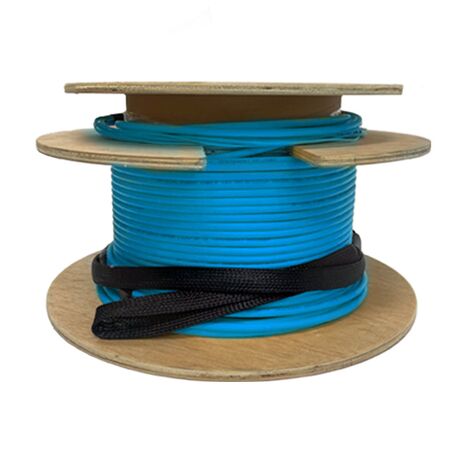
A two-day cutover window for a factory automation upgrade doesn't leave room for a fusion splicer booking that falls through at the last minute. That's usually the exact spot a data cabler is standing in once the multimode vs singlemode decision is locked in and the next call has to be made: run raw fibre and terminate it on site, or order it pre-terminated and just pull it through.
Once the mode is settled, the timeline usually decides the rest. Fusion splicing and polishing raw fibre on site takes a trained tech, a splicer, a cleaver, and enough dwell time to get consistent insertion loss across every strand. On a job with a hard cutover date, that's a lot of variables sitting between the plan and the go-live. A pre-terminated LC-LC assembly moves that risk off the job site entirely — the terminations are done and tested in a controlled environment before the reel ever reaches the van.
That's not an argument that pre-terminated is always the better choice. It's a length-and-access argument first, cost second. If the run is a known, fixed distance between two points that won't change, pre-terminated removes a whole category of on-site risk. If the route is still being confirmed, or runs longer than what's available pre-made, raw fibre with field termination keeps the flexibility.
For a straightforward LC-LC run between a server room and a remote cabinet, here's roughly how the two methods stack up in practice:
| Factor | Pre-Terminated Assembly | Field Termination |
|---|---|---|
| On-site labour | Pull and dress only | Splice/polish per strand on site |
| Tools needed | None beyond standard pulling gear | Fusion splicer, cleaver, polishing kit |
| Length flexibility | Fixed to stocked lengths | Cut to exact run |
| Loss consistency | Factory-tested, typically consistent | Depends on technician and conditions |
Related Reading
For the server-room-to-cabinet scenario, distance is what decides mode. A 100m OM4 pre-terminated LC-LC run comfortably covers most in-building backbone distances at 10G and above. Once the route pushes past that — between buildings, or across a larger site — an OS2 singlemode pre-terminated assembly holds performance over the longer distance without the loss creeping in that multimode can show past its rated span. Core count follows the same logic as any fiber cable plan: 6-core covers a straightforward point-to-point link with a little spare capacity, 12-core is the safer call when the cabinet is likely to grow beyond the current device count.
Where the run needs extra mechanical protection — routed through a plant floor, near moving equipment, or exposed to physical knocks — an armoured variant is worth pricing separately with the supplier before locking in the pre-terminated length, since it changes the pull weight and bend radius the reel needs to account for.
Pre-terminated isn't the default for every job. A long backbone run with an unconfirmed final length, or a route that needs splitting into multiple segments through intermediate patch points, is still better served by raw loose-tube fibre with proper field termination. It's also the more practical option where connector type needs to be decided on site rather than locked in at order time.
Ordering to the straight-line distance instead of the actual pull route. Cable trays, risers, and cabinet dressing all add length. A pre-terminated assembly ordered to the map distance often comes up short once it's actually routed through the building.
Assuming connector polarity is interchangeable on site. LC-LC assemblies are built to a fixed polarity configuration. Swapping which end goes where after the fact isn't something you can fix with a connector by hand — it means a different assembly.
Skipping the bend radius check on the pull path. Pre-terminated connectors are more sensitive to a tight pull than bare fibre being fed through — a sharp bend at a tray edge can stress or damage a factory-terminated end that's otherwise perfectly good.
Not confirming core count against future device count. A 6-core run that's fully used on day one leaves no room for the next switch or camera added to that cabinet without a second pull.
Treating OM4 and OS2 as interchangeable at order time. They're not compatible with the same transceivers, and mixing them up on a multi-run job is a common cause of a link that simply won't come up on cutover day.
can I get pre-terminated LC-LC fibre cut to a custom length?
Pre-terminated assemblies are typically available in stocked standard lengths rather than made-to-order cuts. If your run doesn't match a standard length, raw fibre with field termination is usually the more practical route.
will a pre-terminated OM4 assembly work with older 10G equipment?
Yes, an OM4 12-core pre-terminated assembly is backward compatible with older 10G and lower-speed transceivers, so it's a safe upgrade path if the switch gear is due for a refresh later.
what's the difference between OM4 and OS2 pre-terminated assemblies?
OM4 is multimode, suited to shorter in-building backbone runs; OS2 is singlemode, built for longer distances without the same loss over range. The multimode vs singlemode breakdown covers how to pick between the two before ordering pre-terminated.
do I need to fusion splice pre-terminated fibre on site?
No — that's the point of a pre-terminated assembly. The connectors are factory-installed and tested; on-site work is limited to pulling the cable through and dressing it into the cabinet.
does running fibre backbone through a plant require a cabling licence in Australia?
Structured data and fibre cabling work generally falls under ACMA cabling registration requirements, separate from an electrical licence. Check current registration requirements for the specific cabling class before starting the job if you're not already registered.
what connector type do pre-terminated assemblies use — LC or SC?
Schnap's stocked pre-terminated runs, including the OS2 6-core 200m assembly, use LC-LC connectors, which is the more common form factor in current switch and patch panel hardware.
For runs where the length isn't yet confirmed or field termination is the better fit, a 24-core OM3 loose-tube option is available for on-site splicing.
Related Reading
Trade pricing and same-day dispatch from Kingsgrove NSW on the full pre-terminated and loose-tube fiber cable range.
Find the full pre terminated fibre range at Schnap — trade pricing and same-day dispatch from Kingsgrove NSW.

SCHNAP Electrical Wholesaler - clear, upfront pricing that professional electricians trust

Get what you need in seconds. SCHNAP electrical wholesaler makes ordering quick and simple

Fast delivery anywhere - that's guaranteed. SCHNAP electrical wholesalers ship nationwide with same-day dispatch

Track your order every step of the way. SCHNAP electrical wholesale keeps you updated from click to delivery

SCHNAP is Australia's premier electrical wholesaler and electrical supplies, marketing thousands of quality products from leading brands. Trusted for nearly two decades by licensed electricians, contractors, and engineers, our range covers everything from basic electrical components to complex industrial electrical equipment
Our key categories include: LED lighting, designer switches, commercial switchboards, circuit protection, security systems & CCTV, and smart home automation
All products are certified to Australian standards (AS/NZS), backed by our 30-day, no-questions-asked return policy. Our expert technical team helps you quickly source the right solution for any residential, commercial, or industrial project, with daily dispatch from our Sydney electrical warehouse delivering Australia-wide
SCHNAP offers the most comprehensive electrical product range, with full technical specifications, application details, installation requirements, compliance standards, and warranties — giving professionals total confidence in every purchase


Kingsgrove Branch:
Opening hours:
Mon - Fri: 6:30 AM to 5 PM
Saturday: 8:00 AM to 2:00 PM
Sunday: 9:00 AM to 2:00 PM
Closed on public holidays
Jannali Branch:
Closed for Renovations
© 2004 - 2026 SCHNAP Electric Products