

Kingsgrove Branch:



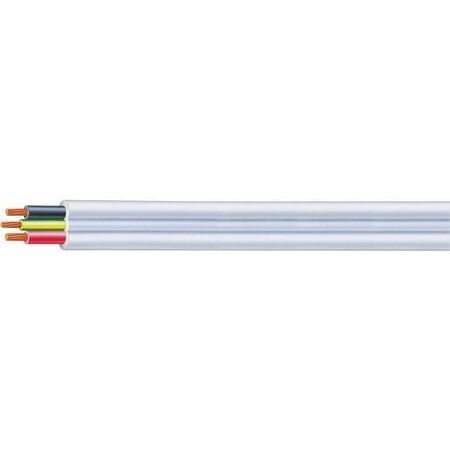
Ask ten apprentices what "TPS" stands for and you'll get a few blank looks. Thermoplastic-Sheathed cable — known on the tools as Twin and Earth, or T&E — is the flat fixed-wiring cable running through the walls and ceilings of almost every house in Australia. It's not glamorous. But get the size, rating, or colour wrong, and it's the difference between a job that sails through inspection and one that gets bounced back.
This guide covers what TPS actually is, how AS/NZS 3008 decides the right size, what the post-2000 colour codes mean on a renovation job, and where single-core building wire fits in as a different product for a different job entirely.
Already know the basics and just need stock? Schnap stocks TPS Twin & Earth cable and single-core building wire with same-day dispatch from Sydney.
TPS (Thermoplastic Sheathed) cable, manufactured to AS/NZS 5000.2, is a flat cable with two insulated conductors — active and neutral — plus an earth conductor, under a single PVC sheath. The flat profile is what makes it "TPS" rather than circular cable: it sits neatly against studs and joists and is the standard choice for fixed wiring inside wall cavities, ceiling spaces, and roof spaces.
It comes in two main insulation grades. V75 is the standard PVC rating for general indoor wiring with moderate temperature exposure. V90 (sometimes labelled V90HT) carries a higher temperature rating — better suited to ceiling cavities and roof spaces, where Australian summers routinely push ambient heat past what V75 is rated to handle long-term.
TPS isn't the only cable in the building wire family, and it's not always the right pick. For outdoor runs along walls or through garden beds, orange circular cable in conduit is the standard alternative — same current tables, tougher round sheath built for the outdoors. For submersible pump wiring, neither will do; that needs purpose-built submersible-rated cable. Splicing one cable type onto another to make up a shortfall isn't compliant and won't pass inspection — buy the correct length of the correct cable the first time.
For a broader overview of all cable types used in Australian homes, see our Electrical Cable Guide.
Twin & Earth (2C+E) is the standard configuration: one active, one neutral, one earth. This covers the large majority of general lighting and power circuits.
Triple & Earth (3C+E) adds a second active conductor, used for two-way switching circuits — light switches controlled from two locations — or other applications needing a third current-carrying core alongside the earth.
| Product | Configuration | Typical Use |
|---|---|---|
| Electra Cables TPS Twin & Earth 10mm² | 2C+E, V90, 450/750V | Sub-mains, high-load circuits, ducted AC |
| Electra Cables TPS Twin & Earth 16mm² | 2C+E, V90, 450/750V | Sub-mains, larger load circuits, longer runs |
| Electra Cables TPS Triple & Earth 1.5mm² | 3C+E, flat, PVC insulated | Two-way light switching, multi-core lighting circuits |
Picking a TPS size isn't a single lookup table — AS/NZS 3008 weighs up three factors together, and whichever is hardest to satisfy decides the final size.
Design current is the obvious starting point: what load is the circuit carrying.
Voltage drop is capped at 5% from point of supply to point of use under AS/NZS 3000. Most electricians work tighter than that in practice — around 3% on a final sub-circuit, leaving 2% in reserve for mains and sub-mains. Long runs and lighting circuits often get sized up for this reason alone, even when the current rating alone would allow a smaller cable.
Installation method is the one most often skipped at the counter. A cable in free air carries more current than the same cable bundled with others or buried in ceiling insulation. A 2.5mm² TPS rated around 27A in open conditions can derate to 16A or less once bundled and partially covered in roof insulation. Protecting that derated cable with a 20A breaker leaves no safety margin for fault conditions — and it's a direct compliance issue under AS/NZS 3000 and AS/NZS 3008.1, not a judgement call.
⚠ Compliance note: Derating for installation method isn't optional. A cable that passes a visual inspection can still be running hot under load if it wasn't sized against the actual installation conditions. Always check against AS/NZS 3008's installation method tables, not a generic published current rating.
As a general working guide for residential installs — always confirm against AS/NZS 3008 for the specific install:
| Cable Size | Typical Application |
|---|---|
| 1.0–1.5mm² | Lighting circuits |
| 2.5mm² | General-purpose power points |
| 4–6mm² | Ovens, ducted air conditioning |
| 10–16mm² | Sub-mains, heavier load distribution |
| 25mm² and above | Consumer mains — commonly 25mm² for an 80A single-phase main, longer runs may need 35mm² |
Australia's wire colour code shifted in the early 2000s to align with IEC 60446, and it's a common source of confusion on renovation and rewiring jobs where old and new cable show up side by side.
| Conductor | Current Colour (AS/NZS 3000:2018) | Legacy Colour (pre-2000) |
|---|---|---|
| Active | Brown | Red |
| Neutral | Blue | Black |
| Earth | Green/Yellow striped | Solid green |
The earth conductor must be fully insulated under AS/NZS 3000. On a multi-core cable with a bare or solid green earth, it needs to be sleeved at terminations so it's clearly identifiable as earth and not mistaken for something else.
⚠ Don't assume colour without checking. On any job touching wiring from before the early 2000s, a black conductor could be legacy neutral or could be a modern active core, depending on which era of cable it came from. Confirm with a meter before connecting — never assume from colour alone on mixed-era wiring.
Compliant TPS cable carries three things printed on the outer sheath at regular intervals: the manufacturer's name or registered trademark, the standard reference (AS/NZS 5000.2), and the conductor size. No markings, or markings that don't match the standard reference, is a red flag regardless of price.
Buying compliant cable is necessary but not sufficient on its own. AS/NZS 3000 also governs how it's installed — minimum burial depths, support spacing, protection through building elements, segregation from other services, and termination requirements. Compliant cable poorly installed is still a compliance failure at inspection.
TPS isn't the only building wire on the truck. Single-core building wire — sold by colour in 100m rolls — is a different product for a different job. Rather than running inside wall cavities as fixed circuit wiring, single-core wire is typically used for switchboard and panel wiring, looping inside enclosures, and other applications where conductors are run and terminated individually rather than as a pre-bundled flat cable.
A standalone green/yellow earth conductor — available from 1.5mm² up to 120mm² — is the other common single-core item on the van, used wherever an additional earth bond is needed independent of a multi-core cable, such as equipotential bonding or extending an existing earth run.
The practical distinction for anyone newer to the trade: wiring through a wall or ceiling to a power point or light is a TPS job. Wiring inside a switchboard, distribution board, or enclosure where each conductor terminates individually is usually a single-core job.
Related Reading
Q: What does TPS stand for, and is it the same as Twin and Earth?
TPS stands for Thermoplastic Sheathed cable. "Twin and Earth" describes the 2-conductor-plus-earth configuration, which is the most common TPS format — so the terms are often used interchangeably on the tools, though TPS also comes in Triple & Earth (3C+E) configuration.
Q: What's the difference between V75 and V90 insulation?
V75 is rated for general indoor wiring with moderate temperature exposure. V90/V90HT carries a higher temperature rating, better suited to ceiling cavities, roof spaces, and applications with sustained heat or higher continuous load.
Q: Can I use TPS cable outdoors or underground?
No. TPS is built for fixed indoor wiring in wall cavities, ceilings, and roof spaces. For outdoor runs or garden beds, orange circular cable in conduit is the correct product. For direct burial or submersible use, a purpose-built cable rated for that application is required.
Q: Why does the same cable size carry different current ratings on different jobs?
Current rating depends on installation method as much as cable size. A cable in free air carries more current than the same cable bundled with others or buried in thermal insulation. AS/NZS 3008 sets out specific installation methods, each with its own rating — always size against the actual conditions, not a generic published figure.
Q: What size TPS do I need for a sub-main?
It depends on load, run length, and installation method — there's no single answer. As a general guide, 10–16mm² covers many residential sub-mains, with 25mm² and above typically used for consumer mains around 80A single-phase. Always confirm the specific calculation against AS/NZS 3008.
Q: Do I need a licensed electrician to install TPS cable?
Yes. Electrical work in Australia must be carried out by a licensed electrician in accordance with AS/NZS 3000. This guide is a reference for product selection, not a substitute for a compliant, certified installation.
Q: How do I know if a TPS cable is compliant?
Check the outer sheath for the manufacturer's name or trademark, the AS/NZS 5000.2 standard reference, and the conductor size, printed at regular intervals. Missing or inconsistent markings are a red flag.
Q: Is it legal to mix old red-black-green wiring with new brown-blue-green/yellow cable on the same job?
Existing legacy wiring doesn't need to be replaced just because the colour code changed, but any new cable added to a job must follow the current AS/NZS 3000:2018 colours, and conductors must be correctly identified — not assumed — wherever old and new wiring meet.
Related Reading
Schnap stocks TPS Twin & Earth and Triple & Earth cable alongside single-core building wire and earth conductors, with trade pricing and same-day dispatch from our Kingsgrove NSW warehouse.
Related guides: Electrical Cable Types in Australia — How to Crimp MC4 Connectors — Solar Cable Ties Australia

SCHNAP Electrical Wholesaler - clear, upfront pricing that professional electricians trust

Get what you need in seconds. SCHNAP electrical wholesaler makes ordering quick and simple

Fast delivery anywhere - that's guaranteed. SCHNAP electrical wholesalers ship nationwide with same-day dispatch

Track your order every step of the way. SCHNAP electrical wholesale keeps you updated from click to delivery

SCHNAP is Australia's premier electrical wholesaler and electrical supplies, marketing thousands of quality products from leading brands. Trusted for nearly two decades by licensed electricians, contractors, and engineers, our range covers everything from basic electrical components to complex industrial electrical equipment
Our key categories include: LED lighting, designer switches, commercial switchboards, circuit protection, security systems & CCTV, and smart home automation
All products are certified to Australian standards (AS/NZS), backed by our 30-day, no-questions-asked return policy. Our expert technical team helps you quickly source the right solution for any residential, commercial, or industrial project, with daily dispatch from our Sydney electrical warehouse delivering Australia-wide
SCHNAP offers the most comprehensive electrical product range, with full technical specifications, application details, installation requirements, compliance standards, and warranties — giving professionals total confidence in every purchase


Kingsgrove Branch:
Opening hours:
Mon - Fri: 6:30 AM to 5 PM
Saturday: 8:00 AM to 2:00 PM
Sunday: 9:00 AM to 2:00 PM
Closed on public holidays
Jannali Branch:
Closed for Renovations
© 2004 - 2026 SCHNAP Electric Products