

Kingsgrove Branch:



A 40-metre run of RG6 out to a rear shed, split three ways to feed extra TV points, and the picture on the furthest set starts breaking up whenever it rains. It's a familiar callback for anyone doing antenna, satellite, or CCTV work around Australian properties — and the fix isn't always "run new cable everywhere." Sometimes RG6 is still fine. Sometimes the run genuinely needs RG11. Here's how to tell the difference before you order the wrong cable.
In practice, every coax cable loses a small amount of signal per metre it runs — this is called attenuation, and it's typically worse at the higher frequencies used by satellite and some digital TV signals. A splitter adds loss of its own on top of that, generally a few dB per split as a rough rule of thumb, which is why a 3-way splitter on an already-long run compounds the problem fast. RG6 handles short-to-moderate runs comfortably. Once you stack enough distance and enough splits together, though, the accumulated loss can drop the signal below what the tuner or set-top box needs to hold a clean lock.
This is the part that catches people out: it's rarely one single factor. A 25-metre run with no splits might be perfectly fine on RG6. The same 25 metres feeding a 4-way splitter to multiple rooms is a different story entirely.
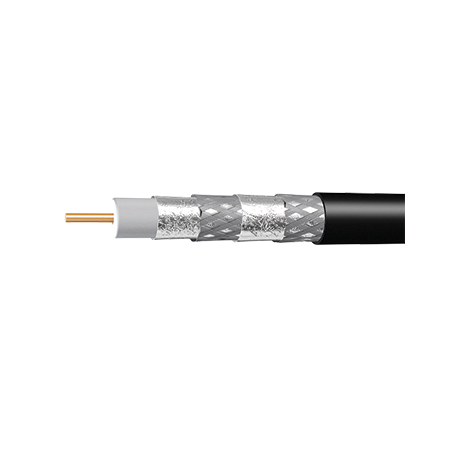
The core difference comes down to conductor and jacket size, and what that does to signal loss over distance:
| Spec | RG6 | RG11 |
|---|---|---|
| Typical outer diameter | Around 6.9mm | Around 10.3mm |
| Centre conductor | Copper-clad steel, roughly 1mm | Copper-clad steel, roughly 1.6mm |
| Signal loss over distance | Higher loss per metre | Lower loss per metre — in practice, roughly half the attenuation of RG6 at the same frequency |
| Flexibility | Easier to route, tighter bends | Stiffer, needs a wider bend radius |
| Typical use | Standard antenna and in-wall runs, most residential jobs | Long runs, heavy splitting, distribution amps, MDU/commercial |
Most standard antenna jobs — a single run from roof to lounge room, or a couple of splits inside a normal-sized house — sit comfortably within what RG6 is built for. It's easier to route through wall cavities and around tight corners, which matters more than people expect once you're fishing cable through an existing ceiling space. If the run is under roughly 30 metres with no more than a couple of splits, RG6 is generally the more practical choice, not just the cheaper one.
[!] Compliance note: For fixed antenna and pay-TV installations, coax cable is generally expected to carry AS/ACIF S008/S009 compliance marking. It's worth checking this on the cable jacket before committing to a bulk order, particularly for commercial or multi-dwelling jobs.
Once a run starts pushing past 30-40 metres, or you're feeding a 3-way or 4-way splitter over any real distance, the accumulated loss from cable and splitters together can genuinely put you below a usable signal level — especially on the furthest outlet. That's the point where swapping to RG11 for the main trunk run (even if the shorter branch runs off the splitter stay on RG6) tends to solve the problem properly, instead of chasing it with an amplifier that just adds noise along with signal.
Once you've decided RG11 is the right call, how you terminate it matters just as much as the cable spec — a compression connector rated for the thicker RG11 jacket, fitted properly, is what actually stops the signal loss argument from becoming a moot point. If you're not sure whether to go compression or crimp for the termination, our guide on terminating coax with F-type connectors walks through it, including how to keep water out of a rooftop or eave termination.
Related Reading
Judging the run on distance alone. A 20-metre run with a 4-way splitter can lose more signal than a 35-metre run with no splits at all. Add up distance and splitter loss together before deciding.
Mixing RG6 and RG11 without matching the connectors. RG11's thicker jacket needs its own compression connector — an RG6-rated connector won't seat properly on RG11, and forcing it usually means a poor crimp that fails months later.
Upgrading the trunk but forgetting the splitter rating. A cheap splitter can undo the benefit of the upgrade — check it's rated for the frequency range you're working with, particularly on satellite jobs.
Going RG11 "just in case" on a short indoor run. The stiffer cable is genuinely harder to route through tight wall cavities and ceiling penetrations, for no real signal benefit on a run that was never going to struggle.
Not checking the existing wall plate or outlet. Some older outlets and F-type wall sockets aren't built for the extra bulk of RG11 — worth a quick check before the whole trunk gets upgraded.
Can I mix RG6 and RG11 on the same run?
Yes, this is common practice — RG11 on the long trunk run where loss adds up, then RG6 on the shorter branch runs off a splitter closer to each outlet. Just make sure the connectors are matched to each cable type at the transition point.
How much further can RG11 actually run before signal drops?
As a general rule, RG11 can typically push noticeably further than RG6 before hitting the same signal loss, though the exact distance depends on frequency, splitter count, and cable quality. For long or heavily split runs, going with a quad shield RG11 cable gives you the most margin.
Do I need a licence to run antenna coax in NSW?
Antenna and satellite installation work in Australia typically falls under separate registration requirements to general electrical licensing — it's worth confirming current requirements with the relevant state regulator before taking on antenna or satellite work, particularly for commercial jobs.
What connector do I actually need for RG11 versus RG6?
RG11 needs a connector sized for its thicker jacket and larger centre conductor — an RG6-rated connector won't compress properly onto it. A compression tool rated for RG6 through RG11 covers both without needing separate tools.
For the full range of RG6, RG11, and other coaxial TV cable, see the shop section below.
Trade pricing on both cable types, with same-day dispatch from Kingsgrove NSW on stocked lines.
Find the full RG6 vs RG11 range at Schnap — trade pricing and same-day dispatch from Kingsgrove NSW.

SCHNAP Electrical Wholesaler - clear, upfront pricing that professional electricians trust

Get what you need in seconds. SCHNAP electrical wholesaler makes ordering quick and simple

Fast delivery anywhere - that's guaranteed. SCHNAP electrical wholesalers ship nationwide with same-day dispatch

Track your order every step of the way. SCHNAP electrical wholesale keeps you updated from click to delivery

SCHNAP is Australia's premier electrical wholesaler and electrical supplies, marketing thousands of quality products from leading brands. Trusted for nearly two decades by licensed electricians, contractors, and engineers, our range covers everything from basic electrical components to complex industrial electrical equipment
Our key categories include: LED lighting, designer switches, commercial switchboards, circuit protection, security systems & CCTV, and smart home automation
All products are certified to Australian standards (AS/NZS), backed by our 30-day, no-questions-asked return policy. Our expert technical team helps you quickly source the right solution for any residential, commercial, or industrial project, with daily dispatch from our Sydney electrical warehouse delivering Australia-wide
SCHNAP offers the most comprehensive electrical product range, with full technical specifications, application details, installation requirements, compliance standards, and warranties — giving professionals total confidence in every purchase


Kingsgrove Branch:
Opening hours:
Mon - Fri: 6:30 AM to 5 PM
Saturday: 8:00 AM to 2:00 PM
Sunday: 9:00 AM to 2:00 PM
Closed on public holidays
Jannali Branch:
Closed for Renovations
© 2004 - 2026 SCHNAP Electric Products