

Kingsgrove Branch:



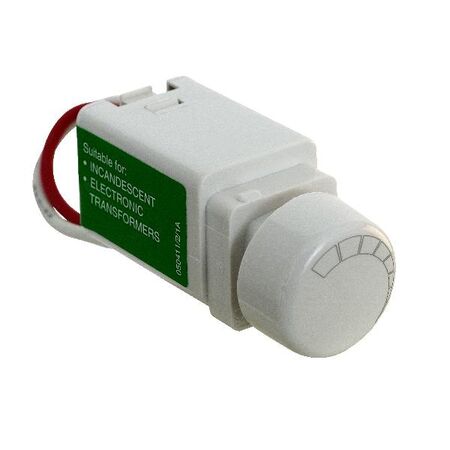
A sparky swaps twenty halogen downlights for LED retrofit globes on a Saturday job, leaves the existing dimmer in place to save time, and gets a callback the following week: the new LEDs buzz faintly and flicker whenever they're dimmed below about 30%. Nothing about the wiring changed. The dimmer did.
Halogen globes are resistive loads — they don't care much what shape of waveform a dimmer sends them. LED drivers are a different story. Most LED retrofit globes and downlights run on switch-mode drivers designed for a specific dimming curve, and older dimmers built for halogen or incandescent loads often cut the waveform in a way the driver reads as noise rather than a dimming signal. The result is flicker at low dim levels, audible buzz from the driver, or a minimum load the dimmer simply won't go below without dropping out.
This is also why flicker complaints tend to show up in clusters on the same jobs where how retrofit LED panels are sized for a ceiling grid — the same retrofit push that swaps out fittings usually leaves the original dimmer behind, and that's the actual point of failure.
Most LED drivers on the market are built to work with trailing edge dimming rather than leading edge. Trailing edge dimmers cut the tail end of the AC waveform, which is a gentler, more predictable transition for a switch-mode driver to interpret — in practice, this is usually the safer default when you're not certain what driver is inside the retrofit globe or downlight fitting. Leading edge dimmers cut the front of the waveform instead, which was standard for older halogen transformers, and can cause exactly the low-end flicker and buzz described above when paired with an LED driver that wasn't designed for it.
| Dimmer Type | Best Suited For |
|---|---|
| Trailing edge | Most LED retrofit globes and downlights, low-wattage LED driver loads |
| Leading edge | Legacy halogen transformers, and LED drivers specifically rated leading-edge compatible |
The safest habit on a retrofit job is checking the driver spec sheet or the fitting's compliance label before assuming trailing edge is the fix — some commercial-grade LED downlights are built leading-edge compatible specifically because they're expected to sit on older switchboards.
Related Reading
Wiring configuration is the second thing that trips people up. A 2-wire dimmer sits in the switch loop with no neutral required, which is common in older Australian homes with two-wire lighting circuits. A 3-wire dimmer needs a neutral at the switch plate, and swapping a 2-wire dimmer for a 3-wire model — or vice versa — without checking the existing wiring first usually means pulling the plate off twice instead of once. On multi-way or commercial fitouts, 3-wire controllers also tend to offer more consistent dimming range across mixed LED loads, which matters when a single circuit is feeding several different downlight brands.
[!] Compliance note: as a general rule, dimmer installation and wiring changes fall under licensed electrical work in Australia. Confirm the dimmer's minimum and maximum load rating against the total connected LED wattage before installing — running well under a dimmer's rated minimum load is a common, avoidable cause of flicker and premature driver failure.
Assuming the old dimmer is fine because "it's only a few globes." Even a small LED retrofit job can fall below a leading-edge dimmer's minimum load, which is exactly the scenario in the hallway job above.
Mixing LED brands on one dimmer circuit. Different drivers respond differently to the same dimming curve — one brand flickering while another on the same circuit runs clean is a strong sign of driver mismatch, not a faulty dimmer.
Overloading a single dimmer with too many downlights. Stacking more fittings onto one dimmer than its wattage rating allows produces flicker that looks like a compatibility issue but is actually a load issue.
Ignoring the neutral requirement on 3-wire dimmers. Forcing a 3-wire controller into a switch loop with no neutral present is a wiring fault, not a product fault — this gets misdiagnosed as a bad dimmer more often than it should.
Not checking the driver's dimming type before ordering. Some commercial LED downlights are leading-edge only. Installing a trailing edge dimmer by default without checking the fitting spec can introduce flicker where there wasn't any before.
Reusing a decades-old dimmer "because it still works." A dimmer that switched halogens cleanly for fifteen years was never tested against a switch-mode LED driver — age and prior reliability don't predict LED compatibility.
Why do LED downlights flicker on a dimmer that worked fine with halogens?
Halogen globes are resistive loads that tolerate almost any dimming waveform. LED drivers are electronic loads that expect a specific dimming curve — typically trailing edge — and an older dimmer built for halogen can send a waveform the driver reads as noise rather than a smooth dim signal, which shows up as flicker or buzz.
Can I just swap in an LED-rated dimmer without rewiring anything?
In most cases yes, provided the existing wiring configuration (2-wire vs 3-wire) matches the replacement dimmer. A 400VA trailing edge dimmer is a common drop-in replacement for a 2-wire halogen dimmer feeding LED retrofit downlights.
Is my existing dimmer 2-wire or 3-wire, and does it matter for LED?
Check whether a neutral conductor is present at the switch plate — if there's no neutral, the circuit is 2-wire. It matters for LED because 3-wire dimmers generally offer a wider, more stable dimming range across mixed LED loads, but they can't be installed where no neutral exists without rewiring.
What's the minimum LED load before a dimmer starts misbehaving?
Every dimmer has a rated minimum load, commonly printed on the datasheet or the unit itself. Running well under that minimum — a handful of low-wattage LED globes on a dimmer rated for a much higher load — is a frequent, overlooked cause of flicker. A leading edge dimmer controller rated closer to the actual connected wattage avoids this.
Do I need a licensed electrician to replace a dimmer switch in Australia?
Yes — dimmer switch replacement involves working on fixed household wiring, which typically requires a licensed electrician in Australia. This applies even when the replacement looks like a simple like-for-like swap.
Does a commercial fitout need a specific dimmer controller type for compliance?
Commercial multi-way circuits generally call for a controller rated for the full connected load and wiring configuration of the job, rather than a residential-grade unit. A multi-way 3-wire dimmer controller is typically the more appropriate choice for these jobs.
Related Reading
Schnap stocks trailing edge, leading edge, and multi-way c bus dimmer controllers with trade pricing and same-day dispatch from Kingsgrove NSW.
Find the full led dimmer flicker range at Schnap — trade pricing and same-day dispatch from Kingsgrove NSW.

SCHNAP Electrical Wholesaler - clear, upfront pricing that professional electricians trust

Get what you need in seconds. SCHNAP electrical wholesaler makes ordering quick and simple

Fast delivery anywhere - that's guaranteed. SCHNAP electrical wholesalers ship nationwide with same-day dispatch

Track your order every step of the way. SCHNAP electrical wholesale keeps you updated from click to delivery

SCHNAP is Australia's premier electrical wholesaler and electrical supplies, marketing thousands of quality products from leading brands. Trusted for nearly two decades by licensed electricians, contractors, and engineers, our range covers everything from basic electrical components to complex industrial electrical equipment
Our key categories include: LED lighting, designer switches, commercial switchboards, circuit protection, security systems & CCTV, and smart home automation
All products are certified to Australian standards (AS/NZS), backed by our 30-day, no-questions-asked return policy. Our expert technical team helps you quickly source the right solution for any residential, commercial, or industrial project, with daily dispatch from our Sydney electrical warehouse delivering Australia-wide
SCHNAP offers the most comprehensive electrical product range, with full technical specifications, application details, installation requirements, compliance standards, and warranties — giving professionals total confidence in every purchase


Kingsgrove Branch:
Opening hours:
Mon - Fri: 6:30 AM to 5 PM
Saturday: 8:00 AM to 2:00 PM
Sunday: 9:00 AM to 2:00 PM
Closed on public holidays
Jannali Branch:
Closed for Renovations
© 2004 - 2026 SCHNAP Electric Products