

Kingsgrove Branch:



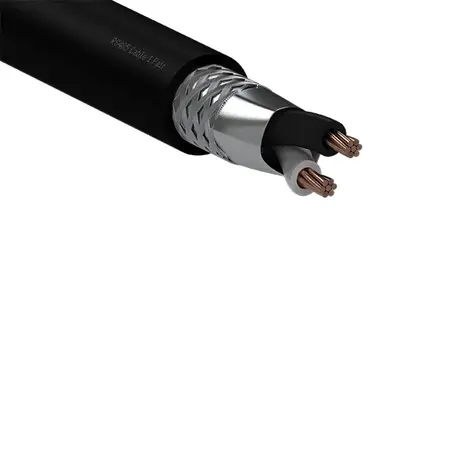
A BMS technician landing one more VAV controller on an existing Modbus loop is usually all it takes to turn a network that's run clean for two years into one throwing CRC errors on the chiller panel downstairs. In practice the fault rarely traces back to the controller itself — it's the cable it's landed on, and whether that drop was ever terminated properly in the first place. This guide walks through picking the right RS-485 construction for a BMS or instrumentation run, and getting the termination right the first time.
Most Modbus RTU networks running today are half-duplex, meaning a single twisted pair carries data in both directions and every device on the segment shares that one pair. If the panel drawing calls up a controller with separate transmit and receive terminals, that's usually an older or non-Modbus RS-485 device expecting a 4-wire, full-duplex arrangement — in that case a 2-pair cable is the correct pick, with the second pair kept genuinely in use rather than run as a spare.
The mistake worth avoiding is defaulting to 2-pair "just in case" and leaving the second pair floating unterminated inside the enclosure. An unterminated pair sitting next to a live one inside the same jacket can pick up crosstalk, and on a long run that shows up as intermittent data errors that are hard to trace back to the cable itself.
Related Reading
RS-485 cable arrives bare-ended, and every drop point on the network ends the same way — stripped conductor landed on a screw terminal at a controller, a gateway, or a terminal block. Stranded conductor pushed straight under a screw head tends to fray over time, especially on panels that see any vibration, so it's common practice to fit the wire end with a ferrule or, where the terminal is a spade-style connection, forked and spade terminals rather than land bare strands directly.
Topology matters here too. RS-485 is designed as a daisy chain, not a star — every device sits inline on the same pair, from one end of the segment to the other. A network wired as a star off a single junction point will usually still power up and even pass some data, but it typically starts showing reflection-related errors once more than a couple of devices are added, which is a difficult thing to diagnose after the panel's already buttoned up.
A 120-ohm termination resistor at each physical end of the segment — not at every device — is standard practice for RS-485. Skipping it, or fitting one partway along the run instead of at the true ends, is one of the more common causes of a network that only misbehaves under load.
Where the cable actually runs decides the jacket. A flexible LSZH (low smoke zero halogen) construction is generally the safer default for risers, ceiling spaces, and return-air paths, since many building fire safety requirements restrict what can be run through those areas — it's worth confirming the specific requirement for the building rather than assuming any LSZH-labelled cable automatically satisfies it. For plant room runs, cable tray, or conduit where that restriction doesn't apply, a standard PVC-jacketed bulk cable off a 500m drum is the more cost-effective option for longer pulls.
Current stock here is built on the Eltech Enviroflex and standard PVC constructions — there's no armoured or outdoor-rated RS-485 variant in the range at the moment, so for a direct-buried or externally exposed run, that's a gap worth flagging before quoting the job.
Leaving a spare pair floating on 2-pair cable. It feels efficient to run 2-pair "for future-proofing," but an unused pair left unterminated inside the enclosure can act as an antenna for noise on the active pair sitting next to it.
Skipping the ferrule on stranded conductor. It looks fine on day one. The failure shows up months later as an intermittent connection once the panel's seen a bit of vibration or thermal cycling.
Terminating with resistors at the wrong point. A resistor fitted at a mid-chain device instead of the true physical end of the segment is easy to do on a retrofit and hard to spot without a multimeter and the drawing in hand.
Running RS-485 tight alongside mains cable in the same tray. It's rarely a problem over short distances, but on a longer parallel run next to switchboard feeders it's a common source of noise that only appears once the mains circuit is under load.
Assuming any LSZH cable satisfies the building's fire rating. LSZH jacketing and a specific fire-rating requirement aren't always the same thing — worth a quick check against the building's actual spec rather than assuming.
What's the difference between 1-pair and 2-pair RS-485 cable?
1-pair (2-wire) is the standard for most half-duplex Modbus RTU networks, with all devices sharing a single twisted pair. 2-pair (4-wire) is used for full-duplex RS-485 setups with separate transmit and receive lines, which is less common but still specified on some legacy or non-Modbus systems.
Is LSZH RS-485 cable necessary for a ceiling space or riser run?
In many buildings, ceiling return-air spaces and fire-isolated risers call for low smoke zero halogen cable — it's worth checking the specific building requirement before quoting. Our 1-Pair Black LSZH Flexible Cable covers that flexible, low-smoke construction.
Can I run RS-485 cable in the same tray or conduit as mains power?
Over short distances it's usually not a problem, but a long parallel run next to mains feeders can introduce noise once the power circuit is loaded up. Where possible, keep some separation or cross at right angles rather than running long stretches side by side.
Do I need ferrules on bare RS-485 wire before it lands on a terminal block?
It's common practice to ferrule stranded conductor before it goes under a screw terminal, since bare strands can fray and loosen over time. See our bootlace ferrule sizing guide for matching ferrule size to conductor gauge.
Do I need an electrical licence to wire RS-485 BMS cabling in NSW?
RS-485 and other low-voltage data/control cabling generally falls outside standard electrical licensing requirements that apply to mains wiring, but licensing scope can vary depending on where the cabling terminates and whether it interfaces with mains-connected equipment. It's worth confirming the specific requirement with the relevant state authority for the job at hand rather than assuming.
Can I use fork terminals instead of ferrules for an RS-485 drop?
Yes, where the terminal block itself is a screw-and-spade style rather than a cage clamp. Our twin bootlace ferrule guide also covers when a twin ferrule is the better fit for two conductors sharing one terminal.
Related Reading
Trade pricing across the range, dispatched same day from Kingsgrove NSW.
Stock up on RS485 cable at Schnap -- everything you need in one place, dispatched same day from Kingsgrove.

SCHNAP Electrical Wholesaler - clear, upfront pricing that professional electricians trust

Get what you need in seconds. SCHNAP electrical wholesaler makes ordering quick and simple

Fast delivery anywhere - that's guaranteed. SCHNAP electrical wholesalers ship nationwide with same-day dispatch

Track your order every step of the way. SCHNAP electrical wholesale keeps you updated from click to delivery

SCHNAP is Australia's premier electrical wholesaler and electrical supplies, marketing thousands of quality products from leading brands. Trusted for nearly two decades by licensed electricians, contractors, and engineers, our range covers everything from basic electrical components to complex industrial electrical equipment
Our key categories include: LED lighting, designer switches, commercial switchboards, circuit protection, security systems & CCTV, and smart home automation
All products are certified to Australian standards (AS/NZS), backed by our 30-day, no-questions-asked return policy. Our expert technical team helps you quickly source the right solution for any residential, commercial, or industrial project, with daily dispatch from our Sydney electrical warehouse delivering Australia-wide
SCHNAP offers the most comprehensive electrical product range, with full technical specifications, application details, installation requirements, compliance standards, and warranties — giving professionals total confidence in every purchase


Kingsgrove Branch:
Opening hours:
Mon - Fri: 6:30 AM to 5 PM
Saturday: 8:00 AM to 2:00 PM
Sunday: 9:00 AM to 2:00 PM
Closed on public holidays
Jannali Branch:
Closed for Renovations
© 2004 - 2026 SCHNAP Electric Products