

Kingsgrove Branch:



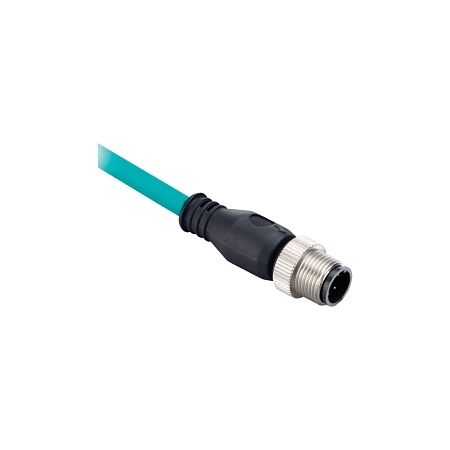
A vision camera on a packaging line at a food processing plant kept dropping its gigabit link every few hours, and the fault only showed up after the electrician swapped in a spare M12 cordset that looked identical to the original -- except it was Cat5e, not Cat6a. The switch negotiated down to 100Mbps and the camera's frame buffer couldn't keep up, and the line stopped every time the buffer filled. Here's how to pick the right M12 ethernet cable the first time, so the spare in the parts drawer actually matches the one it's replacing.
Most sensor-level I/O -- limit switches, proximity sensors, simple PLC discrete inputs -- runs comfortably over Cat5e at 100Mbps and never needs more. The devices that actually push a link past that ceiling are usually vision cameras, managed switch-to-switch trunks, or PLCs handling large data-heavy protocols like PROFINET IRT with motion control. If the device datasheet specifies gigabit, or the cable is feeding a switch uplink rather than a single sensor, Cat6a is the safer spec.
| Spec | Cat5e | Cat6a |
|---|---|---|
| Typical speed | 100Mbps reliable, gigabit possible short runs | Gigabit rated to full 100m |
| Shielding | Usually unshielded or basic foil | Foil + braid common on industrial-rated stock |
| Best suited to | Discrete sensors, simple I/O | Vision cameras, switch uplinks, motion control |
The general pattern on most machine builds is M12 at the field end and RJ45 at the cabinet end -- the M12's screw-lock coupling holds up against vibration and washdown near the sensor or camera, while the RJ45 end plugs straight into a managed switch or PLC ethernet port inside the enclosure. Where two devices both live inside the cabinet, M12-to-M12 extension cordsets skip the RJ45 conversion entirely.
Connector coding matters more than most people expect here. D-coded M12 connectors are common on Cat5e-rated cordsets and are only rated to 100Mbps regardless of what the cable itself can carry -- the connector becomes the bottleneck. X-coded M12 connectors are the ones rated for genuine gigabit throughput, so a Cat6a cable terminated in a D-coded plug still won't give a full gigabit link. If a device is feeding data-heavy traffic through an X-coded port, the cordset needs to match at both ends. For runs along a moving gantry or robot arm, a TPE-jacketed drag chain cordset holds up to repeated flexing far better than a standard PUR jacket, which tends to crack at the strain relief after a few months of continuous cycling.
Related Reading
Anything living outside the switchboard door -- on a sensor, a camera mount, or run across an exposed frame near a washdown station -- needs an IP67 sealed M12 connector at both the plug and the socket it's mating with. Inside the cabinet, that sealing is redundant weight and cost: a standard IP20 RJ45 patch cordset does the job, since the enclosure itself is already providing the ingress protection. The mistake worth avoiding is buying IP67 cordsets purely out of habit for cabinet-internal jumpers, which just adds unnecessary bulk to already tight wireways.
Matching cable spec but not connector coding. A Cat6a cable with D-coded M12 plugs still caps out around 100Mbps -- the connector, not just the cable, has to be rated for the throughput being asked of it.
Assuming "spare in the drawer" is a like-for-like match. This is exactly what took the packaging line down in the intro -- two cordsets can look nearly identical coiled up on a shelf while carrying different Cat ratings underneath the jacket print.
Over-speccing IP67 for cabinet-internal runs. It's not wrong, just wasted budget and unnecessary bend radius in a wireway that's already tight.
Ignoring flex rating on moving axes. A standard PUR-jacketed cordset run through a drag chain on a gantry or robot arm will typically show jacket cracking at the strain relief well before a purpose-built flex-rated cordset would.
Running M12 ethernet cordsets past their rated distance without checking the run. Gigabit copper ethernet is rated to 100m end-to-end including all cordset and patch segments combined -- not 100m per cordset -- so a long field run plus cabinet patching can eat into that budget faster than expected.
Is Cat5e fast enough for M12 sensor cabling?
For discrete sensors and simple I/O, yes -- Cat5e comfortably handles 100Mbps traffic, which covers most sensor-level communication. If the device is a vision camera or feeds a switch uplink, check the datasheet first; a Cat5e IP67 cordset won't give a full gigabit link even over a short run.
What's the difference between M12 D-code and X-code connectors?
D-coded M12 connectors are rated to 100Mbps regardless of the cable's Cat rating, while X-coded connectors support genuine gigabit throughput. If a device is transmitting data-heavy traffic over a gigabit-rated port, the connector coding needs to match the cable spec at both ends -- one without the other won't deliver the full speed.
Can I mix M12 and RJ45 cordsets on the same run?
Yes, this is the standard pattern -- M12 at the field end for sealing and vibration resistance, RJ45 into the switch or PLC port inside the cabinet. Where both ends stay inside the enclosure, an M12-to-M12 extension cordset skips the RJ45 conversion entirely.
Do I need a cabling licence to wire industrial ethernet inside a switchboard?
In most cases, ethernet cordsets terminating inside a control panel or switchboard fall under general electrical work rather than ACMA telecommunications cabling registration, since they're not connecting to a carrier network. As a general rule, panel wiring should still be carried out by a licensed electrician, and it's worth confirming project-specific requirements with the relevant state licensing body before starting work.
Is IP67 M12 overkill for cabling that stays inside the cabinet?
Generally yes -- the enclosure is already providing ingress protection, so a standard IP20 RJ45 patch cordset is the more practical choice for cabinet-internal jumpers. IP67 sealing earns its keep once the cordset leaves the enclosure and faces washdown, dust, or vibration in the field.
Why does my M12 cordset keep dropping the gigabit link?
The most common cause is a mismatch between the cable's Cat rating and the connector coding -- a Cat6a cable terminated in a D-coded plug will still cap out around 100Mbps. Checking that both the cable and connector on an X-coded Cat6a cordset are genuinely gigabit-rated usually resolves it.
For the wider industrial ethernet and fieldbus cable range -- including bulk reel options for custom-length panel runs -- see the full selection below.
Related Reading
Trade pricing applies across the range below, with same-day dispatch from Kingsgrove NSW on orders placed before cut-off.

SCHNAP Electrical Wholesaler - clear, upfront pricing that professional electricians trust

Get what you need in seconds. SCHNAP electrical wholesaler makes ordering quick and simple

Fast delivery anywhere - that's guaranteed. SCHNAP electrical wholesalers ship nationwide with same-day dispatch

Track your order every step of the way. SCHNAP electrical wholesale keeps you updated from click to delivery

SCHNAP is Australia's premier electrical wholesaler and electrical supplies, marketing thousands of quality products from leading brands. Trusted for nearly two decades by licensed electricians, contractors, and engineers, our range covers everything from basic electrical components to complex industrial electrical equipment
Our key categories include: LED lighting, designer switches, commercial switchboards, circuit protection, security systems & CCTV, and smart home automation
All products are certified to Australian standards (AS/NZS), backed by our 30-day, no-questions-asked return policy. Our expert technical team helps you quickly source the right solution for any residential, commercial, or industrial project, with daily dispatch from our Sydney electrical warehouse delivering Australia-wide
SCHNAP offers the most comprehensive electrical product range, with full technical specifications, application details, installation requirements, compliance standards, and warranties — giving professionals total confidence in every purchase


Kingsgrove Branch:
Opening hours:
Mon - Fri: 6:30 AM to 5 PM
Saturday: 8:00 AM to 2:00 PM
Sunday: 9:00 AM to 2:00 PM
Closed on public holidays
Jannali Branch:
Closed for Renovations
© 2004 - 2026 SCHNAP Electric Products