

Kingsgrove Branch:



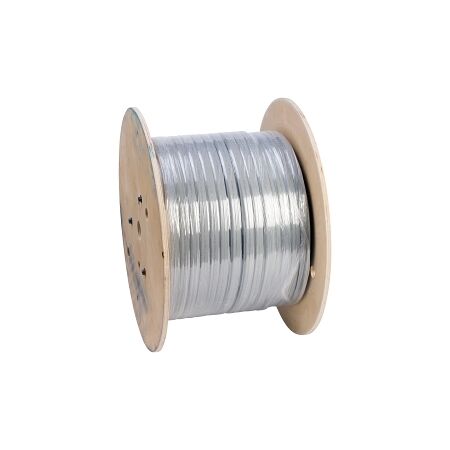
A packaging line trips out mid-shift and the fault log points to a DeviceNet segment somewhere between the PLC and a bank of photoelectric sensors — and the first question on site is always whether the run is drop cable or trunk cable, because that changes what's actually allowed to have failed. Getting the cable spec wrong at install time is what turns a five-minute swap into a half-day network audit later.
DeviceNet networks are built on a trunk-and-drop topology, and the cable spec changes depending on which role it's playing. The trunk line carries the full network current and needs to handle longer runs without excessive voltage drop, so it's rated to 8A on thick cable. Drop lines feeding individual sensors or actuators off the trunk are shorter and lower current, which is where 4A thin cable earns its keep — it's more flexible and easier to route through cable trays and drag chains than the thick equivalent.
Mixing the two up on a job isn't just a spec mismatch — running thin cable as a trunk segment on a long network can starve voltage to the far end of the line, and it's usually the last thing anyone checks when a distant node starts dropping out intermittently.
| Cable Type | Typical Role | Current Rating |
|---|---|---|
| Thick cable | Network trunk, longer backbone runs | 8A |
| Thin cable | Drop lines to sensors, actuators, junction taps | 4A |
This is the split that trips up techs who are used to buying network cable by length alone. Anything running outside an enclosure — across a machine frame, down a drag chain, out to a field sensor exposed to washdown or dust — needs IP67 sealed construction with the moulded M12 connectors. Inside the panel, between the PLC's DeviceNet port and a distribution block or scanner module, IP20 cordsets are the norm — they're not rated for the field environment, but they're cheaper and easier to route in tight enclosure space where sealing doesn't matter.
A common site mistake is spec'ing an IP20 cordset for a short run that happens to cross outside the enclosure door — even a few hundred millimetres of exposed IP20 cable in a washdown area is enough to let moisture in over time, and it's rarely the first thing anyone suspects when a node starts faulting intermittently after a clean.
Related Reading
Where the network doesn't rely purely on pre-moulded M12 cordsets — bare thin drop cable landing on a tap box, or trunk cable terminating into a distribution block — the conductor ends need proper termination before they go under a screw. Stripped, tinned-looking copper jammed straight into a cage clamp terminal is a common shortcut, but it's also a common source of loose connections once vibration sets in on a production line. A correctly sized bootlace ferrule sizing guide is worth a look before terminating bare DeviceNet conductors, since undersized or oversized ferrules on fine-stranded fieldbus cable are just as likely to loosen as bare wire.
Running thin cable as a trunk segment to save on cost. It works until the network grows or the run gets long enough that voltage drop starts causing intermittent faults at the far end — by then it's a rewiring job, not a component swap.
Using an IP20 cordset anywhere near a washdown zone. It might run fine for months before moisture ingress causes a fault that looks nothing like a cabling issue at first glance.
Assuming DeviceNet and CAN-based automation cable are interchangeable. The connector pinout and cable construction are purpose-built for DeviceNet's protocol requirements — swapping in a generic industrial cable can technically fit the connector while still causing communication errors.
Skipping termination resistors at both ends of the trunk. This isn't a cable spec issue, but it's the mistake most often mistaken for a bad cable run — always rule it out before condemning the cable itself.
Under-sizing ferrules on fine-stranded drop cable conductors. Thin DeviceNet drop cable often uses finer stranding than standard control wiring, so a ferrule sized for general-purpose cable can leave strands loose inside the crimp.
can I use thick DeviceNet cable for a short drop line instead of thin?
Yes — thick cable will work electrically on a drop line, but in practice it's harder to route and terminate in tight tap boxes, so it's typically reserved for trunk runs where its higher current handling actually matters.
why is my DeviceNet segment dropping out only at the far end of the trunk?
This is commonly a voltage drop issue on a long trunk run, especially if thin cable was used where thick cable should have been, or if termination resistors weren't installed correctly at both ends.
do I need IP67 connectors inside a sealed panel enclosure?
No — inside a properly sealed panel, IP20 panel-internal cordsets are the standard choice; IP67 sealing is only needed for cable exposed outside the enclosure.
what's the difference between the M12 male and female cordset ends?
The male and female M12 ends mate with the corresponding port or tap on the network device — as a general rule, check the device's port gender before ordering rather than assuming, since it varies between DeviceNet devices.
do I need an electrical licence to install DeviceNet cabling in a factory in NSW?
DeviceNet cabling itself is low-voltage data/control cabling rather than mains wiring, but any work that involves connecting into or near mains-powered equipment or control panels should be assessed against NSW electrical licensing requirements for the specific scope of work — check with Fair Trading NSW or your site's electrical compliance officer if there's any doubt.
can DeviceNet cable be run in the same tray as mains power cable?
Running low-voltage fieldbus cable alongside mains power in the same tray is generally discouraged due to electromagnetic interference risk — as a general rule, maintain separation or use segregated trays where the site layout allows it.
Schnap stocks DeviceNet cable across thick trunk, thin drop, and IP20 panel cordset configurations, part of the broader industrial ethernet and fieldbus cable range, with trade pricing and same-day dispatch from Kingsgrove NSW.

SCHNAP Electrical Wholesaler - clear, upfront pricing that professional electricians trust

Get what you need in seconds. SCHNAP electrical wholesaler makes ordering quick and simple

Fast delivery anywhere - that's guaranteed. SCHNAP electrical wholesalers ship nationwide with same-day dispatch

Track your order every step of the way. SCHNAP electrical wholesale keeps you updated from click to delivery

SCHNAP is Australia's premier electrical wholesaler and electrical supplies, marketing thousands of quality products from leading brands. Trusted for nearly two decades by licensed electricians, contractors, and engineers, our range covers everything from basic electrical components to complex industrial electrical equipment
Our key categories include: LED lighting, designer switches, commercial switchboards, circuit protection, security systems & CCTV, and smart home automation
All products are certified to Australian standards (AS/NZS), backed by our 30-day, no-questions-asked return policy. Our expert technical team helps you quickly source the right solution for any residential, commercial, or industrial project, with daily dispatch from our Sydney electrical warehouse delivering Australia-wide
SCHNAP offers the most comprehensive electrical product range, with full technical specifications, application details, installation requirements, compliance standards, and warranties — giving professionals total confidence in every purchase


Kingsgrove Branch:
Opening hours:
Mon - Fri: 6:30 AM to 5 PM
Saturday: 8:00 AM to 2:00 PM
Sunday: 9:00 AM to 2:00 PM
Closed on public holidays
Jannali Branch:
Closed for Renovations
© 2004 - 2026 SCHNAP Electric Products