

Kingsgrove Branch:



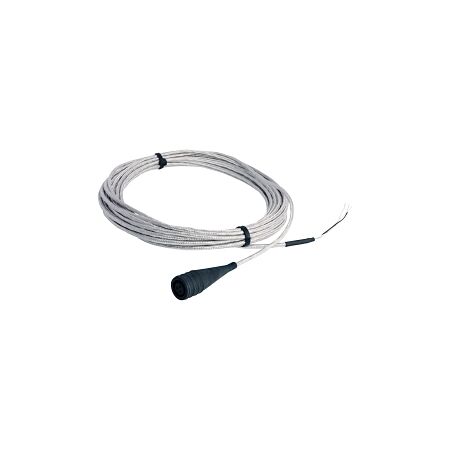
A pump bearing accelerometer that reads clean on the bench can go noisy the moment it's wired through a cable tray back to the data collector twenty metres away — not because the sensor's faulty, but because nobody thought about shield grounding or cable length until the readings started drifting.
Most top-connector piezoelectric accelerometers used in condition monitoring run on a 2-pin cable — one conductor for signal, one for return/shield. That covers the majority of vibration monitoring points on pumps, motors and fans. A 3-pin cable comes into play when the accelerometer or the data collector interface calls for a separate case ground or a third reference conductor — in practice, this is more common on certain triaxial mounting setups or where the collector manufacturer specifies it. Before ordering, check the connector spec on the accelerometer itself rather than assuming pin count from the sensor's physical size.
The same logic carries over to eddy current probe cables, which run alongside accelerometer cable on most reliability jobs. These are typically supplied as a matched pair (probe cable to extension cable) with a fixed pin configuration set by the probe manufacturer — swapping in a generic cable here usually isn't an option.
[!] Check before you order: Accelerometer cable pin count and connector type must match the sensor's data sheet exactly. A cable that physically fits but has the wrong pin assignment can still connect — and still produce garbage data — without any obvious fault indication.
If the run from bearing to data collector stays inside a cable tray or conduit for its full length, non-armoured ETFE-jacketed cable is usually sufficient and easier to terminate on site. Once the route crosses open floor space, drags near rotating equipment, or sits somewhere it could be stepped on or caught by a forklift, armoured cable earns its keep — the steel braid under the jacket protects the signal conductors from the kind of mechanical damage that shows up as intermittent readings months later rather than an immediate failure.
This is where sizing your instrumentation cable run properly matters just as much for accelerometer cable as it does for multi-pair signal wiring — a cable that's technically long enough but poorly protected along the route will cost more in re-runs than choosing armoured from the start.
Standard shield-grounded accelerometer cable is fine for most process plants — the shield ties to ground at one end (typically the data collector side) to avoid ground loops, which is the usual cause of 50Hz hum riding on the vibration signal. If the monitoring point sits in a classified hazardous area — a gas compressor skid or a fuel storage area, for example — intrinsically safe (IS) rated cable becomes a compliance requirement, not a preference. IS-rated cable is built to limit the energy that can reach the hazardous zone, and it typically needs to be installed and terminated according to the site's IS loop drawings rather than general good practice.
[!] Compliance note: Installing IS-rated accelerometer cable in a hazardous area typically falls under AS/NZS 60079 requirements in Australia. If you're not the one who signed off the site's hazardous area classification, confirm with the site's electrical engineer before substituting cable types.
It's tempting to grab whatever length is on the shelf and coil the excess, but excess coiled cable can act like an unintended antenna and add noise to a low-level signal. As a general rule, it's better to measure the actual run — sensor mounting point to junction box or portable collector position — and order the closest length above that, rather than rounding up generously. For permanent installations feeding a data collector via a Lemo-style connector, this matters even more, since the connector end is usually fixed and can't be trimmed and re-terminated on site the way a standard shielded cable can.
The same length-matching principle applies to fibre optic temperature probe extension cable, which often runs the same route as accelerometer cable on bearings that are monitored for both vibration and temperature. If that's part of your scope, it's worth reading how to choose between multimode and singlemode fibre for the temperature probe side of the run, since the wrong fibre grade over a longer run can cause its own signal loss issues — separate from anything on the accelerometer side.
Related Reading
Ordering by physical fit instead of pin assignment. A 2-pin and 3-pin connector can sometimes look similar enough at a glance that the wrong cable gets pulled from stock — always cross-check against the sensor data sheet, not the connector shape.
Grounding the shield at both ends. This is one of the most common causes of noisy vibration data — grounding both ends creates a ground loop. The shield should typically only be earthed at one end of the run.
Using non-armoured cable across an exposed route to save cost. It works fine until the first forklift pass or foot traffic incident, after which the fault can be intermittent and genuinely difficult to trace back to physical damage.
Coiling excess cable instead of measuring the run. Coiled cable behaves differently to a straight run electrically, and it's an easy way to introduce noise that wasn't there on the test bench.
Assuming standard cable is fine in a hazardous area. IS-rated cable and standard shield-grounded cable are not interchangeable in a classified zone, regardless of how similar they look on the reel.
do I need 2-pin or 3-pin accelerometer cable?
Check the connector spec on the accelerometer's data sheet. Most top-connector piezoelectric accelerometers use 2-pin; 3-pin is used where the sensor or collector interface calls for a separate reference conductor.
can I use the same cable for accelerometer and eddy current probe?
Not usually. Eddy current probes are typically supplied with a matched probe-and-extension cable set from the manufacturer, while accelerometer cable is generally sourced separately — see the instrumentation and multi-pair screened cable range for both.
do I need IS-rated cable for a bearing sensor near a gas compressor?
If the point sits inside a classified hazardous area, IS-rated accelerometer cable is typically required under AS/NZS 60079 in Australia. Confirm the zone classification with the site's electrical engineer before installing.
is a licence required to terminate accelerometer cable on site?
Terminating low-voltage instrumentation cable in Australia generally falls under the same licensing requirements as other electrical work, though scope can vary by state and site. Check with the relevant state licensing authority and the site's electrical safety rules before starting work.
why is my accelerometer reading noisy after a long cable run?
Common causes include shield grounded at both ends (creating a ground loop), excess cable coiled rather than run straight, or non-armoured cable picking up interference near motors and VFDs along the route.
what length accelerometer cable do I need for a 15m run?
Measure the actual route from sensor mount to junction box or collector, then order the closest standard length above that figure — for a genuine 15m run, a 15m armoured 2-pin shielded cable avoids both a short-fall and excess coiling.
can accelerometer data collector cable be extended?
Cables terminated with a Lemo-style connector to the data collector are generally supplied as fixed-length assemblies and aren't designed to be field-extended or re-terminated — order the length matched to your actual collector-to-sensor distance up front.
Related Reading
Trade pricing and same-day dispatch from Kingsgrove NSW across the accelerometer, probe and data collector cable range.
Browse the full accelerometer cable range at Schnap for trade pricing and same-day dispatch from Kingsgrove NSW.

SCHNAP Electrical Wholesaler - clear, upfront pricing that professional electricians trust

Get what you need in seconds. SCHNAP electrical wholesaler makes ordering quick and simple

Fast delivery anywhere - that's guaranteed. SCHNAP electrical wholesalers ship nationwide with same-day dispatch

Track your order every step of the way. SCHNAP electrical wholesale keeps you updated from click to delivery

SCHNAP is Australia's premier electrical wholesaler and electrical supplies, marketing thousands of quality products from leading brands. Trusted for nearly two decades by licensed electricians, contractors, and engineers, our range covers everything from basic electrical components to complex industrial electrical equipment
Our key categories include: LED lighting, designer switches, commercial switchboards, circuit protection, security systems & CCTV, and smart home automation
All products are certified to Australian standards (AS/NZS), backed by our 30-day, no-questions-asked return policy. Our expert technical team helps you quickly source the right solution for any residential, commercial, or industrial project, with daily dispatch from our Sydney electrical warehouse delivering Australia-wide
SCHNAP offers the most comprehensive electrical product range, with full technical specifications, application details, installation requirements, compliance standards, and warranties — giving professionals total confidence in every purchase


Kingsgrove Branch:
Opening hours:
Mon - Fri: 6:30 AM to 5 PM
Saturday: 8:00 AM to 2:00 PM
Sunday: 9:00 AM to 2:00 PM
Closed on public holidays
Jannali Branch:
Closed for Renovations
© 2004 - 2026 SCHNAP Electric Products