

Kingsgrove Branch:



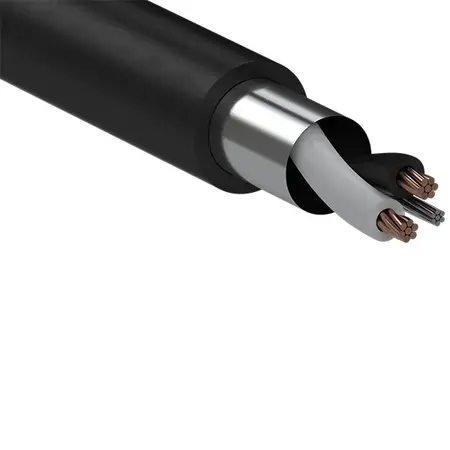
You're standing in the ceiling void with a wiring diagram in one hand and a cable order form in the other, forty metres of run between a new pressure transmitter and the PLC cabinet, and three pair counts on the supplier page that all look close enough to what the drawing calls for. Get the pair count or gauge wrong and you're either pulling cable twice or leaving spare cores dead in the wall. This is the decision that trips up even experienced installers when the drawing isn't crystal clear — see our DeviceNet cable guide for a similar sizing conversation on the fieldbus side.
A loop drawing that calls for "1 x 2C shielded" is telling you exactly one thing: one pair, screened, nothing more. It's easy to over-order out of caution — grab a 4-pair cable "just in case" — but every unused pair in a screened cable is a potential earth loop or noise path if it's left floating instead of properly terminated or isolated. For a single 4-20mA loop from a transmitter to a PLC input card, 1-pair cable is the correct call almost every time. Multi-pair cable only makes sense when the drawing genuinely shows multiple instruments sharing one cable run back to the same cabinet — a common setup on packaging lines or water treatment skids where several transmitters sit close together.
Where it gets murkier is when the drawing shows "spare pairs for future use." That's a legitimate reason to step up from 1-pair to 2-pair or from 4-pair to 6-pair, but it should be a deliberate decision noted on the drawing — not a default because nobody wanted to think about it twice.
Related Reading
Gauge selection comes down to run length and loop type. On that 40-metre pressure transmitter run, 0.5mm conductor is typically fine for a standard 4-20mA loop — the current draw is low and the run isn't long enough to cause meaningful voltage drop. Where 1.0mm or 1.5mm earns its place is on longer runs (past roughly 80-100 metres, as a general rule) or on loops powering the transmitter itself over the same pair, where every bit of conductor resistance eats into the loop's available voltage budget.
| Gauge | Typical Use Case | Common Run Length |
|---|---|---|
| 0.5mm | Standard 4-20mA signal loop | Up to ~80m as a general rule |
| 1.0mm | Longer runs or loop-powered transmitters | 80-150m typically |
| 1.5mm | Extended runs, sensitive loop budgets | 150m+ commonly |
These figures are a starting point, not a substitute for a proper voltage drop calculation on critical loops — but for the majority of straightforward transmitter-to-PLC runs, matching gauge to run length using this rule of thumb will keep you well inside spec.
Back to that ceiling void — if it's also acting as a return air plenum, or the run passes through a riser or shared building service space, that's usually the trigger for LSZH (Low Smoke Zero Halogen) jacket instead of standard PVC. Standard PVC cable releases dense smoke and corrosive halogen gas when it burns, which is generally the reason building compliance requirements steer plenum and riser runs toward LSZH — it's a life-safety consideration for anyone needing to evacuate or for emergency services attending a fire.
[!] Compliance note: Whether LSZH is mandatory depends on the building classification and where the cable run sits — as a general rule, plenum spaces, risers, and public building common areas are the situations most likely to require it. If you're unsure, check the project specification or ask the building's fire engineer rather than assuming standard PVC is acceptable.
If the run is staying entirely within a plant room or dedicated cable tray with no shared building air path, standard PVC-jacketed screened cable is typically the more cost-effective choice and performs the same electrically.
When a marshalling cabinet feeds several field instruments along the same route, one multi-pair cable often beats pulling separate single-pair runs — less tray congestion, fewer glands, and one screen to earth instead of several. Count the actual instruments on the drawing, add genuine spares if the project calls for future expansion, then round up to the nearest standard pair count (4, 6, 8, 10, 12, or 20 pair). Don't round up "just in case" beyond what the drawing supports — unused pairs in a shared screen still need to be terminated or isolated properly, and a cable pulled with double the pairs you need is wasted cost and extra gland size for no benefit.
Worth flagging: not every signal cable decision follows this same logic. Vibration monitoring and accelerometer cabling runs to a different set of considerations entirely — connector type, armouring, and intrinsic safety ratings matter more than pair count. If that's the run you're specifying, our accelerometer cable selection guide covers it in detail.
Ordering pair count from memory instead of the actual drawing. "It's usually 2-pair for these" is how spare cores end up floating in a junction box, or worse, a cable gets pulled short because the real drawing called for 4-pair.
Going thinner to save on cable cost over a long run. 0.5mm looks like the cheaper option on paper, but on a run pushing past 100 metres it can leave a loop-powered transmitter without enough voltage headroom to operate reliably — the saving disappears the moment the loop starts reading erratically.
Not checking whether the ceiling void is shared HVAC return air. This is the single most common reason a PVC cable order gets rejected on site and has to be swapped for LSZH — and it's avoidable with one question to the building services drawing before ordering.
Skipping the spare-pair conversation with the client or engineer. Pulling cable through a ceiling void or conduit run is the expensive part of the job, not the cable itself. If there's any chance of a future instrument being added to the same route, that's the moment to step up pair count — not after the ceiling's been sealed back up.
What pair count do I need for a single 4-20mA loop?
1-pair screened cable is correct for a single loop between one transmitter and one PLC input, unless the drawing specifically calls for spare pairs.
Does thicker gauge instrumentation cable actually reduce signal loss over long runs?
Yes, thicker conductor reduces resistance and voltage drop over distance, which matters most on loop-powered instruments. Our 1.5mm screened instrumentation cable is the typical step-up choice for runs pushing past 150 metres.
Do I need LSZH cable for ceiling void or riser runs?
Generally, yes if the ceiling void doubles as return air plenum, or the run passes through a riser or shared building service space — check the building classification and project specification to confirm, since requirements vary by project.
Can I run 20 pair instrumentation cable in the same tray as power cable?
As a general rule, screened instrumentation cable should be segregated from power cable in the tray or kept a reasonable separation distance apart to avoid induced noise on the signal pairs — check your site's cabling standard for the exact separation required. Our 20 pair screened instrumentation cable is commonly used for exactly this kind of consolidated multi-instrument run.
Full range of screened instrumentation cable in stock at Kingsgrove NSW, with trade pricing and same-day dispatch on orders placed before cut-off.
Find the full instrumentation cable range at Schnap -- trade pricing and same-day dispatch from Kingsgrove NSW.

SCHNAP Electrical Wholesaler - clear, upfront pricing that professional electricians trust

Get what you need in seconds. SCHNAP electrical wholesaler makes ordering quick and simple

Fast delivery anywhere - that's guaranteed. SCHNAP electrical wholesalers ship nationwide with same-day dispatch

Track your order every step of the way. SCHNAP electrical wholesale keeps you updated from click to delivery

SCHNAP is Australia's premier electrical wholesaler and electrical supplies, marketing thousands of quality products from leading brands. Trusted for nearly two decades by licensed electricians, contractors, and engineers, our range covers everything from basic electrical components to complex industrial electrical equipment
Our key categories include: LED lighting, designer switches, commercial switchboards, circuit protection, security systems & CCTV, and smart home automation
All products are certified to Australian standards (AS/NZS), backed by our 30-day, no-questions-asked return policy. Our expert technical team helps you quickly source the right solution for any residential, commercial, or industrial project, with daily dispatch from our Sydney electrical warehouse delivering Australia-wide
SCHNAP offers the most comprehensive electrical product range, with full technical specifications, application details, installation requirements, compliance standards, and warranties — giving professionals total confidence in every purchase


Kingsgrove Branch:
Opening hours:
Mon - Fri: 6:30 AM to 5 PM
Saturday: 8:00 AM to 2:00 PM
Sunday: 9:00 AM to 2:00 PM
Closed on public holidays
Jannali Branch:
Closed for Renovations
© 2004 - 2026 SCHNAP Electric Products