

Kingsgrove Branch:



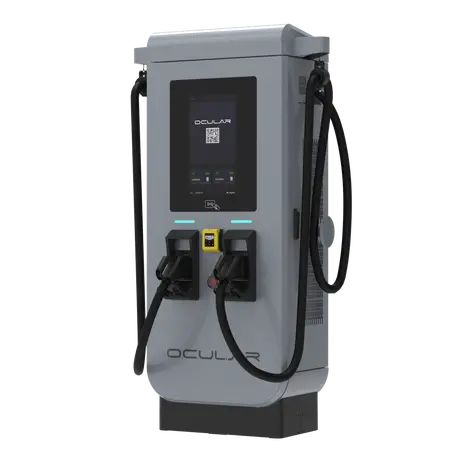
Twelve delivery vans need to be back on the road by 6am, and the depot's only 60kW charger can't cycle through all of them overnight. This is the kind of kW-and-connector math that trips up fleet operators moving from a single trial vehicle to a full depot rollout — the answer isn't just "buy DC", it's matching power rating and connector count to how many vehicles actually need to leave charged by shift start. For depots still deciding between a standard AC circuit and something heavier duty, our three-phase EV charger guide covers when AC still does the job before DC becomes necessary.
Most depot charging happens in a fixed window — vehicles roll in after the last run, and they need to be ready again before the first one the next morning. A 60kW charger is fine for two or three vans with a full eight-hour window, but it starts to struggle once you're trying to turn over ten or more vehicles, or if the window shrinks because of split shifts. Going up in power rating buys back time, but it also means checking with the site's network connection first — larger loads sometimes need sign-off from the local distribution network before they can be connected.
| Power Rating | Typical Fit |
|---|---|
| 60kW | Small depot, 2-3 vehicles, long overnight window |
| 90-120kW | Mid-size fleet, mixed shift patterns |
| 150-180kW | Larger fleet or shorter charging window |
| 240kW | High-turnover sites, multiple vehicles queued through the day |
These are general starting points, not a substitute for a proper load calculation — in practice, actual charge time also depends on the vehicle's own onboard charging limit, so a 180kW charger won't necessarily replenish a van's battery any faster than a 90kW unit if the vehicle itself can't accept more than 90kW.
Related Reading
A dual CCS2 charger lets two vehicles plug in to the one unit, which matters more for depot layout than most buyers expect — one charger footprint instead of two means less trenching, less conduit run, and one less unit to maintain. The trade-off worth understanding before ordering: on most dual-connector units, the rated power is shared across both connectors rather than doubled, so two vans charging at once will typically split the available kW rather than each getting the full rating. For depots running a handful of ev chargers side by side, this is usually still faster overall than queuing vehicles one at a time on separate single-connector units.
The Atlas Pro range adds a screen and card reader on top of the same dual CCS2 hardware, which matters if the depot also wants to charge visiting contractor vehicles or run the site as a semi-public bay — the standard Atlas range is built for internal fleet use where access is already controlled at the gate.
Depot layouts change — a new lease term, an extra loading bay, or a fleet that grows faster than the site plan anticipated. The Atlas and Atlas Pro range is built as a transportable unit rather than a permanently trenched installation, which means it can be repositioned within the site without a full civil works redo if the layout shifts later. For sites genuinely tight on space, a lower-output wallbox-style DC unit in the 25-50kW range is sometimes used instead of a full commercial charger, though that format trades off charging speed for a smaller physical footprint.
Where a depot has already locked in its layout and just needs maximum throughput at a fixed point — a corner bay that will always be the charging point, for example — a fixed-format unit like the 50kW or 100kW Delta chargers can be the more straightforward option, since there's no ongoing need for repositioning.
Sizing for today's fleet, not next year's. A charger bought for three vans this quarter often needs to service eight within twelve months once the switch to electric picks up pace — buying headroom into the power rating now is usually cheaper than adding a second charger later.
Assuming dual connectors mean double the power. As covered above, most dual CCS2 units share their rated output across both connectors — planning around full simultaneous power at both plugs is the most common miscalculation depot managers make when comparing spec sheets.
Skipping the network capacity check. It's easy to treat a DC charger purchase like any other equipment order, but anything drawing significant load can trigger a distribution network approval step that takes longer than the charger delivery itself if it's left until installation day.
Locking in a fixed unit before the layout is settled. A permanently trenched charger in the wrong spot is expensive to move. Sites still finalising their depot plan are usually better served starting transportable, then switching to fixed once the layout is proven.
Underestimating card-reader friction on shared-access sites. Adding payment or access control (Atlas Pro's screen and card reader) is worth it for any site with non-fleet vehicles charging, but it does add a few seconds of setup per session — a detail that only shows up once the charger is actually in daily use.
how many kW do I need to charge 10 vans overnight?
It depends on the charging window and each vehicle's onboard limit, but as a general rule, a depot running ten vehicles across a standard overnight window usually looks at something in the 120-180kW range rather than a single 60kW unit — spreading the load across a dual-connector charger like the Atlas Pro 120kW dual CCS2 charger is often more practical than one very high-output single-connector unit.
can one DC charger charge two EVs at the same time?
Yes, on any dual CCS2 model — but as covered above, the two connectors typically share the unit's total rated power rather than each getting the full output, so charging speed per vehicle drops when both bays are in use at once.
what's the difference between a 60kW and 120kW commercial EV charger?
Beyond the raw power rating, the practical difference is charging window — a 120kW unit can typically get a vehicle back to a usable charge in roughly half the time of a 60kW unit, assuming the vehicle itself can accept that higher rate. For small fleets with long overnight windows, the extra speed often isn't needed.
do I need a licensed electrician to install a commercial DC EV charger in Australia?
Yes — DC fast charger installation involves fixed wiring work that must be carried out by a licensed electrician, and depending on the state, may also require notification to the local network operator given the load involved. Site-specific requirements are worth confirming with the installing electrician before committing to a power rating.
can a commercial EV charger run on single phase power?
No — DC fast chargers at commercial power ratings require a three-phase supply. Our three-phase EV charger guide covers what that connection typically involves for sites that haven't run three-phase power before.
does a transportable EV charger still need a permanent electrical connection?
Yes — "transportable" refers to the physical unit being repositionable within a site, not to the electrical connection, which still needs to be installed by a licensed electrician at each location it's used. It just avoids the trenching and civil works that a fully fixed installation requires if the charger later needs to move.
Trade pricing and same-day dispatch from Kingsgrove NSW on the full range of ev chargers below, from transportable depot units to fixed high-throughput chargers.
Browse the full commercial EV charger range at Schnap for trade pricing and same-day dispatch from Kingsgrove NSW.

SCHNAP Electrical Wholesaler - clear, upfront pricing that professional electricians trust

Get what you need in seconds. SCHNAP electrical wholesaler makes ordering quick and simple

Fast delivery anywhere - that's guaranteed. SCHNAP electrical wholesalers ship nationwide with same-day dispatch

Track your order every step of the way. SCHNAP electrical wholesale keeps you updated from click to delivery

SCHNAP is Australia's premier electrical wholesaler and electrical supplies, marketing thousands of quality products from leading brands. Trusted for nearly two decades by licensed electricians, contractors, and engineers, our range covers everything from basic electrical components to complex industrial electrical equipment
Our key categories include: LED lighting, designer switches, commercial switchboards, circuit protection, security systems & CCTV, and smart home automation
All products are certified to Australian standards (AS/NZS), backed by our 30-day, no-questions-asked return policy. Our expert technical team helps you quickly source the right solution for any residential, commercial, or industrial project, with daily dispatch from our Sydney electrical warehouse delivering Australia-wide
SCHNAP offers the most comprehensive electrical product range, with full technical specifications, application details, installation requirements, compliance standards, and warranties — giving professionals total confidence in every purchase


Kingsgrove Branch:
Opening hours:
Mon - Fri: 6:30 AM to 5 PM
Saturday: 8:00 AM to 2:00 PM
Sunday: 9:00 AM to 2:00 PM
Closed on public holidays
Jannali Branch:
Closed for Renovations
© 2004 - 2026 SCHNAP Electric Products