

Kingsgrove Branch:



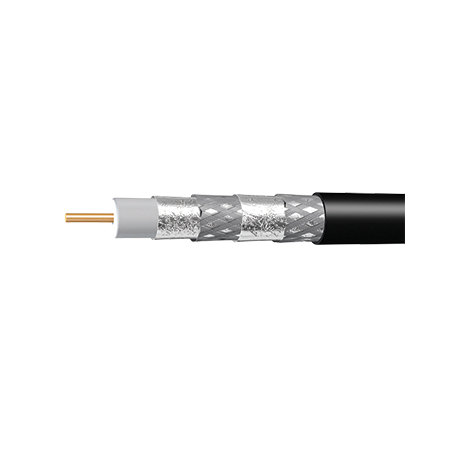
You've just mounted a new UHF antenna on the roof, and the client also wants a CCTV camera covering the driveway from a shed 15 metres away. The spare roll of RG6 sitting in the van handles the inside runs fine — but the moment that cable has to survive full sun along the eave, then go underground beneath a path, "whatever's in the van" stops being good enough.
Standard PVC-jacketed RG6 is built for indoor runs and short, protected outdoor stretches — a wall penetration into a roof cavity, for example. It's not designed for prolonged UV exposure, and it's definitely not rated to sit in contact with damp soil. Left exposed on a north-facing wall for a couple of years, the jacket can crack; buried without protection, moisture eventually tracks along the braid and shows up as signal dropout or corrosion at the connector months later — long after the installer has left site.
The fix isn't always a different cable altogether. Schnap stocks RG6 and RG11 in several jacket variants built for exactly this situation, and picking the right one comes down to what the cable is actually doing at each point of the run — aerial, wall-mounted, or buried.
Back to the roof job: the antenna mast sits a metre or so proud of the eave, and there's a short unsupported span before the cable reaches the fascia. Run standard cable across that gap and its own weight, plus wind load over time, puts constant strain on the F-connector at the mast end — that's a common cause of intermittent signal loss that only shows up in bad weather.
Messengered coax solves this with a steel support wire bonded along the jacket, so the cable carries its own weight across the span instead of relying on the connector. It's the right call for any aerial run — dish drops, antenna masts, or a cable running unsupported between a house and a detached structure — where the cable isn't sitting in conduit or clipped continuously.
Once the cable comes off that aerial span and heads into a wall-mounted run down to floor level, in practice a properly clipped standard or messengered cable in conduit is usually fine for the vertical section — the messenger wire isn't doing anything useful once the cable is fully supported.
The last four metres of the shed run is where most installers get caught out. Once the cable goes under a path or garden bed — even inside conduit — it's sitting in a damp environment for years, and a compromised jacket or a nick from the install itself becomes a slow leak point for moisture.
Flooded RG6 and RG11 are gel-filled between the jacket and the shield, so even if water finds a way in at a joint or a damaged section, it can't track along the cable to the connector. This is the variant to reach for any time the run goes into the ground, into a wet subfloor, or anywhere it'll sit in standing water — conduit or no conduit.
[!] Don't rely on conduit alone. Conduit protects the cable mechanically, but it's not watertight over the long term — condensation and groundwater can still find their way in through joints and end caps. For any buried run, flooded cable is the layer that actually stops water reaching the copper.
| Variant | Best for | Not for |
|---|---|---|
| Standard PVC RG6 | Indoor runs, short protected outdoor sections in conduit | Aerial spans, burial, prolonged UV |
| Messengered RG6/RG11 | Unsupported aerial spans — antenna, dish, house-to-shed drops | Buried or fully clipped/conduited sections |
| Flooded RG6/RG11 | Direct burial, wet subfloors, standing water exposure | Aerial spans needing self-support |
Getting the right cable variant sorted only solves half the problem — the other common failure point outdoors is the connector itself. Standard indoor F-connectors aren't sealed against moisture, and once one corrodes at an outdoor termination point, it doesn't matter how good the cable behind it is. Weatherproof compression connectors with dual O-ring seals are worth using at every outdoor termination, and it's worth reading up on choosing weatherproof F-type connectors if you're not already using compression rather than crimp fittings on outdoor jobs.
Running standard cable underground because "it's in conduit anyway." Conduit slows water ingress, it doesn't stop it — over a couple of wet seasons, moisture usually finds a way to the jacket regardless.
Letting cable sag across an aerial span. Without a messenger wire, the load ends up on the F-connector at each end, and that's typically where the first fault shows up after a storm.
Using indoor crimp connectors outside. They're cheaper and faster on the day, but they're not sealed — corrosion at the pin is one of the most common causes of a "working fine, then suddenly not" outdoor coax fault.
Choosing cable based on price per metre alone. Flooded cable costs more than standard PVC, but a callback to dig up and replace a failed buried run costs a lot more than the price difference ever would.
Ignoring run length on long shed or outbuilding drops. Past roughly 30 metres, signal loss in RG6 starts to add up — RG11's thicker centre conductor and lower loss per metre is usually the better call for those longer runs.
Is standard RG6 ok to run along an outside wall?
In practice, yes for a short, clipped or conduited vertical run in a spot with reasonable weather protection — the issue is longer-term UV exposure and any section that ends up in contact with the ground, not a wall run on its own.
What's the difference between messengered and flooded coax?
Messengered cable has a steel support wire for unsupported aerial spans; flooded cable has gel filling to stop moisture tracking through the cable when it's buried or sitting in wet conditions. They solve different problems, and a single run can sometimes need both variants at different points.
Can I use RG6 for a 20 metre run to a shed or do I need RG11?
RG6 is generally fine at that distance for antenna and CCTV feeds. Past around 30 metres, or for anything low-loss sensitive, an RG11 messengered cable is worth the switch.
Do I need a licence to install antenna coax outside in Australia?
As a general rule, standard residential antenna and CCTV coax work doesn't require ACMA cabling registration the way telecommunications cabling to the network boundary point does. Requirements can vary by job type and connection point, so it's worth checking the current ACMA Cabling Provider Rules against your specific scope before starting.
Can I bury flooded RG6 directly in the ground without conduit?
Flooded cable is rated for direct burial, but running it through conduit is still worth doing where practical — it protects against physical damage from future digging, not just moisture. If conduit isn't an option, flooded RG6 cable is built to handle direct soil contact on its own.
Do outdoor F connectors really need to be different from indoor ones?
Yes — an unsealed connector is one of the most common failure points on outdoor coax runs, regardless of how good the cable behind it is. See the guide on weatherproof F-connector selection for what to look for.
Related Reading
Trade pricing and same-day dispatch from Kingsgrove NSW on the full outdoor coaxial tv cable range.
Browse outdoor coax cable at Schnap -- trade pricing, trusted brands, dispatched same day from Kingsgrove NSW.

SCHNAP Electrical Wholesaler - clear, upfront pricing that professional electricians trust

Get what you need in seconds. SCHNAP electrical wholesaler makes ordering quick and simple

Fast delivery anywhere - that's guaranteed. SCHNAP electrical wholesalers ship nationwide with same-day dispatch

Track your order every step of the way. SCHNAP electrical wholesale keeps you updated from click to delivery

SCHNAP is Australia's premier electrical wholesaler and electrical supplies, marketing thousands of quality products from leading brands. Trusted for nearly two decades by licensed electricians, contractors, and engineers, our range covers everything from basic electrical components to complex industrial electrical equipment
Our key categories include: LED lighting, designer switches, commercial switchboards, circuit protection, security systems & CCTV, and smart home automation
All products are certified to Australian standards (AS/NZS), backed by our 30-day, no-questions-asked return policy. Our expert technical team helps you quickly source the right solution for any residential, commercial, or industrial project, with daily dispatch from our Sydney electrical warehouse delivering Australia-wide
SCHNAP offers the most comprehensive electrical product range, with full technical specifications, application details, installation requirements, compliance standards, and warranties — giving professionals total confidence in every purchase


Kingsgrove Branch:
Opening hours:
Mon - Fri: 6:30 AM to 5 PM
Saturday: 8:00 AM to 2:00 PM
Sunday: 9:00 AM to 2:00 PM
Closed on public holidays
Jannali Branch:
Closed for Renovations
© 2004 - 2026 SCHNAP Electric Products