

Kingsgrove Branch:



By SCHNAP Electric Products | Solar Installation Guides
Cable ties are one of the smallest line items on a solar job — but they're also one of the most commonly get wrong. Pick the wrong type, and you're back on the roof 18 months later replacing failed ties and re-securing cables that have been chafing against racking rails the entire time.
Australia's climate is unforgiving. UV levels here are among the highest in the world. Rooftop temperatures regularly hit 70–80°C in summer. In coastal areas, salt air accelerates corrosion faster than most products are rated for. A cable tie that's perfectly fine in a European warehouse has no business being on an Australian solar install.
This guide covers everything you need to make the right call on solar cable ties — material selection, sizing, when to use stainless steel pawl vs plastic pawl, and what Australian Standards say about cable management in solar PV systems.
Most tradies have seen it: white or natural nylon cable ties that have gone brittle and snapped within a year or two of installation. Sometimes less. This isn't a batch issue — it's a material issue.
Standard nylon cable ties are made from PA66 (polyamide 66). PA66 is not UV-stabilised by default. Under prolonged UV exposure, the polymer chains break down — the tie becomes brittle, loses tensile strength, and eventually cracks under minimal load or thermal expansion.
The US Department of Energy flagged this specifically in their Solar PV cable management guidance: standard plastic cable ties used in solar PV arrays frequently fail prematurely due to heat and UV exposure, leading to safety hazards and performance issues including cable abrasion, electrical faults, and structural damage to the array.
In the Australian context, this is amplified. Our UV index is consistently higher than Europe or North America, and rooftop surface temperatures can exceed ambient air temperature by 20–30°C on hot days. A tie rated for "outdoor use" in a temperate climate may degrade in a fraction of the expected time here.
Rule of thumb: If a cable tie is white or natural-coloured nylon and doesn't specify UV stabilisation, it has no place on a solar installation. Full stop.
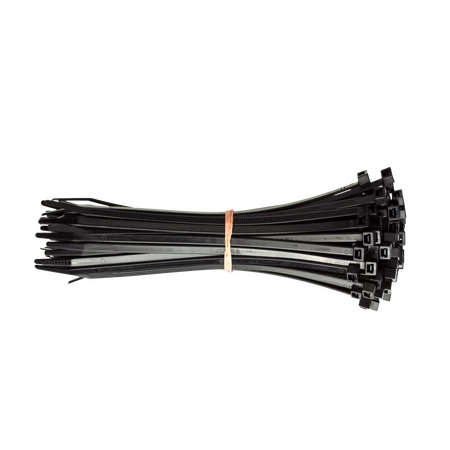
UV-stabilised black nylon is the baseline standard for solar cable management. The black colouration comes from carbon black additive, which acts as a UV absorber and significantly extends outdoor service life.
PA66 UV-stabilised ties — like the Bitek 200mm UV Resistant Cable Ties — are a cost-effective choice for standard residential rooftop installs where conditions are moderate. They're lighter, easier to handle in volume, and cut flush without leaving sharp edges.
PA11 (polyamide 11) is the premium nylon option. Compared to PA66, PA11 offers better UV resistance, wider operating temperature range, improved chemical resistance, and lower water absorption — which matters in humid coastal environments. If your install is in a high-UV or coastal zone, PA11 is worth the marginal extra cost.
This is where the Matelec SPCT range sits — and it's a product category that's often overlooked.
A stainless steel pawl cable tie combines a UV-stabilised nylon strap with a 304 stainless steel locking mechanism. The key advantage: the pawl is what takes the mechanical load when the tie is tensioned. A plastic pawl can creep under sustained tension — particularly at elevated temperatures. A stainless pawl doesn't.
This makes stainless pawl ties particularly well suited for:
The Matelec SPCT range available at SCHNAP covers four lengths — 100mm, 200mm, 300mm, and 370mm — all with stainless steel pawl and UV-stabilised black nylon strap, in 100-pack quantities suited to volume solar work.
For the harshest environments — coastal, industrial, high-salt-air, or any install where longevity over 20+ years is a hard requirement — full stainless steel is the answer.
Stainless steel cable clips (not traditional zip-tie style, but clip-mount style) are particularly useful for securing DC string cables along racking rails without the failure risk of nylon in high-heat conditions. The Matelec 4x4mm Stainless Steel Solar Cable Clips and the Right Angle variant are designed specifically for solar racking applications and won't corrode or degrade over the system's service life.
Full stainless is the go-to for:
Getting the size right matters. An undersized tie won't close properly over a bundle. An oversized tie wastes material and can be harder to tension correctly.
| Tie Length | Best For | Typical Cable Bundle Diameter |
|---|---|---|
| 100mm Matelec SPCT-100-30B |
Single DC cable securing to racking, small bundles, tight spaces near junction boxes | Up to ~18mm |
| 200mm Matelec SPCT-200-48B |
Standard DC string cable bundling, most common residential rooftop use | Up to ~50mm |
| 300mm Matelec SPCT-300-36B |
Larger cable bundles, securing multiple strings together, conduit bundling | Up to ~80mm |
| 370mm Matelec SPCT-370-48B / SPCT-370-70B |
Large bundle groups, securing cable looms, commercial installs with multiple string runs | Up to ~100mm+ |
AS/NZS 5033 is the Australian standard for installation and safety requirements for photovoltaic arrays. It sets requirements for DC cable management including support, securing, and protection from mechanical damage.
Key requirements relevant to cable tie selection:
Using non-UV-rated cable ties on a solar installation isn't just a quality issue — it's a compliance issue. If a tie fails and a cable abrades against racking, you have a potential DC arc fault. That's a safety and liability problem.
| Environment | Recommended Cable Tie | Reasoning |
|---|---|---|
| Standard suburban rooftop, inland | UV-stabilised black nylon or stainless pawl nylon | Good UV resistance is the primary requirement. Corrosion is lower risk. |
| Coastal (within 1–2km of ocean) | Stainless steel cable clips or coated stainless ties | Salt air accelerates corrosion in nylon pawl mechanisms over time. Full stainless is the safer long-term choice. |
| Metal deck rooftop (colorbond etc) | Stainless pawl nylon or full stainless clips | Rooftop temps can exceed 80°C. Stainless pawl resists creep at elevated temperatures better than plastic pawl. |
| Commercial ground mount | Stainless steel cable clips | Higher wind load, longer cable runs, 25+ year system life expectation. Stainless clips offer the most reliable long-term performance. |
| High UV zone (QLD, NT, WA outback) | PA11 nylon or stainless | PA11 outperforms PA66 under extreme UV. Worth the upgrade in high-UV regions. |
Using white nylon ties from the tradie van. These are PA66 without UV stabilisation. They'll look fine on install day and be brittle within 12–18 months. Don't do it.
Over-tightening. Cable ties should secure without compressing the cable insulation. Over-tightening can stress the insulation at the tie point and create a failure location. Tension to secure, not to compress.
Spacing too far apart. AS/NZS 5033 requires cables to be supported at intervals that prevent sagging. On racking rails, 300–400mm spacing is a common working guide. Too far apart and cables sag onto panel frames or racking edges — that's where abrasion damage starts.
Using the wrong size for the bundle. A 100mm tie around a 60mm bundle isn't going to close properly. Size up when in doubt — it's better to have a slightly long tail than a tie that won't seat correctly.
Not accounting for thermal expansion. DC cables move with temperature. A tie that's perfectly tensioned in the morning may be under stress by midday when the cable has expanded. Leave a small amount of play in larger bundles, particularly on long cable runs.
Q: Can I use standard black cable ties on a solar installation?
A: Only if they're specified as UV-stabilised. Standard black nylon ties may contain carbon black for colour but not for UV stabilisation — the spec sheet will confirm. If the product doesn't explicitly state UV-stabilised or UV-resistant with a rated service life, don't use it on a solar install.
Q: What's the difference between a stainless steel pawl and a plastic pawl cable tie?
A: The pawl is the locking mechanism inside the cable tie head. A stainless steel pawl maintains its locking strength under sustained tension and at elevated temperatures. A plastic pawl can creep — gradually loosening its grip — particularly in hot conditions. For solar work, stainless pawl is the more reliable choice for any tie that's under tension.
Q: Do I need to use stainless steel cable clips instead of cable ties?
A: Not always, but in coastal environments and on commercial installs with long expected service lives, stainless clips are worth it. They don't degrade from UV or corrosion, they don't loosen under thermal cycling, and they don't need to be replaced. For a system expected to run for 25 years, the small upfront cost difference is negligible.
Q: How far apart should cable ties be spaced on a solar installation?
A: There's no single mandated spacing in AS/NZS 5033, but the requirement is that cables must be supported to prevent sagging and contact with surfaces that could cause abrasion. A common working practice is every 300–400mm along racking rails. On longer unsupported cable runs, closer spacing reduces cable movement under wind load.
Q: Are the Matelec SPCT cable ties compliant for use on solar PV systems?
A: Yes. The Matelec SPCT range features UV-stabilised black nylon with stainless steel pawl — meeting the material requirements for outdoor solar cable management under AS/NZS 5033. They're a trade-grade product used by solar installers across Australia.
Related Reading
SCHNAP stocks a full range of solar-rated cable ties and clips for residential and commercial installations. All products available with trade pricing and fast Australia-wide dispatch from our Kingsgrove NSW warehouse.
Need more for your solar install? Browse the full solar installation accessories range including Dektite flashings, cable glands, and solar mounting hardware — or explore the complete cable ties and clips range for all jobsite applications.

SCHNAP Electrical Wholesaler - clear, upfront pricing that professional electricians trust

Get what you need in seconds. SCHNAP electrical wholesaler makes ordering quick and simple

Fast delivery anywhere - that's guaranteed. SCHNAP electrical wholesalers ship nationwide with same-day dispatch

Track your order every step of the way. SCHNAP electrical wholesale keeps you updated from click to delivery

SCHNAP is Australia's premier electrical wholesaler and electrical supplies, marketing thousands of quality products from leading brands. Trusted for nearly two decades by licensed electricians, contractors, and engineers, our range covers everything from basic electrical components to complex industrial electrical equipment
Our key categories include: LED lighting, designer switches, commercial switchboards, circuit protection, security systems & CCTV, and smart home automation
All products are certified to Australian standards (AS/NZS), backed by our 30-day, no-questions-asked return policy. Our expert technical team helps you quickly source the right solution for any residential, commercial, or industrial project, with daily dispatch from our Sydney electrical warehouse delivering Australia-wide
SCHNAP offers the most comprehensive electrical product range, with full technical specifications, application details, installation requirements, compliance standards, and warranties — giving professionals total confidence in every purchase


Kingsgrove Branch:
Opening hours:
Mon - Fri: 6:30 AM to 5 PM
Saturday: 8:00 AM to 2:00 PM
Sunday: 9:00 AM to 2:00 PM
Closed on public holidays
Jannali Branch:
Closed for Renovations
© 2004 - 2026 SCHNAP Electric Products