
Kingsgrove Branch:

Skooby
Electrical Assistant

G'day! I'm Skooby. Ask me about wiring rules or search our product catalog.
SCHNAP Trade Support
Product help, identification or bulk pricing.
Opens WhatsApp Trade Support
Not sure what this product is?
Send us a photo and our team will help identify it.
Send us any one of these:
Send Us a Photo on WhatsApp
- A clear photo of the full product
- Product label or brand
- Model/part number, if visible
- Product packaging, if available
Request Bulk Quote
Large quantities? Send us the details via WhatsApp.
Enter a quantity or some details about your bulk request.
Request via WhatsApp
- Menu
-
-
Cable
- Power Cables
- Specialty Cable
- Data & Comms Cable
- Fibre Optic Cable
- Solar Cable
-
Cable Accessories
- Aluminium Lugs
- Copper Lugs
- Bi-Metal Lugs
- Circuit Breaker Lugs
- Bootlace Pins & Terminals
- Bullet Terminals
- Forked Terminals
- Insulated Bell Terminals
- Insulated Pins
- Lug Terminals
- Non Insulated Tabs
- Piggy Back Terminals
- Quick Disconnects
- Stud Rings
- Terminal Lip Blades
- C Connectors
- Crimp Links
- Waterproof Crimp Links
- In-Line Splices
- Cable Joiners
- View more →
- Cable Support
-
Conduit & Ducts
- Heavy Duty Conduit
- Medium Duty Conduit
- Communications Conduit
- NBN Conduit
- Solar Conduit
- Corrugated Conduit
- Anaconda Pipe & Adaptors
- Rubber / Flex Conduit
- Split Conduit / Loom Tube
- Conduit Fittings
- Cable Duct
- Skirting Duct & Accessories
- Cable Covers
- Cable Pulling Accessories
- Pits, Pillars & Underground Enclosures
- Hazardous Area Ex Fittings
- Cabinets & Network Equipment
- Copper Cabling Components
- Fibre Optic
- Voice & NBN
- Data & Comms Tools
-
Electrical
- Powerpoints
- Switches & Mechs
- Plugs, Sockets & Adaptors
- Cover Plates & Grid Plates
- Mounting Accessories
- MATV & TV
- Sensors, Bells & Chimes
- Lighting Parts
- Appliance Parts
-
Switchboards & Meter Boxes
- Flush Mounted Switchboards
- Surface Mounted Switchboards
- Temporary Switchboards
- Temporary Switchboard Accesssories
- Distribution Boards
- Meter Boxes
- Plastic Enclosures
- Metal Enclosures
- Circuit Breaker Enclosures
- NBN Enclosures
- IP Rated Enclosures
- Adaptable Boxes & Accessories
- Pushbutton Enclosures
- Junction Boxes
- Extension Boxes
- Enclosure Accessories
-
Switch Gear & Protection
- AC Circuit Breakers
- DC Circuit Breakers
- Plug-In Circuit Breakers
- Moulded Case Circuit Breakers (MCCB)
- MCCB Accessories
- Residual Current Devices (RCDs)
- MCB / RCD / RCBO Combos
- Surge Protection
- Arc Fault Detection
- Main Switches
- Change Over Switches
- Isolators
- Contactors & Equipment
- Contactor Accessories
- Relays
- Overload Relays
- Relay Bases
- Thermal Overloads
- Electronic Overloads
- Fuses & Fuse Holders
- View more →
- Timers
- Metering
- Switchboard Accessories
- Earthing
- Kitchen & Household Appliances
- Battery & Device Chargers
-
Lighting
- Indoor Lighting
- Outdoor & Landscape
- Commercial & Industrial
- Lamps & Globes
- Ceiling Fan Lights & Fittings
- Lighting Accessories
- Exit & Emergency
- Air Conditioning
- Ceiling Fans
- Exhaust Fans
- Heaters & Hand Dryers
- Pedestal & Wall Fans
- Louvres & Grillers
- Ducting
-
HVAC & Ducted Components
- Pair Coil
- Colorbond Trunking
- Drip Trays & Drain Pipe
- Condensate Pumps
- Dektites
- Duct Supporting Straps
- Mounts & Brackets
- Quick Connect Fittings
- AC Cable
- Tape & Accessories
- AC Support Hardware
- Anti-Vibration & Seismic Mounts
- Copper Braze Fittings
- Flare & SAE Fittings
- Refrigerant Hoses & Line Sets
- Refrigeration Valves
- Ducted Vacuum Systems
- Filter Driers & Sight Glasses
- Oil Separators & Receivers
- Ducted Fittings
- Zone & System Controls
- HVAC Tools
- Worklights & Task Lighting
-
Solar & Smart
- Solar Panels
- Inverters
- Battery Storage
- EV Chargers & Accessories
- Solar Racking
- Solar BOS & Accessories
- Network Protection Boards
- Off-Grid Systems
- Portable Power Solutions
- Solar Tools
-
Automation
- C-Bus Controllers
- C-Bus Dimmer Controllers
- C-Bus Keypads
- C-Bus Mechs
- C-Bus Sensors
- C-Bus Output Boards
- C-Bus Input Boards
- C-Bus Built Boards
- C-Bus Network Interface & Bridges
- C-Bus PC Interface & Dongles
- C-Bus Power Supply
- C-Bus Bus Couplers
- C-Bus Gateways
- C-Bus Relays
- C-Bus Wall Box & Plates
- Clipsal Wiser
- Other BUS Automation
- Smart Switches & Outlets
- Smart Lighting
- WiFi & Wireless
- Security & Surveillance
- Access Control
- Intercoms
- Alarms & Detection
- Home Entertainment
- E-Mobility
-
Industrial
-
Tools
- Hand Tools
-
Power Tool Accessories
- Drill Bit Sets
- Drill Bit - Metal & Wood
- Drill Bit - Masonry
- Drill Bit - Glass & Tile
- Drill Bit - Ceramic
- Drill Bit - Long Series
- Multi Purpose Drill Bits
- Hole Saws & Kits
- Hole Saw Blades & Accessories
- Spade Bits & Kits
- Step Drills
- Auger Bits
- Driver / Adapter Bits
- Hexagonal Driver Bits
- Extension Bars
- Cut Off Discs
- Flap Discs
- Grinding Discs
- Blades
- Hacksaw Blades
- View more →
-
Meters & Testers
- Multimeters
- Clamp Meters
- Insulation Testers
- RCD Testers
- Loop Impedance Testers
- Multifunction Testers
- Voltage Testers
- Phase Rotation Testers
- Pair Testers
- Appliance Testers
- Lux Meters
- Circuit Tracers
- Butt Phones & Accessories
- Meter Load Testers
- Earthing Leads
- Test Equipment Accessories
- Earth Resistance Testers
- Micro-Ohm & Low Resistance Testers
- Specialty Test Instruments
- Heat & Soldering
- Work & Safety Lights
- Tool Storage
- Tool Kits
-
Fixings & Hardware
- Wood Screws
- Metal Screws
- Masonry / Brick Screws
- Bakerlite Screws
- Assorted Screw Packs
- Nuts and Bolts
- Nylon Nuts & Bolts
- Washers
- Rivets
- Toggles
- Wall Fixings
- Wall Mates / Plaster Mates
- Drop In Anchors
- Dyna Bolts / Sleeve Anchors
- Eye Bolts
- Nylon Nail In Anchors
- Screw Bolts
- Wall Plugs
- Chain
- D Shackles
- View more →
-
Consumables
- Electrical Insulation Tape
- Self Amalgamating Tape
- Construction Tape
- Double Sided Tape
- Duct Tape
- Warning Tape
- Adhesives & Glue
- Silicone & Foam
- Paint & Zinc Spray
- Corrosion Inhibitors
- Fire Seal
- Pens, Pencils & Markers
- Crayons
- Compliance Certificates
- Appliance Test Log Books
- Emergency Testing Log Books
- Batteries
- Vacuum Accessories
- Thinners & Solvents
- Painting Accessories
- View more →
- PPE & Personal Protection
- Site Safety & Emergency
- Ladders & Access Equipment
- Cleaning & Janitorial
- General & Site Equipment
- Power Tools
- Outdoor Power Equipment
- Plumbing
- Brands
- Blog
-
Cable
Speaker Cable Gauge Guide: 14 vs 16 AWG for Every Run
24/08/2026
by Denny Setiawan
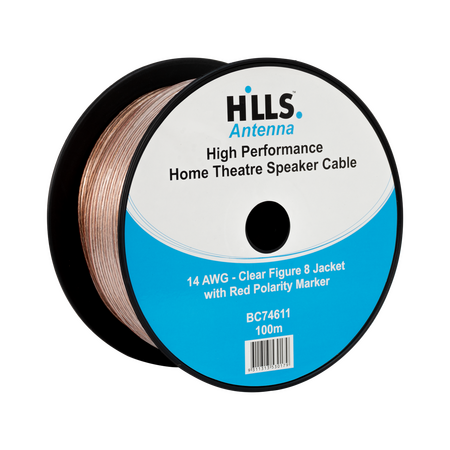
Forty metres from the amp rack to the last zone speaker, and the volume on that run sits noticeably lower than every other zone on the system. It's not a faulty speaker or a loose connection — it's usually gauge. Speaker cable resistance adds up over distance, and picking the wrong AWG for a longer run is one of the more common call-backs on multi-zone PA and security-integrated audio jobs. Here's how to match gauge to run length and system size so every zone sounds the way it should.
Why Gauge Matters More Than You'd Think
Every metre of speaker cable adds a small amount of electrical resistance. On a short run that resistance is negligible, but stretch the same gauge out past 20-30 metres and it starts eating into the amp's output before it ever reaches the speaker. The amp doesn't know the difference — it's still pushing the same signal — but the speaker at the end of a long, thin run gets less power and less clarity than one wired closer to the rack.
This is why gauge isn't just a spec on a datasheet. It's the difference between a zone that sounds even with the rest of the system and one that quietly underperforms until someone notices during a walkthrough and asks why one corner sounds thinner than the rest.
16 AWG vs 14 AWG: Which Run Gets Which
As a general rule, 16 AWG covers the majority of standard runs — ceiling speakers, background music zones, and most single amp-channel runs under about 15 metres. It's the gauge stocked in the highest volume for a reason: it's the right fit for most jobs without over-speccing the cable.
Once a run pushes past 15-20 metres, or you're feeding a zone with a lower-impedance speaker load, 14 AWG starts to matter. The thicker conductor keeps resistance lower over distance, so the speaker at the far end still gets the power the amp is sending. This is typically the gauge worth reaching for on warehouse runs, long corridor zones, or any commercial job where the cable run is genuinely long rather than just "a bit further than the last one."
| Run Length | Typical Gauge | Notes |
|---|---|---|
| Up to 15m | 16 AWG | Standard for most single-zone runs |
| 15-30m | 16 or 14 AWG, depending on load | Step up if speaker impedance is low or the run has multiple bends |
| 30m+ | 14 AWG | Minimises resistance loss on longer commercial runs |
For a run like the 40-metre example above, 14 gauge speaker cable is the safer starting point rather than pushing 16 AWG past its comfortable range and hoping the amp compensates.
[!] Compliance note: For runs sharing risers or ceiling voids with other building services, check local requirements around cable jacket rating (e.g. LSZH or plenum-rated where applicable) — this generally applies alongside gauge selection, not instead of it.
Single-Zone vs Multi-Zone Runs
A single speaker on its own amp channel only needs 2-core cable — one pair, one zone, straightforward. Where it gets more involved is multi-zone and bi-wire setups, where several speakers share a run or a single speaker is wired with separate high and low frequency feeds. That's where 4-core cable earns its place, running two circuits through one jacket instead of pulling two separate cables through the same conduit or ceiling space.
Reaching for 4-core out of habit on a simple single-zone run adds cost and bulk with no real benefit. The reverse mistake — running 2-core into a job that turns out to need bi-wiring later — usually means pulling new cable through a ceiling that's already closed up. Confirming the wiring scheme before the cable goes in saves the re-pull.
Related Reading
Common Mistakes
- Blaming the amp for a weak zone. A 40m+ run on 16 AWG can look like an amplifier fault when it's really resistance loss over distance — swap to 14 AWG before assuming the amp needs replacing.
- Mixing gauges across zones on the same amp. Running 16 AWG to one zone and 14 AWG to another off the same channel group can leave one zone noticeably louder than the rest, even with identical speakers.
- Defaulting to 4-core for every run. If the job is a single speaker on a single channel, 2-core is all it needs — 4-core only pays off once bi-wiring or a second circuit is actually in the plan.
- Ignoring speaker impedance. A lower-impedance speaker load draws more current, which makes gauge selection matter more, not less, even on a moderate-length run.
- Skimping on gauge to save a few dollars on a long commercial run. The cost difference between 16 AWG and 14 AWG on a 100m reel is small next to the cost of re-running cable after a client complains about volume.
- Loose termination undoing a correct gauge choice. Even the right cable underperforms if it's not terminated properly at the speaker end — a loose connection adds its own resistance on top of whatever the cable run already has.
Frequently Asked Questions
Choosing Gauge
does speaker wire gauge really matter for a short run under 10m?
Not much. Resistance losses on short runs are minimal regardless of gauge, so 16 AWG is fine for most runs under 10 metres. Gauge starts to matter once the run length or speaker load increases.
what gauge speaker cable do I need for a 30 metre run?
As a general rule, 30 metres sits right at the point where 16 gauge cable starts to show resistance loss, so 14 AWG is the safer choice unless the speaker load is genuinely light.
Multi-Zone & PA Setups
can I use 2-core speaker cable for a bi-wire setup?
No — bi-wiring needs two separate circuits to the same speaker, which means 4-core cable or two runs of 2-core. Trying to bi-wire off a single 2-core run doesn't work.
do I need a licence to wire a PA speaker system in a commercial building?
Speaker-level cabling is typically low-voltage and doesn't require an electrical licence in most cases, but if the install involves mains-powered amplifier circuits or shares containment with other electrical services, that part of the job generally does fall under licensed work — check with the relevant authority for the specific job.
Termination & Connections
why does my speaker cable connection keep coming loose?
Bare wire wrapped around a screw terminal tends to loosen over time, especially with vibration from HVAC or foot traffic nearby. A proper binding post gives a firmer, more repeatable termination than a bare-wire wrap.
is 16 gauge speaker cable the same as Cat6 or data cable?
No. Speaker cable and data cable use gauge and construction suited to very different electrical loads — they're not interchangeable even though both come as reels of twin or multi-core cable.
Related Reading
Shop Speaker Cable Gauge at Schnap
Trade pricing and same-day dispatch from Kingsgrove NSW on the full speaker cable range.
- 16 AWG Speaker Cable
- Speaker Cable 152m 2-Core 16AWG (Certech) -- compact reel for single-zone runs
- Speaker Cable 305m 2-Core 16AWG (Certech) -- long reel for multiple standard runs
- 4-Core & Bi-Wire
- Speaker Cable 152m 4-Core 16AWG (Certech) -- for bi-wire and dual-circuit runs
- Termination
- Speaker Binding Post, Black (Certech) -- secure termination at the speaker end
Find the full speaker cable gauge range at Schnap -- trade pricing and same-day dispatch from Kingsgrove NSW.

Transparent Pricing
SCHNAP Electrical Wholesaler - clear, upfront pricing that professional electricians trust

Streamlined Ordering
Get what you need in seconds. SCHNAP electrical wholesaler makes ordering quick and simple

Australia-wide Delivery
Fast delivery anywhere - that's guaranteed. SCHNAP electrical wholesalers ship nationwide with same-day dispatch

End-to-end Support
Track your order every step of the way. SCHNAP electrical wholesale keeps you updated from click to delivery

Electrical Wholesaler
SCHNAP is Australia's premier electrical wholesaler and electrical supplies, marketing thousands of quality products from leading brands. Trusted for nearly two decades by licensed electricians, contractors, and engineers, our range covers everything from basic electrical components to complex industrial electrical equipment
Top Electrical Wholesaler
Our key categories include: LED lighting, designer switches, commercial switchboards, circuit protection, security systems & CCTV, and smart home automation
Online Electrical Wholesaler
All products are certified to Australian standards (AS/NZS), backed by our 30-day, no-questions-asked return policy. Our expert technical team helps you quickly source the right solution for any residential, commercial, or industrial project, with daily dispatch from our Sydney electrical warehouse delivering Australia-wide
Best Electrical Supplies
SCHNAP offers the most comprehensive electrical product range, with full technical specifications, application details, installation requirements, compliance standards, and warranties — giving professionals total confidence in every purchase


Customer Support
Information
Contact Us
-
-
-
-
Opening hours:
-
Mon - Fri: 6:30 AM to 5 PM
Saturday: 8:00 AM to 2:00 PM
Sunday: 9:00 AM to 2:00 PM
-
-
Closed on public holidays
-
Jannali Branch:
-
-
Closed for Renovations
© 2004 - 2026 SCHNAP Electric Products