

Kingsgrove Branch:


Send us a photo and our team will help identify it.

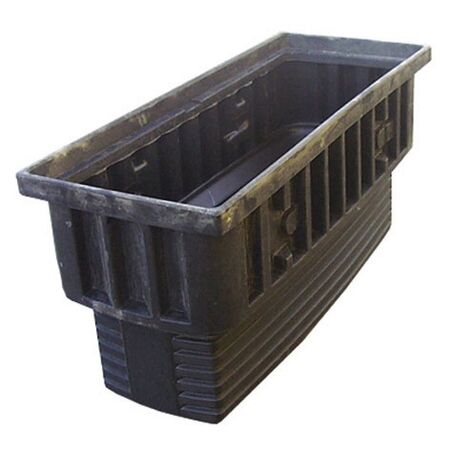
A contractor running a new underground supply to a rear switchboard hits a direction change halfway through the trench, and there's no clean way to pull the cable through without an access point right there. Order a pit that's too small for the number of cables passing through, and the job stalls while a bigger one gets delivered. Getting the size right the first time comes down to two things: how many cables are actually going through it, and how often someone's going to need to open it back up.
Size and depth are decided together on most jobs, but they're not the same question. If you haven't locked in confirming your burial depth yet, that's worth sorting first — this guide picks up from there, on what happens once the pit goes in and which size actually holds up to being opened again and again.
It's a common mistake to size a pit off the trench it's sitting in, rather than what's actually going to be coiled and joined inside it. A single service cable passing straight through needs very little room. The same pit trying to hold a joint, a spare loop for future testing, and a second cable entering from a different angle needs a lot more — even though the trench either side looks identical.
Before ordering, count what's actually going in: how many cables pass through, whether any of them terminate or joint at this point rather than just running through, and whether there's a spare loop being left for future work. A pit sized for a straight pass-through will feel undersized the moment a joint or a second cable gets added later, and re-digging to swap it out costs more than ordering one size up would have.
Schnap's underground cable pit range runs from compact single-service pits through to large distribution pits built for multiple heavy runs. As a general starting point, here's how the range breaks down by what each size is typically suited to:
| Size Tier | Approx. Range | Typically Suited To |
|---|---|---|
| Small | Around 320-420mm | Single service cable, straight pass-through, infrequent access |
| Medium | Around 550-670mm | Multi-cable junctions, direction changes, occasional testing access |
| Large | Around 580-1240mm | Heavier junctions, joints with spare loops, regular access |
| Extra-Large | Around 900-2040mm | Major distribution points, multiple large cable runs |
These pits sit within Schnap's broader range of underground enclosures, and the sizing logic above is a starting point — a Medium pit with one joint and no spare loop can behave more like a Small one in practice, while a Small pit pressed into service for a junction it wasn't sized for gets cramped fast.
A pit that only ever gets opened for an emergency fault doesn't need to be worked in comfortably. A pit that's going to have a technician kneeling over it every time cabling gets tested or extended does — cramped access means more time on site and a higher chance of damaging a joint while working around it. If maintenance or testing access is going to be routine rather than rare, it's generally worth sizing up from what the cable count alone would suggest, purely to leave room to actually work.
Load rating follows a similar logic to access frequency, but it's about what sits on top of the pit rather than what happens inside it. A pit set into a garden bed or verge that never sees vehicle traffic has different requirements to one installed in a driveway or car park. As a general rule, pits expected to carry any vehicle loading need a higher load class than pedestrian-only locations — check the specific load rating listed against each product before ordering if the pit is going anywhere near driveway or trafficable ground.
Sizing off the trench instead of the cable count. A wide trench doesn't mean a wide pit is needed, and a narrow one doesn't rule out a joint being added later. Count what's going in, not what's around it.
Not leaving room for a spare loop. A pit sized exactly for the cables going through it today leaves no slack for re-termination or future testing — a common regret once the pit's already backfilled around.
Ignoring how often the pit will actually be opened. A pit that's technically big enough but painful to kneel in front of turns a quick job into a slow one every single time it's accessed.
Assuming pedestrian load rating covers a driveway install. If there's any chance a vehicle will drive over the pit — including during construction, before landscaping is finished — the load rating needs to match that, not the finished use.
how many cables can go through a small underground pit?
It depends on the cable diameter and whether the pit is a straight pass-through or a joint point. As a general rule, a small pit around 320-420mm is comfortable for a single service cable running straight through, but gets tight fast once a joint, spare loop, or second cable is added.
is a small pit big enough for a single-phase service run?
For a straight single-phase service cable with no joint at that point, a compact pit such as the 320 x 530mm pit is generally sufficient. If a joint or a spare loop is planned for that access point, size up to a medium pit instead.
do I need a licensed electrician to install an underground cable pit?
Installing the pit itself as a civil element generally doesn't require an electrical licence, but any cabling work connected to it — joints, terminations, or connecting into a switchboard — does need to be carried out or supervised by a licensed electrician under Australian regulations. Check your state's specific licensing requirements before starting.
does the pit depth need to match my conduit depth?
Yes — the pit needs to sit at the same depth as the cable or conduit run it's connecting to, rather than being set at a convenient depth on its own. If you haven't confirmed matching pit and conduit depth for your run yet, that's worth locking in before finalising which pit to order.
Related Reading
Trade pricing and same-day dispatch from Kingsgrove NSW across the full underground cable pit range, from single-service sizes through to large distribution pits.
Find the full underground cable pit range at Schnap — trade pricing and same-day dispatch from Kingsgrove NSW.

SCHNAP Electrical Wholesaler - clear, upfront pricing that professional electricians trust

Get what you need in seconds. SCHNAP electrical wholesaler makes ordering quick and simple

Fast delivery anywhere - that's guaranteed. SCHNAP electrical wholesalers ship nationwide with same-day dispatch

Track your order every step of the way. SCHNAP electrical wholesale keeps you updated from click to delivery

SCHNAP is Australia's premier electrical wholesaler and electrical supplies, marketing thousands of quality products from leading brands. Trusted for nearly two decades by licensed electricians, contractors, and engineers, our range covers everything from basic electrical components to complex industrial electrical equipment
Our key categories include: LED lighting, designer switches, commercial switchboards, circuit protection, security systems & CCTV, and smart home automation
All products are certified to Australian standards (AS/NZS), backed by our 30-day, no-questions-asked return policy. Our expert technical team helps you quickly source the right solution for any residential, commercial, or industrial project, with daily dispatch from our Sydney electrical warehouse delivering Australia-wide
SCHNAP offers the most comprehensive electrical product range, with full technical specifications, application details, installation requirements, compliance standards, and warranties — giving professionals total confidence in every purchase


Kingsgrove Branch:
Opening hours:
Mon - Fri: 6:30 AM to 5 PM
Saturday: 8:00 AM to 2:00 PM
Sunday: 9:00 AM to 2:00 PM
Closed on public holidays
Jannali Branch:
Closed for Renovations
© 2004 - 2026 SCHNAP Electric Products