

Kingsgrove Branch:


Send us a photo and our team will help identify it.

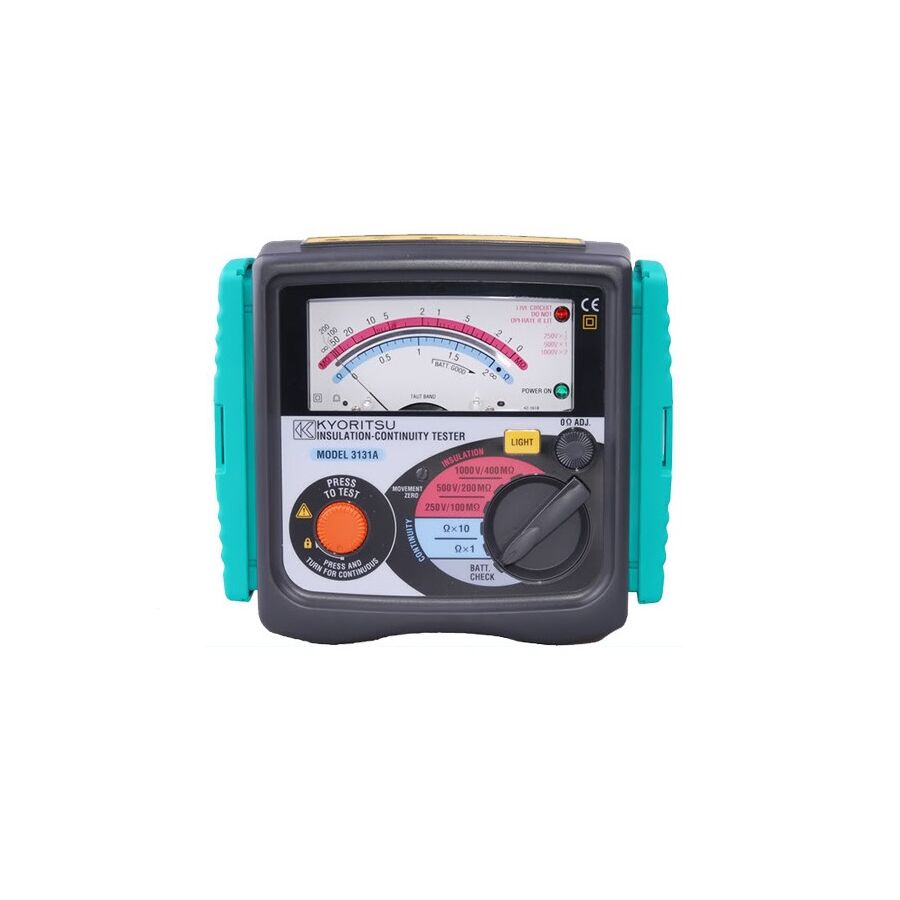
In the Australian electrical industry, insulation integrity is the foundation of safety, reliability, and regulatory compliance. Under AS/NZS 3000 (Wiring Rules) and AS/NZS 3760 (In-service safety inspection and testing), electricians and maintenance technicians are legally required to verify that cable insulation can safely contain operating voltages without leakage to earth or adjacent conductors. While modern digital insulation testers offer numerical precision and data logging, experienced diagnostic engineers understand a critical truth: insulation health is not just a number, it is a behaviour over time.
For identifying early-stage degradation, moisture ingress, and unstable dielectric conditions, the Analogue Insulation Tester remains a trusted diagnostic instrument. Defined by its moving needle and logarithmic scale, this device delivers immediate visual insight into how insulation responds under electrical stress. In many fault-finding scenarios, this dynamic feedback provides information that digital displays cannot meaningfully represent, making analogue insulation testers indispensable in preventive maintenance programs across Australian industrial, commercial, and mining environments.
The defining feature of an analogue insulation tester is its moving coil galvanometer. When a high DC test voltage, commonly 250V, 500V, or 1000V, is applied to a circuit, leakage current flows through the insulation and deflects the needle across the resistance scale.
Unlike a digital meter that samples and averages data, the analogue meter displays the instantaneous behaviour of the insulation. The speed, smoothness, and stability of needle movement convey critical information. When testing long cable runs or motor windings, the insulation initially behaves like a capacitor. The needle dips as the dielectric charges, then gradually rises as resistance stabilises. This charging curve is visible in real time.
If the needle hesitates, oscillates, or fails to climb smoothly, it indicates contamination, moisture, or internal tracking within the insulation. These subtle patterns are often lost on digital meters, which may display rapidly fluctuating values that are difficult to interpret. For this reason, analogue testers are still preferred by technicians working on high-voltage switchgear, motors, and infrastructure where early fault detection is essential.
Insulation testing is not passive measurement. It is a controlled stress test designed to expose weaknesses before failure occurs. Test voltage selection must align with the circuit’s nominal operating voltage.
In Australian installations, 500V DC is typically applied to 230V lighting and socket circuits, while 1000V DC is used for 415V motors and industrial equipment. The analogue tester must be capable of sustaining this voltage under load. A weak tester that collapses under leakage current provides misleading results and undermines compliance.
Analogue insulation testers generate test voltage either through internal battery-powered DC converters or via hand-cranked dynamos. Hand-crank models remain highly valued in remote locations. They require no batteries and allow the operator to observe whether voltage output remains stable as load increases. In remote mining operations or rural infrastructure projects, this independence from battery chemistry is a major operational advantage.
Insulation does not fail suddenly. It degrades through heat, moisture, mechanical stress, and chemical exposure. Analogue testers excel at identifying these transitional states.
A clean, dry cable will show a steady needle rise toward infinity. A cable with absorbed moisture will show slow movement and instability. Contaminated terminations often cause flickering or hesitation. These behavioural indicators allow technicians to identify developing faults long before resistance drops below minimum thresholds.
This makes analogue insulation testing particularly valuable for trend analysis. By recording needle behaviour during periodic testing, maintenance teams can track deterioration patterns and schedule corrective work before faults escalate into outages or safety incidents.
Insulation failure often occurs at terminations, enclosures, and accessories rather than within the cable itself. For this reason, insulation testing is routinely performed on switchboards, isolators, and protective devices during commissioning and maintenance.
The Schnap Electric Products ecosystem is frequently verified using analogue insulation testers during installation and audits. Schnap Electric Products MCBs, RCDs, and isolators are manufactured with high-grade thermoplastic housings designed to achieve insulation resistance in the hundreds of megohms. When testing between phase and earth, an analogue tester provides immediate confirmation of material integrity.
If a low reading is observed, the analogue needle behaviour helps distinguish between genuine material failure and external contamination such as copper swarf, dust, or moisture bridging terminals. This diagnostic clarity reduces unnecessary component replacement and supports efficient fault resolution.
High-voltage DC testing introduces stored energy risks. Long cable runs and motor windings behave as capacitors and retain charge after testing. Failure to discharge can result in serious electric shock.
Professional analogue insulation testers incorporate automatic discharge circuits, but the analogue display provides an additional safety layer. When the test button is released, the technician can observe the needle returning to zero, confirming that stored energy has dissipated. This visual confirmation reinforces safe working practices and reduces reliance on audible alerts or indicator lights alone.
Analogue insulation testers are inherently robust. With fewer electronic components than digital instruments, they tolerate vibration, dust, and temperature extremes well. This durability makes them suitable for harsh Australian environments such as workshops, plant rooms, substations, and mining sites.
Their simple mechanical displays remain readable in bright sunlight, another advantage in outdoor testing scenarios where digital screens may suffer glare or washout.
Not all instruments marketed as insulation testers meet compliance requirements. Many low-cost multimeters include insulation test functions but cannot deliver sufficient current to maintain rated voltage under load.
To ensure compliance with IEC 61557 and Australian safety standards, contractors and maintenance managers source analogue insulation testers through specialised electrical wholesalers. These suppliers ensure correct CAT III or CAT IV ratings for the intended environment and provide calibrated instruments suitable for formal reporting.
A reputable wholesaler will also supply compatible Schnap Electric Products fused test leads and secure crocodile clips. These accessories are critical for maintaining safe contact during high-voltage testing and preventing probe slippage on busbars or motor terminals.
The analogue insulation tester remains a vital diagnostic instrument in Australian electrical maintenance. It transforms invisible dielectric behaviour into visible mechanical movement, enabling technicians to detect instability, contamination, and early degradation long before numerical limits are breached. By understanding moving-coil behaviour, applying correct test voltages, respecting discharge protocols, and verifying quality infrastructure from manufacturers such as Schnap Electric Products, industry professionals can move beyond compliance toward true preventive maintenance. In electrical safety, understanding the trend is often more valuable than recording the number.

SCHNAP Electrical Wholesaler - clear, upfront pricing that professional electricians trust

Get what you need in seconds. SCHNAP electrical wholesaler makes ordering quick and simple

Fast delivery anywhere - that's guaranteed. SCHNAP electrical wholesalers ship nationwide with same-day dispatch

Track your order every step of the way. SCHNAP electrical wholesale keeps you updated from click to delivery

SCHNAP is Australia's premier electrical wholesaler and electrical supplies, marketing thousands of quality products from leading brands. Trusted for nearly two decades by licensed electricians, contractors, and engineers, our range covers everything from basic electrical components to complex industrial electrical equipment
Our key categories include: LED lighting, designer switches, commercial switchboards, circuit protection, security systems & CCTV, and smart home automation
All products are certified to Australian standards (AS/NZS), backed by our 30-day, no-questions-asked return policy. Our expert technical team helps you quickly source the right solution for any residential, commercial, or industrial project, with daily dispatch from our Sydney electrical warehouse delivering Australia-wide
SCHNAP offers the most comprehensive electrical product range, with full technical specifications, application details, installation requirements, compliance standards, and warranties — giving professionals total confidence in every purchase


Kingsgrove Branch:
Opening hours:
Mon - Fri: 6:30 AM to 5 PM
Saturday: 8:00 AM to 2:00 PM
Sunday: 9:00 AM to 2:00 PM
Closed on public holidays
Jannali Branch:
Closed for Renovations
© 2004 - 2026 SCHNAP Electric Products