

Kingsgrove Branch:


Send us a photo and our team will help identify it.

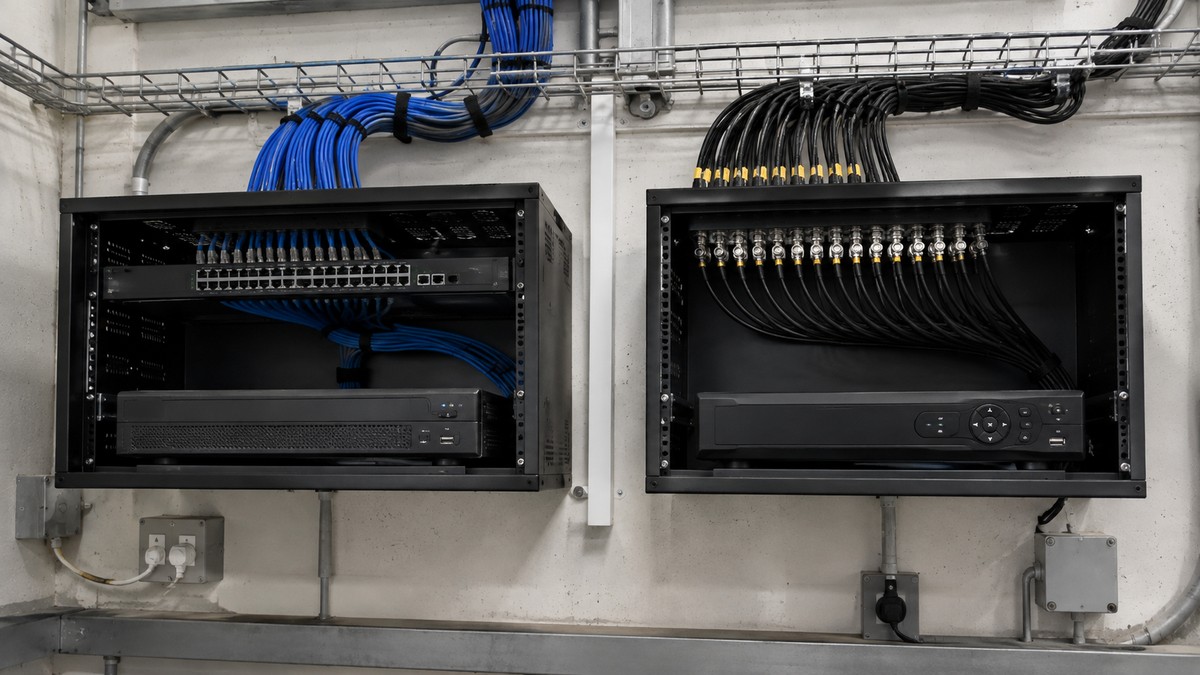
A client wants twelve cameras across a warehouse yard and loading dock. The site already has coax runs from an old analog system installed a decade ago, and the question on the table is simple: rip it all out for a fresh PoE setup, or work with what's already in the walls. That decision comes down to one thing — NVR or DVR.
An NVR (Network Video Recorder) processes video that's already been converted to digital by the camera itself, then sent over Ethernet — usually PoE, so one cable carries both power and data. A DVR (Digital Video Recorder) takes raw analog signal over coax and does the digital conversion at the recorder end. That single difference cascades into almost everything else in this decision.
Image quality is the first place it shows. IP cameras on an NVR system commonly run at resolutions well above what analog HD-TVI/AHD cameras on a DVR can deliver, and because the signal stays digital from lens to storage, there's less degradation over distance. In practice, a DVR system with modern HD-TVI cameras can still produce genuinely usable footage for identification purposes — it's not the grainy analog of fifteen years ago — but if the job spec calls for reading number plates at range or zooming into faces after the fact, NVR generally has the edge.
This is where the warehouse job above actually gets decided. Existing coax is a genuine argument for DVR — a HD-TVI or pentabrid DVR can usually run straight off that old coax without touching a single wall, which turns a two-day rewiring job into an afternoon of swapping the recorder and cameras. Going NVR on that same site means pulling new Cat6 to every camera position, which is a different quote entirely once you factor in cable, conduit, and labour.
On the flip side, a fresh install with no existing cabling removes that argument completely — there's no cost advantage to coax if you're pulling cable either way, and PoE Cat6 is typically faster to terminate than coax with separate power runs. As a general rule, the deciding factor isn't "which is better" in isolation, it's what's already in the ground or the walls at this specific site.
Camera count also plays into cable planning either way — once the recorder side is settled, sizing your NVR channel count for the current job (and whatever gets added next year) is the next thing worth working through before you finalise the quote.
Upfront, budget DVR kits are typically cheaper than an equivalent-channel NVR kit, mostly because the cameras themselves cost less. Where that flips is scalability. Adding a camera to a PoE NVR system is usually a matter of running one Cat6 cable and plugging it in — power comes down the same line. Adding a camera to a DVR system means running coax plus a separate power cable to that camera, which is more physical work per addition.
| Consideration | NVR (IP/PoE) | DVR (Analog/HD-TVI) |
|---|---|---|
| Cabling | Cat6, one cable per camera (data + power) | Coax + separate power run |
| Typical image quality | Higher resolution ceiling | Good enough for most ID purposes, lower ceiling |
| Reusing existing cable | Not possible with old coax runs | Straightforward if coax is already in place |
| Adding cameras later | One Cat6 run per camera | Coax plus separate power per camera |
Quoting NVR without checking the existing cable run. On the warehouse job, assuming a fresh Cat6 pull without first checking whether the existing coax is even usable wastes a site visit — always test the old cable run before pricing either option.
Underestimating PoE power budget. Stacking more cameras onto an NVR's PoE ports than its power budget supports is a common oversight — in practice, high-resolution or IR-heavy cameras draw more than entry-level fixed-lens units, so it's worth checking the recorder's total PoE wattage against the camera list, not just the port count.
Assuming DVR footage won't hold up. Written off as outdated technology, modern HD-TVI DVR footage is often perfectly usable for insurance and incident review — the real gap only shows up when the client specifically needs long-range facial or plate detail.
Forgetting storage duration in the comparison. Higher-resolution NVR footage eats hard drive space faster than DVR footage at the same retention period — as a general rule, doubling resolution roughly doubles storage needs at the same frame rate and retention window, which affects HDD sizing on the quote.
Not checking internet dependency with the client. Some clients assume NVR means cloud-only footage — worth clarifying upfront that local recording to the NVR's own HDD works with or without internet, and internet is typically only needed for remote viewing.
Is NVR image quality really better than DVR?
Typically yes at the top end — IP cameras on NVR systems commonly reach higher resolutions than analog HD-TVI cameras on DVR systems. But the gap has narrowed a lot in recent years, and for straightforward identification (not long-range detail), a modern DVR setup is often good enough.
Can I upgrade my DVR system to NVR later without rewiring?
Not directly — DVR runs on coax, NVR needs Cat6/PoE, so moving from one to the other generally means a new cable run to each camera position. If you're weighing this up now, a PoE NVR with headroom for extra channels can save a second upgrade down the track.
Can I run PoE NVR cameras over 100 metres?
Standard PoE over Cat6 typically has a practical limit around 100 metres before signal quality drops, in line with general Ethernet cabling standards — beyond that, a PoE extender or switch closer to the cameras is usually the workaround.
How many channels do I need for a small job?
It depends on the current camera count plus realistic future additions — a separate nvr channel sizing guide walks through how to size this properly rather than just matching channels to today's camera count.
Do I need a security licence to install CCTV in NSW?
In NSW, installing security equipment including CCTV generally requires a security licence under the Security Industry Act, though requirements can vary by the specific scope of work and jurisdiction — check current requirements with NSW Fair Trading before quoting commercial jobs if you're not already licensed for this class of work.
What's the difference between a DVR and a fleet dashcam recorder?
A standard DVR for building CCTV is built for fixed installation and mains power, not vehicle vibration or ignition-linked power cycles. If the job is actually for a truck or work vehicle rather than a fixed site, a fleet vehicle DVR recorder guide covers what's different about specifying for mobile use.
Whichever way the job lands, trade pricing and same-day dispatch from Kingsgrove NSW applies across both recorder types.
Find the full NVR vs DVR range at Schnap — trade pricing and same-day dispatch from Kingsgrove NSW.

SCHNAP Electrical Wholesaler - clear, upfront pricing that professional electricians trust

Get what you need in seconds. SCHNAP electrical wholesaler makes ordering quick and simple

Fast delivery anywhere - that's guaranteed. SCHNAP electrical wholesalers ship nationwide with same-day dispatch

Track your order every step of the way. SCHNAP electrical wholesale keeps you updated from click to delivery

SCHNAP is Australia's premier electrical wholesaler and electrical supplies, marketing thousands of quality products from leading brands. Trusted for nearly two decades by licensed electricians, contractors, and engineers, our range covers everything from basic electrical components to complex industrial electrical equipment
Our key categories include: LED lighting, designer switches, commercial switchboards, circuit protection, security systems & CCTV, and smart home automation
All products are certified to Australian standards (AS/NZS), backed by our 30-day, no-questions-asked return policy. Our expert technical team helps you quickly source the right solution for any residential, commercial, or industrial project, with daily dispatch from our Sydney electrical warehouse delivering Australia-wide
SCHNAP offers the most comprehensive electrical product range, with full technical specifications, application details, installation requirements, compliance standards, and warranties — giving professionals total confidence in every purchase


Kingsgrove Branch:
Opening hours:
Mon - Fri: 6:30 AM to 5 PM
Saturday: 8:00 AM to 2:00 PM
Sunday: 9:00 AM to 2:00 PM
Closed on public holidays
Jannali Branch:
Closed for Renovations
© 2004 - 2026 SCHNAP Electric Products