

Kingsgrove Branch:


Send us a photo and our team will help identify it.

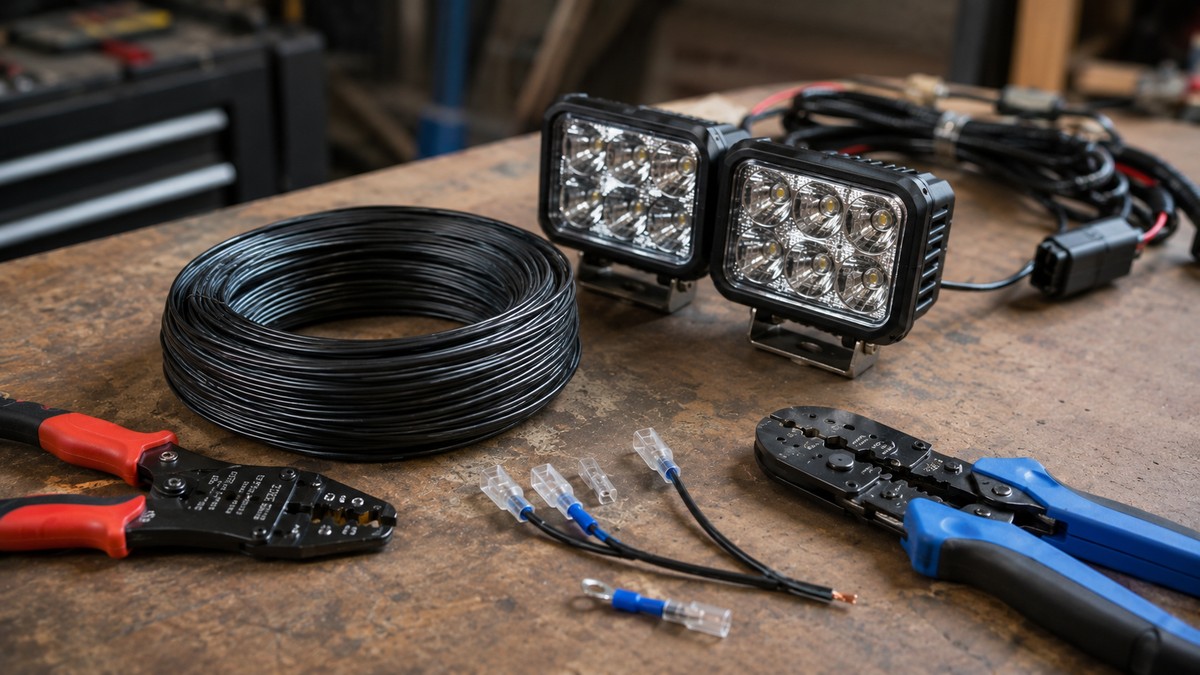
A pair of 200mm LED driving lights pulling 20 amps combined, wired with a 4-metre run of 0.75mm cable back to the battery, will light up fine in the driveway and then go noticeably dim the first time they're actually needed at highway speed with the alternator under load. That's not a faulty light bar — it's undersized cable losing voltage over the run.
Most people sizing automotive and vehicle cable for the first time look up the maximum current rating for a given gauge and stop there. That number tells you what the cable can carry without overheating — it doesn't tell you what voltage actually arrives at the other end of a 4-metre, 8-metre, or 12-metre run. Every metre of copper has resistance, and at 12V that resistance matters a lot more than it does at mains voltage. A voltage drop of even half a volt across the run is enough to make an LED bar noticeably dimmer, cause a winch solenoid to chatter instead of engaging cleanly, or trigger a fridge compressor to cycle oddly on long touring trips.
The practical rule of thumb is to size for both the amp draw AND the length of the run — not one or the other. A cable rated to carry 20 amps over a 1-metre bench test can still deliver a disappointing voltage drop over 4 metres in a real vehicle, especially once you count the return path back to the battery negative.
Take the driving light scenario above: two lights drawing roughly 10 amps each, 20 amps combined, over a 4-metre run from battery to bar (with a relay close to the battery, which is standard practice and keeps the switched wire run short). At that length, 0.75mm cable is genuinely too light for the job — it's more suited to low-current accessories like dash switches or indicator feeds. A 2.5mm or 3.5mm FLY cable is a more realistic fit for a 20 amp, 4-metre run, and stepping up to 6.0mm gives headroom if the run is longer or a third light gets added down the track.
| Gauge | Typical Use | Comfortable Run at ~15-20A |
|---|---|---|
| 0.5mm - 0.75mm | Switch feeds, indicator wiring, low-current accessories | Under 2m |
| 1.0mm - 1.6mm | Single driving light, dash-mounted accessories | 2-3m |
| 2.5mm - 3.5mm | Paired driving lights, sound system amp feed, fridge circuit | 4-6m |
| 6.0mm+ | Longer runs, winch feed circuits, higher combined draw | 6m+ |
These figures are a practical starting point rather than a substitute for checking the actual current draw of your specific lights or accessory — in practice, doubling up a size when the run is longer than expected is cheap insurance against a dim, underperforming circuit.
The same length-plus-load approach applies whether it's a winch feed, a fridge circuit on a long-distance tour setup, or a car audio amp draining hard on bass-heavy tracks. A winch pulling under load can spike well past its rated draw for short bursts, so the feed side is usually sized generously rather than to the bare minimum. A fridge circuit, by contrast, draws modest current but often runs a long way to the back of a wagon or camper trailer — length ends up mattering more than load there. twin core cable options come into play for circuits like these where a simpler two-wire feed and earth combination is genuinely a better fit than running the positive and earth as separate single-core runs.
Sizing off the datasheet current rating alone. The rated capacity of a cable ignores the length of your specific run — it's the starting point, not the final answer, and it's the single biggest reason people end up with a dim light bar despite "correctly rated" cable.
Reusing whatever offcut is on the shelf. A leftover length of 0.5mm from a previous indicator job gets pressed into service for a driving light feed because it's already there — it's an easy trap when the light bar itself only came with a short pigtail and the rest of the run needs sourcing separately.
Undersizing the earth return. As covered above, a heavy-gauge positive feed paired with a thin earth strap still gives you a weak circuit overall — the whole loop needs to be sized consistently.
Ignoring the relay's switched-side wiring. The wire running from the switch to the relay coil carries very little current and can be light gauge — using heavy cable there wastes money without fixing anything, while people sometimes go the other way and undersize the relay's load-side output, which is the wire that actually needs the bigger gauge.
Related Reading
what gauge wire do I need for a 20 amp driving light run?
For a combined 20 amp draw over a typical 4-metre run, 2.5mm to 3.5mm is generally a comfortable fit — see the 2.5mm FLY cable as a starting point if your run is around that length.
why do my LED driving lights flicker at idle?
Flickering at idle is often a symptom of voltage sag under load rather than a faulty light — undersized cable, a marginal earth point, or a tired battery can all cause the supply voltage to dip momentarily when the alternator output drops at low RPM.
can I run automotive cable through the engine bay near the block?
It's typically avoided where possible — engine bay heat can degrade PVC insulation over time, so runs are usually routed along the chassis rail or through existing loom paths rather than directly across or near the block.
how do I join two runs of automotive cable without a proper crimp tool?
A mechanical join without proper crimping tends to loosen with vibration over time, which is a common failure point in vehicle wiring — picking the right ferrule size for the cable gauge and using a proper crimp tool is the more reliable approach than twisting and taping.
do I need an auto electrician licence to wire aftermarket accessories on my own vehicle?
Low-voltage (12V) auxiliary wiring on a private vehicle is generally treated differently to mains electrical work and typically doesn't require an electrical licence — as a general rule it's still worth checking current requirements for your state and, for anything tied into factory wiring or safety-critical circuits, having it checked by a qualified auto electrician.
what happens if I use undersized cable on a winch circuit?
Undersized cable on a winch feed typically shows up as excessive voltage drop under load — sluggish winch performance, a solenoid that chatters instead of engaging cleanly, or in more serious cases, cable insulation that heats up during extended pulls. 6.0mm FLY cable is a common choice for feed-side winch wiring where the run allows.
Related Reading
Trade pricing and same-day dispatch from Kingsgrove NSW across the automotive single-core range below.
Find the full automotive cable size range at Schnap -- trade pricing and same-day dispatch from Kingsgrove NSW.

SCHNAP Electrical Wholesaler - clear, upfront pricing that professional electricians trust

Get what you need in seconds. SCHNAP electrical wholesaler makes ordering quick and simple

Fast delivery anywhere - that's guaranteed. SCHNAP electrical wholesalers ship nationwide with same-day dispatch

Track your order every step of the way. SCHNAP electrical wholesale keeps you updated from click to delivery

SCHNAP is Australia's premier electrical wholesaler and electrical supplies, marketing thousands of quality products from leading brands. Trusted for nearly two decades by licensed electricians, contractors, and engineers, our range covers everything from basic electrical components to complex industrial electrical equipment
Our key categories include: LED lighting, designer switches, commercial switchboards, circuit protection, security systems & CCTV, and smart home automation
All products are certified to Australian standards (AS/NZS), backed by our 30-day, no-questions-asked return policy. Our expert technical team helps you quickly source the right solution for any residential, commercial, or industrial project, with daily dispatch from our Sydney electrical warehouse delivering Australia-wide
SCHNAP offers the most comprehensive electrical product range, with full technical specifications, application details, installation requirements, compliance standards, and warranties — giving professionals total confidence in every purchase


Kingsgrove Branch:
Opening hours:
Mon - Fri: 6:30 AM to 5 PM
Saturday: 8:00 AM to 2:00 PM
Sunday: 9:00 AM to 2:00 PM
Closed on public holidays
Jannali Branch:
Closed for Renovations
© 2004 - 2026 SCHNAP Electric Products