

Kingsgrove Branch:


Send us a photo and our team will help identify it.

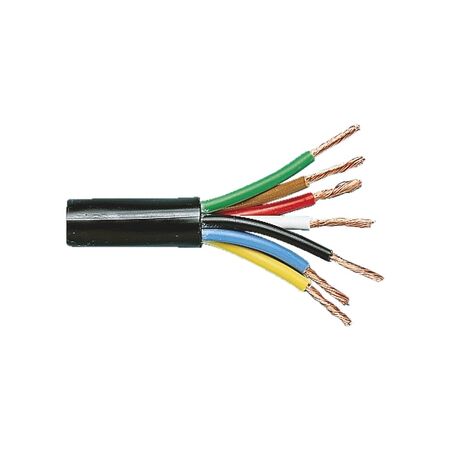
A box trailer rolls into the shop for a full rewire — tail lights, stop lights, both indicators, reverse lights, and a rear fog light, six functions in total. Cable gauge is the easy part; the harder question is how many cores actually get every one of those functions back to the plug without doubling two circuits onto one wire. That decision point — core count matched to function count — is where trailer wiring jobs go sideways before the crimping even starts.
A standard AU 7-pin trailer plug is commonly wired for seven functions: earth, tail/park lights, stop lights, left indicator, right indicator, reverse lights, and an auxiliary circuit for fog lights or a charge line. In practice, not every trailer needs all seven wired separately — the core count you actually need comes down to how many of those functions the trailer carries, not the cable's rated amperage.
A simple single-axle box trailer with tail, stop, and shared indicator lights typically gets by on 4 cores. Add separate left and right indicators and you're usually looking at 5 cores. It's only once reverse lights and a fog or aux light both come into the build — the case with the trailer above — that a genuine 7-core run earns its keep, because each of those functions needs its own dedicated conductor back to the plug rather than sharing a wire with something else.
| Core Count | Typical Function Coverage | Common Use Case |
|---|---|---|
| 2-core | Single circuit plus return | Short extension runs or a single dedicated accessory circuit |
| 4-core | Earth, tail/park, stop, shared indicator | Basic single-axle trailers without reverse or fog lights |
| 5-core | Earth, tail/park, stop, separate LH/RH indicators | Trailers needing independent indicator circuits, no reverse/fog |
| 7-core | Earth, tail/park, stop, LH/RH indicators, reverse, fog/aux | Full-function tandem or box trailers with reverse and fog lights |
Related Reading
Getting the core count right only solves half the problem — each stranded core still has to land on a pin or terminal without the strands splaying, working loose, or wicking moisture up the conductor. Trailer plugs and junction boards typically use screw or spring-clip terminals, and bare stranded ends pushed straight into either one tend to loosen over time as the trailer flexes on rough tracks or boat ramps.
Ferruling each core before it goes into the plug or junction board gives it a solid, uniform end that seats properly and resists corrosion better than a bare crimped or twisted strand bundle — matching ferrule size to trailer cable cores is worth checking against the core's actual cross-sectional area rather than guessing off the cable's overall diameter. On an oil-resistant 7-core run destined for a boat trailer or a farm trailer that sees grease and diesel, that terminal quality matters more than usual — a loose reverse light connection is annoying, but a loose earth core is the one that tends to cause the most confusing intermittent faults.
Doubling two functions onto one core to save a wire. Sharing a core between the stop light and one indicator to avoid stepping up from 5-core to 7-core usually means the brake light flashes along with the indicator, or the indicator dims when the brakes are also on — an easy fault to chase for hours before realizing it was a wiring shortcut, not a bulb or relay issue.
Skipping ferrules on stranded cores. Pushing bare stranded ends straight into spring-clip plug pins often works fine on the bench, then loosens after a few thousand kilometres of trailer vibration and road grime working into the joint.
Choosing core count by price instead of function count. A cheaper 4-core cable looks like the better buy until reverse lights or a fog light get added later and the whole loom has to be re-pulled through the chassis — running the 7-core from the start is usually the cheaper option over the trailer's life.
Assuming the chassis handles earth return. Some older trailers rely on a chassis or coupling earth return rather than a dedicated core, but corrosion at the coupling or axle stub can make that return unreliable — running a dedicated earth core in the multicore cable is generally the more predictable approach for a full rewire.
Not labelling cores at both ends during the pull. On a 7-core run, sorting seven similarly coloured conductors at the plug end without labels usually means testing each one individually with a multimeter — a step that's quick to skip when pulling the cable, and slow to redo once it's already run through the chassis.
does a trailer with reverse lights need 7 cores or can I get away with 5?
If reverse lights are wired as their own circuit rather than shared with another function, they typically need a dedicated core — on a trailer that also has separate LH/RH indicators, that generally pushes the count from 5 to 6 or 7 depending on whether a fog/aux circuit is fitted as well.
what's the actual difference between 4-core and 5-core trailer wire?
The step from 4-core to 5-core is usually one extra dedicated conductor, most often used to split a shared LH/RH indicator circuit into two independent ones. See the 3-core FLRYY cable for jobs that sit between the two.
can I run fog lights and reverse lights off the same core?
Combining them on one core generally means both circuits switch together, which isn't correct for either function — reverse lights should only activate in reverse gear and fog lights are typically switched independently, so in practice each one needs its own dedicated core.
do I need a licensed auto electrician to wire a trailer plug in Australia?
Requirements vary by state and by whether the trailer is used commercially, so it's worth checking current licensing rules for your state before starting a trailer light rewire — this isn't something to assume is DIY-only just because it's low voltage.
can I use bootlace ferrules on FLRYY trailer wire?
Yes — FLRYY cores are fine-stranded, which is exactly the type of conductor ferrules are designed for. Sizing them correctly matters more than the ferrule brand; see the twin bootlace ferrule option if two cores are landing on a single terminal.
why does my trailer wiring keep corroding at the plug?
Bare stranded ends left uncrimped are more prone to wicking moisture up the conductor, especially on trailers regularly exposed to boat ramps or wash-down. An oil-resistant jacket helps with the outer sheath, but the termination itself is usually where corrosion actually starts.
Related Reading
Schnap stocks the FLRYY range across trade pricing with same-day dispatch from Kingsgrove NSW, from single-circuit 2-core through to full 7-core trailer looms.
Browse the full automotive and vehicle cable range at Schnap for trade pricing, trusted brands, and same-day dispatch from Kingsgrove NSW.

SCHNAP Electrical Wholesaler - clear, upfront pricing that professional electricians trust

Get what you need in seconds. SCHNAP electrical wholesaler makes ordering quick and simple

Fast delivery anywhere - that's guaranteed. SCHNAP electrical wholesalers ship nationwide with same-day dispatch

Track your order every step of the way. SCHNAP electrical wholesale keeps you updated from click to delivery

SCHNAP is Australia's premier electrical wholesaler and electrical supplies, marketing thousands of quality products from leading brands. Trusted for nearly two decades by licensed electricians, contractors, and engineers, our range covers everything from basic electrical components to complex industrial electrical equipment
Our key categories include: LED lighting, designer switches, commercial switchboards, circuit protection, security systems & CCTV, and smart home automation
All products are certified to Australian standards (AS/NZS), backed by our 30-day, no-questions-asked return policy. Our expert technical team helps you quickly source the right solution for any residential, commercial, or industrial project, with daily dispatch from our Sydney electrical warehouse delivering Australia-wide
SCHNAP offers the most comprehensive electrical product range, with full technical specifications, application details, installation requirements, compliance standards, and warranties — giving professionals total confidence in every purchase


Kingsgrove Branch:
Opening hours:
Mon - Fri: 6:30 AM to 5 PM
Saturday: 8:00 AM to 2:00 PM
Sunday: 9:00 AM to 2:00 PM
Closed on public holidays
Jannali Branch:
Closed for Renovations
© 2004 - 2026 SCHNAP Electric Products