

Kingsgrove Branch:



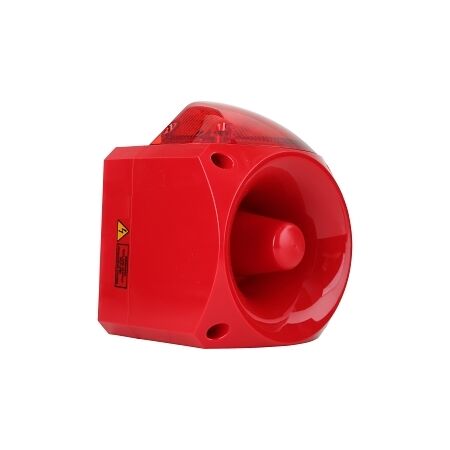
You’re commissioning a plant area where an operator needs to see and hear a warning from the same point, but the obvious-looking beacon on the shelf may not suit the voltage, environment or sound level. A sounder beacon solves that combined signalling problem, but the useful specification is not just the headline dB figure.
For a typical industrial installation, start with the actual warning scenario, then work through sound output, tone selection, supply voltage, IP rating, visual indication and mounting. The broader bells sirens screamers range covers several signalling formats, so choosing by application is more reliable than choosing by appearance.
Picture a machinery area where the warning needs to be recognised quickly from across the floor. The unit has to provide a visible signal under normal plant lighting, while the audible warning needs to remain noticeable against machinery noise. That immediately rules out treating every beacon, buzzer and siren as interchangeable.
A sounder beacon combines two jobs in one device: visual indication and audible warning. That can simplify an installation where space, wiring points or operator recognition are concerns. It also means the selection has to satisfy both sides of the warning function rather than optimising only the light or only the sound.
For example, a 105dB IP66 sounder beacon with a 10-60V DC supply can make more sense on a machine or control installation than a lower-output unit simply because the latter is smaller. Conversely, a very high-output device is not automatically the right answer if the installation does not need that level of acoustic output.
[!] Selection note: Do not choose a warning device from dB alone. The supply voltage, enclosure rating, mounting format and required visual indication can eliminate an otherwise suitable-looking model.
Related Reading
Once the job scenario is clear, narrow the shortlist using the specifications that affect whether the device will work where you are installing it.
A higher sound level can be useful in a noisy industrial area, but bigger is not automatically better. Think about where the sound has to be recognised and what competing noise exists around the installation. The catalogue includes devices ranging from more compact 80dB-class sounder solutions through to industrial horns and sounders exceeding 120dB, giving installers room to match the device to the environment rather than applying one number to every job.
For the audible side of the warning decision, see the warning sounder selection article for a closer look at sound output, tones, voltage and mounting.Selectable tones matter when the warning has to be distinguished from other alarms or plant sounds. A multi-tone unit can give more flexibility during commissioning, while a simpler fixed-tone solution may be entirely adequate where there is only one warning condition.
Check the actual control or supply voltage before choosing the device. The available range in this category includes low-voltage DC models as well as higher-voltage AC units, so voltage mismatch is an easy way to end up with a product that looks ideal on paper but does not suit the installed circuit.
| Selection factor | What to check | Why it matters |
|---|---|---|
| Sound output | Required dB level for the installation | The warning must remain noticeable in the real operating environment. |
| Tone | Fixed or selectable tones | Helps distinguish the warning from other plant signals. |
| Voltage | AC or DC and nominal supply | Prevents selecting a unit that does not match the circuit. |
| IP rating | Required environmental protection | The enclosure needs to suit the installation conditions. |
| Mounting | Panel, wall or surface mounting | The mounting format needs to fit the physical installation. |
| Visual signal | Colour and steady/flashing operation | The operator needs to recognise what the visual indication means. |
This is where a basic indoor-looking beacon can become the wrong choice. If the installation is exposed to dust, water or harsher industrial conditions, the enclosure rating deserves the same attention as sound output. For an outdoor or washdown-prone location, an IP-rated model such as an IP66 sounder beacon may be more appropriate than a lower-rated panel device.
Look at the physical point where the warning must be seen and heard. Panel-mounted devices suit control enclosures and operator stations, while surface or wall-mounted units can be more appropriate when the signal needs to project into an open plant area. Mounting is not just a mechanical detail; it affects visibility, accessibility and how the warning integrates into the installation.
For installations using horn-based audible warning equipment, speaker cable sizing may also become part of the wiring decision.
[!] Installation note: Make sure the selected sounder beacon matches the equipment supply and the physical environment. Where the installation involves regulated electrical work, use the appropriately licensed electrical trade and follow the applicable requirements for the jurisdiction.
The main practical advantage of a sounder beacon is that one device can provide the two signals the operator needs. That is particularly useful when the warning point is compact or when combining audible and visual indication makes the alarm easier to recognise.
A combined unit can also simplify the selection process. Instead of trying to coordinate a separate horn with a separate beacon, you are choosing one assembly whose light and sound functions are designed to operate together. The trade-off is that the combined unit still has to meet the requirements of both functions.
Choosing by dB alone. A high sound output does not compensate for the wrong voltage, enclosure rating or mounting arrangement. In a real plant, the right device is the one that fits the whole installation.
Ignoring the existing control voltage. It is easy to focus on the warning function and overlook whether the available circuit is AC or DC. Check the supply before narrowing the product choice.
Using an indoor-style unit in a harsh location. A beacon mounted where it sees moisture, dust or other environmental exposure needs the appropriate enclosure protection. A visually similar lower-rated model is not an equivalent substitute.
Overlooking the visual signal. The light colour and flashing or steady operation should support the warning function and the way operators recognise the alarm, not simply match the colour that happens to be available.
Using more functionality than the job needs. Selectable tones, very high sound output and combination features are useful when the installation benefits from them. They should not become the reason for choosing a more complex unit when a simpler solution already satisfies the warning requirement.
Can I use a 24V DC sounder beacon on a 24V control circuit?
Only where the selected device is rated for the actual supply and installation conditions. For example, a model specified for 24V DC is intended for that type of supply, but the rest of the device specification still needs to suit the job.
Is a 105dB sounder always better than an 85dB unit?
No. The suitable output depends on the environment and how the warning needs to be recognised. A higher rating may be useful in a noisy area, but excessive output is not automatically the correct specification.
What should I check for an outdoor sounder beacon?
Check the enclosure rating, supply voltage, mounting format and the required sound and visual output. An IP66 sounder beacon is one example of a higher-protection configuration available in the range.
Do I need a licensed electrician to install a fixed sounder beacon?
Licensing requirements depend on the electrical work and jurisdiction. For fixed electrical installation work, use the appropriately licensed electrician and follow the applicable state or territory requirements.
Does a panel-mounted sounder beacon need an IP-rated enclosure?
That depends on the environment and the enclosure arrangement. The sounder beacon itself should have an appropriate rating for its exposure, and the complete installation should suit the conditions where it is installed.
Should I choose selectable tones for every industrial alarm?
Not necessarily. Selectable tones are useful when the warning needs to be distinguished from other signals or when commissioning requires flexibility. A fixed-tone device can be sufficient for a straightforward single-warning application.
What is the advantage of a combined light and sound alarm?
It provides audible and visual indication from one device, which can be useful where the warning needs to be recognised quickly or where the installation benefits from a combined unit. Options such as this 24V light-and-sound alarm illustrate that combined approach.
When would I use a higher-output industrial horn instead of a compact panel sounder?
The decision comes back to the warning environment and the installation point. A larger industrial horn can make sense where the warning needs stronger acoustic projection across plant areas, while a compact panel sounder may be more appropriate at a local operator station. A 126dB industrial horn is an example of a much higher-output option.
Once the warning scenario and specifications are clear, the final shortlist is usually much smaller. That is the point of the selection process: not to compare every sounder beacon in the catalogue, but to identify the units that actually fit the job.
Related Reading
Schnap carries a broad range of audible and visual signalling products for trade applications, with trade pricing and same-day dispatch from Kingsgrove NSW.
Browse the full sounder beacon range at Schnap -- trade pricing, trusted brands, dispatched same day from Kingsgrove NSW.

SCHNAP Electrical Wholesaler - clear, upfront pricing that professional electricians trust

Get what you need in seconds. SCHNAP electrical wholesaler makes ordering quick and simple

Fast delivery anywhere - that's guaranteed. SCHNAP electrical wholesalers ship nationwide with same-day dispatch

Track your order every step of the way. SCHNAP electrical wholesale keeps you updated from click to delivery

SCHNAP is Australia's premier electrical wholesaler and electrical supplies, marketing thousands of quality products from leading brands. Trusted for nearly two decades by licensed electricians, contractors, and engineers, our range covers everything from basic electrical components to complex industrial electrical equipment
Our key categories include: LED lighting, designer switches, commercial switchboards, circuit protection, security systems & CCTV, and smart home automation
All products are certified to Australian standards (AS/NZS), backed by our 30-day, no-questions-asked return policy. Our expert technical team helps you quickly source the right solution for any residential, commercial, or industrial project, with daily dispatch from our Sydney electrical warehouse delivering Australia-wide
SCHNAP offers the most comprehensive electrical product range, with full technical specifications, application details, installation requirements, compliance standards, and warranties — giving professionals total confidence in every purchase


Kingsgrove Branch:
Opening hours:
Mon - Fri: 6:30 AM to 5 PM
Saturday: 8:00 AM to 2:00 PM
Sunday: 9:00 AM to 2:00 PM
Closed on public holidays
Jannali Branch:
Closed for Renovations
© 2004 - 2026 SCHNAP Electric Products