




Kingsgrove Branch:
A loose termination in a terminal block is one of those faults that takes forever to chase — intermittent, no obvious cause, and usually traced back to a ferrule that was slightly too small or too large for the wire it was crimped onto. Getting bootlace ferrule sizes right before you order saves that headache entirely. If you're also working with TPS building wire, the cross-section you're running directly determines which ferrule you need — so it helps to have both sorted before you start.
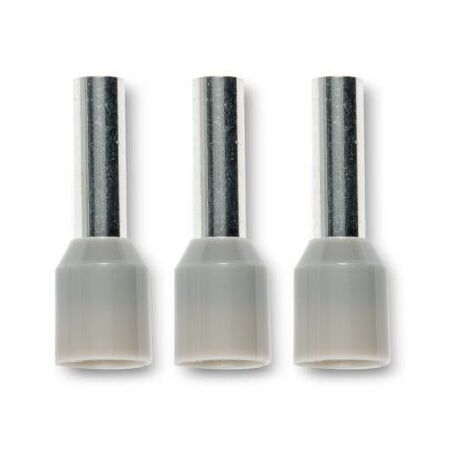
A bootlace ferrule does one job: it consolidates stranded wire conductors into a solid pin that seats cleanly and consistently inside a screw terminal or push-in clamp. When the size is right, the pin fills the terminal bore, the screw or spring clamp grips it properly, and the connection holds under vibration and thermal cycling. When it's wrong, problems follow quickly.
Too small, and the ferrule rattles in the terminal — the clamping force distributes unevenly across the pin, which can loosen over time or create a high-resistance contact point. Too large, and the ferrule won't seat fully, leaving the insulation collar partially inside the terminal bore where it can interfere with clamping. Neither scenario is acceptable in a switchboard or control panel where connections need to stay reliable.
The size of a bootlace ferrule is defined by two measurements: the cross-sectional area it's rated for (in mm²), which matches the wire's conductor cross-section, and the pin length (in mm), which needs to be compatible with the terminal block's clamping depth. Most standard DIN rail terminal blocks are designed around common pin lengths — typically 6mm, 8mm, 12mm, or 18mm — so for most panel work, matching the cross-section is the primary decision and pin length follows from the terminal spec.
The colour coding system for insulated bootlace ferrules follows a widely adopted convention across European and Australian panel wiring practice — though it's worth noting this isn't universally mandated by a single Australian standard, so minor variations exist between manufacturers. The table below reflects the most common convention you'll encounter across the products stocked at Schnap:
| Wire Cross-Section (mm²) | Insulated Ferrule Colour | Common Pin Lengths | Typical Application |
|---|---|---|---|
| 0.5 mm² | White | 6mm, 8mm | Control wiring, instrumentation |
| 0.75 mm² | Grey / Blue | 6mm, 8mm | Control circuits, light signalling |
| 1.0 mm² | Red | 6mm, 12mm | General panel wiring, lighting circuits |
| 1.5 mm² | Black | 8mm, 14mm | Power circuits, general wiring |
| 2.5 mm² | Grey | 8mm, 18mm | Sub-mains, power distribution |
| 4 mm² | Orange | 9mm, 18mm | Power circuits, motor feeds |
| 6 mm² | Green | 12mm, 18mm | Sub-mains, larger motor circuits |
| 10 mm² | Brown | 12mm, 18mm | Heavy power feeds, MCC panels |
| 16 mm² | Ivory / White | 18mm | Main distribution boards, large feeds |
[!] Colour coding varies by manufacturer. The table above reflects the most common convention, but some manufacturers use different colours for certain sizes — particularly in the 0.75mm² and 16mm² range. Always cross-check against the actual product spec before ordering for a job where colour identification matters for inspection or maintenance purposes.
Most panel and switchboard terminations use insulated bootlace ferrules — the plastic collar protects the wire entry point, helps with conductor identification via colour coding, and provides a clean appearance that inspectors and maintenance electricians appreciate. The collar also acts as a strain relief point where the wire enters the ferrule barrel, reducing the risk of the strands pulling back out if the wire is moved during or after installation.
Non-insulated ferrules are typically used where terminal blocks have very tight spacing or shallow entry depth that won't physically accommodate a collared ferrule, or in applications where the terminal design itself provides adequate conductor retention. They're less common in standard panel wiring but still useful for specific terminal types or retrofit situations where clearances are tight.
For a new panel build or any switchboard work where you have flexibility, insulated is generally the better default choice. The colour coding alone is worth it for any job that someone else might need to trace later — and in an inspection context, neat colour-coded terminations read as professional workmanship.
If you're routing two conductors into a single terminal position, a standard single ferrule won't work regardless of whether it's insulated or not — that's a job for a twin bootlace ferrule sizing guide, which covers the sizing logic for that scenario separately.
For electricians who don't do panel work regularly, committing to individual packs of every size upfront is overkill. A pre-insulated ferrule kit gives you a working selection across the most common cross-sections — typically 0.5mm² through to 2.5mm² or 4mm² — in a single purchase. It's a practical way to cover most residential and light commercial panel jobs without ordering six separate packs and ending up with 450 ferrules in sizes you rarely use.
If your work runs regularly to larger cables — 6mm², 10mm², or beyond — or if you're doing production panel builds where you'll burn through a single size quickly, individual packs in the specific sizes you need will be more economical than kits.
It's also worth considering whether your terminations call for a different connector type entirely. For panel connections where a wire is looping through rather than terminating dead-end, forked terminals handle that differently and are worth understanding alongside ferrules as part of your panel hardware toolkit.
Going by wire diameter instead of cross-sectional area. The mm² rating on a ferrule refers to the conductor cross-section, not the overall cable diameter or the conductor diameter. A 1.5mm² TPS active conductor and a 1.5mm² flexible control wire are both 1.5mm² conductors, but their overall diameters differ. Always match the ferrule to the conductor cross-section marked on the cable, not to a physical measurement.
Ignoring pin length relative to the terminal block. A ferrule with a 6mm pin seated in a terminal designed for a 12mm pin will sit shallow in the bore — the clamping mechanism may grip the collar rather than the barrel, which is not a reliable connection. Check your terminal block spec sheet for recommended pin length before ordering in volume.
Crimping a ferrule onto wire that's too large for the barrel. Forcing stranded wire into a ferrule one size down is a common site shortcut when the right size isn't to hand. The result is a barrel that won't close properly under crimp pressure, leaving a loose or deformed termination. Order the right size — it's not worth the callback.
Using a single ferrule where two conductors need to share a terminal. Putting two stripped wires into one standard ferrule barrel and crimping them together looks plausible but rarely results in consistent clamping on both conductors. One wire tends to sit offset, and the connection integrity is compromised. The right answer for dual-conductor termination is a twin ferrule — not a workaround with a single.
Assuming colour means size without checking. If you're pulling ferrules from a mixed kit or a job bag that's been used before, confirm the size marking on the ferrule itself rather than relying solely on colour — particularly for the 0.75mm² grey and 2.5mm² grey which share a colour in some product ranges.
What size bootlace ferrule do I need for 2.5mm² wire?
A 2.5mm² ferrule — typically grey in colour under the common convention — is the correct match for 2.5mm² conductor wire. For most DIN rail terminal blocks, an 8mm or 18mm pin length will be appropriate depending on the terminal's clamping depth. Check the terminal block datasheet if you're unsure which pin length to spec. You'll find the 2.5mm² grey ferrule in packs of 500 at Schnap.
Can I use a 1.5mm² ferrule on 1.0mm² wire to get a tighter fit in the terminal?
No — sizing up to get a snugger feel in the terminal doesn't work the way you might expect. The ferrule barrel needs to be filled by the conductor for the crimp to hold properly. A 1.5mm² barrel around a 1.0mm² conductor will leave voids inside the crimp, reducing mechanical strength and increasing resistance at the joint. Use the correct size for the wire.
Do I need a licence to install bootlace ferrules in a switchboard?
Yes. Terminating conductors inside a switchboard or distribution board is electrical work under Australian law and requires a licensed electrician in all states and territories. The ferrule itself is a component — the act of making the connection inside a live or to-be-energised switchboard is the licensable work. DIY switchboard termination is not permitted regardless of how simple the connection looks.
Is there an Australian standard that specifies bootlace ferrule colour coding?
There is no single Australian standard that mandates a specific colour convention for bootlace ferrules. The colour coding widely used in Australia follows European convention (closely aligned with DIN 46228), but this is a de facto industry practice rather than a hard AS/NZS requirement. Individual job specs or client standards may specify a particular colour convention — check the project spec before ordering if colour coding consistency matters for the installation.
I'm doing a panel build and not sure which sizes I'll need — is a ferrule kit worth it?
For a one-off or occasional panel job, yes — a pre-insulated kit covering 0.5mm² to 2.5mm² or 4mm² gives you the most-used sizes without committing to bulk packs of each. The 535-piece pre-insulated kit is a practical option for this. If you're doing production panel builds where you know exactly what wire sizes you'll run, individual packs in the sizes you burn through most will be better value.
What's the difference between pin length options for the same cross-section?
Pin length affects how deep the ferrule seats inside the terminal bore. Shorter pins (6mm or 8mm) suit compact or shallow terminal blocks — common in control panels with space constraints. Longer pins (12mm, 18mm, or more) are used in terminals designed for deeper clamping, or in applications where the extra depth provides better pull-out resistance. Match the pin length to your terminal block specification — mixing lengths across a panel that uses one terminal type creates inconsistency in termination quality.
Schnap carries a full range of bootlace ferrules across all common wire sizes, with trade pricing and same-day dispatch from Kingsgrove NSW.
Pre-Insulated Ferrule Kits
170-Piece Pre-Insulated Ferrule Kit — compact starter kit for occasional panel work
535-Piece Pre-Insulated Ferrule Kit — solid range coverage for most residential and light commercial jobs
689-Piece Pre-Insulated Ferrule Kit — extended range including larger cross-sections for heavier panel builds
Insulated Ferrules — Individual Sizes
0.5mm² White Ferrule — Pack of 500 — control wiring and instrumentation
1.0mm² Red Ferrule — Pack of 500 — general panel wiring and lighting circuits
1.5mm² Black Ferrule — Pack of 500 — power circuits and general switchboard wiring
2.5mm² Grey Ferrule — Pack of 500 — sub-mains and power distribution
4mm² Orange Ferrule — Pack of 100 — motor feeds and power circuits
6mm² Green Ferrule — Pack of 50 — sub-mains and larger motor circuits
10mm² Brown Ferrule — Pack of 50 — heavy power feeds and MCC panels
16mm² Ivory Ferrule — Pack of 40 — main distribution boards and large feeds
Non-Insulated Ferrules
1.5mm² Non-Insulated Ferrule — Pack of 100 — for tight-clearance terminals
2.5mm² Non-Insulated Ferrule — Pack of 100
4mm² Non-Insulated Ferrule — Pack of 100
6mm² Non-Insulated Ferrule — Pack of 100
Two conductors, one terminal position — it sounds straightforward until you're staring at a terminal block that won't accept a double-up without the right ferrule. Twin bootlace ferrules are built specifically for this situation, and getting the size selection wrong means either a loose termination or a ferrule that physically won't seat. Understanding how twin ferrule sizing works alongside bootlace ferrule sizes for single conductors gives you the full picture for any panel wiring job.
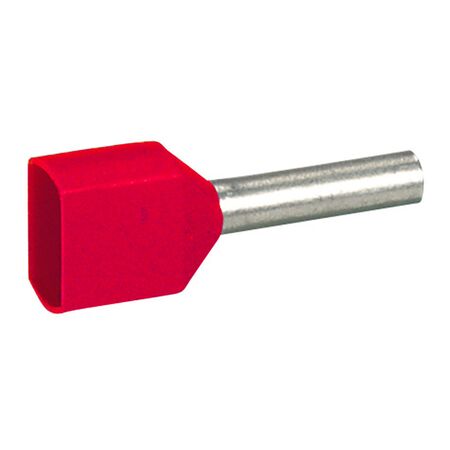
A twin bootlace ferrule — sometimes called a twin entry ferrule or dual conductor ferrule — has two separate conductor barrels joined at a single insulated collar. Both conductors insert side by side, get crimped simultaneously, and exit into the terminal block as a single terminated end. The terminal block sees one entry, not two.
The practical use case comes up constantly in panel building: common neutrals, shared circuit returns, or any configuration where two wires need to land on the same terminal position without stacking them loosely under a single screw. In a properly built switchboard, bare conductors doubled up under a screw clamp — without a ferrule rated for that configuration — are a termination that won't pass inspection.
Twin ferrules are also the correct answer in PLC and automation panels where terminal block density is high and conductor management matters. A neat twin ferrule termination keeps the wiring organised and makes future tracing significantly easier compared to two independently terminated singles sharing the same slot.
[!] Compliance Note
AS/NZS 3000 (the Wiring Rules) requires that terminal connections be mechanically secure and that conductors are properly restrained at their termination point. Doubling bare conductors under a screw clamp without a ferrule designed for that configuration typically does not meet this requirement. If your terminal block manufacturer's documentation specifies ferrule use for multi-conductor entry, that documentation becomes part of the compliance chain.
The question comes up at the bench regularly: can you just use two single ferrules side by side in the same terminal entry? The short answer is that it depends entirely on the terminal block design.
Some terminal blocks — particularly push-in or cage-clamp types — have a single conductor entry point by design. Trying to fit two single ferrules into one entry physically won't work, or results in a termination where only one is properly gripped. A twin ferrule solves this by presenting the two conductors as a single unit sized to fit that entry point correctly.
Where the terminal block has a genuine dual-entry design (two separate conductor entry holes on the same terminal position), two individual single ferrules is the correct approach — each conductor gets its own crimped sleeve, and each enters its own entry. Using a twin ferrule in a dual-entry terminal forces both conductors through a single hole on a block designed to handle them separately, which is the wrong application.
The distinction matters more than it looks on first inspection. Check the terminal block datasheet or manufacturer markings before reaching for twin ferrules. In panel builds where forked terminals are already in the toolkit for multi-position bridging, twin ferrules handle the conductor-entry side of the same problem — they're complementary tools, not interchangeable ones.
Twin ferrule sizing follows a different logic to single ferrules, and this is where most mistakes happen. The size printed on a twin ferrule — say, 1mm² — refers to the cross-section of each individual conductor barrel, not the combined total.
So a twin 1mm² ferrule accepts two conductors of 1mm² each. It does not accept one 2mm² conductor, and it does not accept two 0.5mm² conductors doubled up as a workaround for a 1mm² ferrule you don't have. Each barrel is sized for one conductor of that rating, full stop.
The practical implication: you need to know the cross-section of each conductor going into the twin ferrule, and match to a ferrule rated for that conductor size — not the combined load. A common scenario in panel work is routing two 1.5mm² conductors to a shared neutral position on a terminal block. The correct product is a twin 1.5mm² ferrule — not a single 3mm² ferrule, not two individual 1.5mm² singles jammed together.
| Twin Ferrule Size | Each Conductor | Typical Insulation Colour | Common Panel Use |
|---|---|---|---|
| Twin 0.5mm² | 0.5mm² each | White | Control wiring, PLC I/O |
| Twin 0.75mm² | 0.75mm² each | Blue or Grey | Light control circuits, instrumentation |
| Twin 1mm² | 1mm² each | Red | Common neutral bars, shared returns |
| Twin 1.5mm² | 1.5mm² each | Black | General purpose dual-conductor termination, TPS neutral runs |
| Twin 2.5mm² | 2.5mm² each | Grey or Blue | Power circuits, heavier neutral consolidation |
Where twin ferrule sizing intersects with TPS cable work — for example, consolidating two neutral conductors from separate TPS building wire runs at a terminal block — the 1.5mm² twin ferrule is typically the right product for standard residential and light commercial circuits, since 1.5mm² is the common conductor cross-section in that cable.
What happens when the two conductors going into one terminal position aren't the same size? This comes up more often than you'd expect — a control circuit might bring a 0.75mm² signal wire together with a 1mm² return at the same terminal point.
In practice, most twin ferrule manufacturers specify that both conductors entering a twin ferrule should be the same cross-section. The crimp is designed around consistent barrel fill — when one conductor is significantly thinner than the other, the crimp geometry doesn't grip both equally, and you end up with a termination where one conductor can pull through under mechanical stress.
The correct approach for mismatched conductors going to the same terminal position is typically to bring them in on adjacent terminal blocks with a bridge connector, rather than forcing them into a twin ferrule that isn't rated for the combination. This is worth discussing with your terminal block supplier if you're specifying a panel build from scratch — the terminal block selection can simplify or complicate the ferrule choices significantly.
Sizing to the combined cross-section instead of per-conductor. A twin 2.5mm² ferrule is not the answer for two 1.25mm² conductors. Each barrel is rated for one conductor of the stated size. Getting this wrong means under-crimped barrels — the conductors may feel secure at first but won't hold under vibration or repeated maintenance cycles.
Using a single ferrule with two conductors stuffed in. It's a shortcut that gets attempted when twin ferrules aren't on the van. A single ferrule barrel filled with two conductors won't crimp consistently — the die geometry is wrong for that fill profile and one conductor typically sits off-centre. The result is a termination that passes visual inspection but fails under pull-test.
Applying twin ferrules to dual-entry terminal blocks. As covered above, some terminal blocks are designed with separate entries for two conductors. Installing a twin ferrule on these blocks routes both conductors through one entry on a block that expects them in separate entries — you lose the mechanical advantage the block was designed to provide.
Using mismatched crimp tooling. Twin ferrules require a crimp tool die that can handle the wider ferrule body. A single-ferrule die profile will often produce an asymmetric crimp on a twin ferrule — one barrel gets proper compression, the other gets caught at the edge of the die and under-crimped. If your existing crimper doesn't have a twin ferrule die option, it's worth checking the tool manufacturer's compatibility list before burning through a pack of ferrules with inconsistent results.
Ignoring colour coding between brands. Twin ferrule colour coding isn't universal — a red ferrule from one manufacturer might indicate 1mm², while another uses red for 1.5mm². When mixing brands on the same panel build, verify the size from the product specification rather than relying on colour alone. This is particularly relevant if you're restocking mid-job with a different brand than what you started with.
Can I use a twin 1.5mm² ferrule for two 1mm² conductors to get a tighter fit?
No — and it's a common workaround that creates the opposite problem. Undersized conductors in an oversized ferrule barrel leave gaps in the crimp, which means neither conductor is properly retained. Match the ferrule size to the actual conductor cross-section, not to a size you happen to have in stock. Check the product specification for the correct size before ordering.
What's the difference between twin 1mm² and twin 1.5mm² in panel work — when does it matter?
The 1mm² twin is typically used in control and instrumentation circuits where the conductor cross-section is 1mm². The 1.5mm² twin is more common in power circuit terminations — shared neutrals, lighting circuits, and general wiring where 1.5mm² is the conductor size. The choice is determined by the conductor, not by the terminal block or the current load at that point.
Do I need a licence to terminate wires using bootlace ferrules in an electrical panel in Australia?
Yes. Termination work inside an electrical switchboard or distribution board is electrical work under Australian state and territory legislation — it requires a licensed electrician or someone working under direct supervision of a licensed electrician. The ferrule itself is a fitting, not a regulated product, but the act of connecting conductors to terminal blocks in a panel is licensed work regardless of the termination method used.
Is there an Australian standard that specifies when twin ferrules are required versus single ferrules?
AS/NZS 3000 sets the overarching requirement for mechanically secure terminations, but it doesn't mandate ferrule type at a product level. The specific requirement for twin ferrules typically comes from the terminal block manufacturer's installation documentation — if the block is rated for single-entry only, that documentation effectively mandates a twin ferrule for dual-conductor termination. Always check the terminal block datasheet alongside the Wiring Rules.
Legrand vs Clipsal vs Eltech twin ferrules — are they interchangeable for the same size?
Dimensionally, twin ferrules of the same cross-section from different manufacturers are generally interchangeable for crimping purposes — the barrel dimensions follow the conductor cross-section, so a 1mm² twin from any brand should crimp correctly with the same die. The practical difference is pack size, collar length (which affects how deep the ferrule seats), and colour coding convention. As noted above, don't rely on colour alone to confirm size when switching brands.
How many twin ferrules should I stock for a typical panel build?
It depends on the terminal block count and wiring density, but for a typical commercial switchboard build, packs of 500 in the most common sizes (1mm² and 1.5mm²) are generally the efficient stock unit — enough to cover a full job without over-ordering. Smaller 100-pack options work for van stock where you need range coverage across sizes without committing to bulk quantities of each.
Related Reading
Schnap stocks twin bootlace ferrules across the most common sizes from Legrand, Clipsal, Eltech, and Wattmaster — trade pricing with same-day dispatch from Kingsgrove NSW.
Grab the wrong forked terminal at the wholesaler and you'll know about it at the panel — either the barrel won't crimp down on the wire, or the fork won't clear the stud. The red-blue-yellow colour system looks simple until you're staring at a product list with M3, M4, M5, and M6 options across three wire size ranges, two grip types, and both insulated and non-insulated versions. This article walks through how to match the right forked terminal to your wire, your stud, and your job.
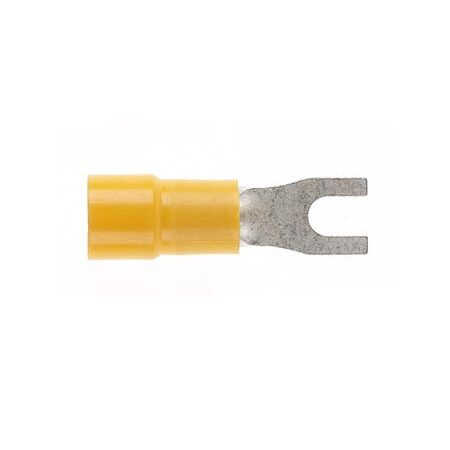
A forked — or spade — terminal is a crimp connector with an open-ended fork at the tip that slides over a threaded stud or screw without needing to remove the nut completely. That open slot is the difference between a ring terminal and a forked terminal: rings need the fastener fully out, forks just need it loosened. In practice, this makes forked terminals the go-to for terminals blocks, DIN rail-mounted equipment, switchboard busbars, and anywhere you expect to disconnect and reconnect under service conditions.
They're found across residential, commercial, and light industrial work — anywhere a TPS building wire lands on a terminal block or equipment stud. The termination is simple, but getting the spec right matters: an undersized barrel cracks under crimp pressure, an oversized fork rattles on the stud and creates a poor contact.
The insulation colour on a forked terminal tells you the wire size range the barrel is designed for. This system is consistent across most manufacturers, so once you know it you can order confidently from any supplier:
| Colour | Wire Size Range | Typical Application |
|---|---|---|
| Red | 0.5–1.6mm² | Control wiring, light signal circuits, 1mm² TPS |
| Blue | 1.0–2.6mm² | General power wiring, 1.5mm² and 2.5mm² TPS |
| Yellow | 2.5–6.0mm² | Sub-mains, 4mm² and 6mm² circuits |
| Black | 10mm² | Heavier sub-mains, motor connections |
Note that wire size ranges overlap between colours — a 1.5mm² conductor sits in both red and blue range depending on the exact product specification. In practice, blue is the standard choice for 1.5mm² in most commercial and residential work. Always check the mm² range stamped or printed on the terminal packaging, not just the colour.
[!] Important: Colour coding is for the wire barrel — it has nothing to do with the stud size or fork width. A red terminal can come in M3, M4, M5, or M6 fork sizes. Colour tells you the wire; the stud size is a separate spec you need to match to your equipment.
Related Reading
The stud size — M3, M4, M5, or M6 — refers to the metric thread diameter of the screw or bolt the terminal fork slides onto. This is determined by your equipment, not your wire. A terminal block might use M3 screws; a busbar connection might need M5 or M6. The fork slot must be wide enough to clear the stud but not so wide that the fork is loose on a smaller fastener.
In switchboard work, M4 is the most common stud size for terminal blocks and DIN rail equipment. M5 appears frequently on busbar connections and heavier equipment terminals. If you're not sure what size the equipment uses, measure the screw shank diameter — M4 is 4mm, M5 is 5mm across the thread.
Most forked terminals you'll handle are insulated — the barrel has a plastic sleeve that protects the crimped wire end and gives the colour coding you need to identify wire size at a glance. The insulation also provides a degree of protection against incidental contact on live terminals during commissioning, though it doesn't make the fork itself safe to touch when live.
Non-insulated forked terminals are used where the insulated sleeve would create a clearance issue — typically in compact equipment where there isn't enough room around the stud for the sleeve to clear adjacent components, or where the termination is fully enclosed within rated equipment. They're less common in general electrical work but are used in control panel builds and some industrial applications.
Standard forked terminals crimp the conductor only — the barrel grips the stripped wire, and that's it. For most fixed wiring applications where the termination isn't subject to vibration or repeated movement, that's sufficient.
Double grip terminals add a second crimp zone that grips the wire insulation behind the conductor crimp. This strain relief matters when the cable has any movement or tension — equipment panels where cables are bundled and pulled, or anywhere the termination might see mechanical load during service or maintenance. The DG suffix in product codes typically indicates double grip.
Supergrip is a variant grip construction that typically provides additional mechanical retention through a different barrel geometry — check the specific product for details, as construction varies between manufacturers. These are generally used in applications where pull-out resistance is a specific requirement.
[!] Note: For panel wiring where cables are dressed and tied back with minimal tension on individual terminations, standard grip is typically fine. Reach for double grip when cables are heavier, when the panel door opens and closes repeatedly pulling on cable bundles, or when the job spec calls for it.
Twin forked terminals carry two wire barrels side by side on a single fork — the purpose is to land two conductors on the one stud without needing a separate dual-wire ferrule or piggyback arrangement. They're used in control panel work where two circuits need to share a common earth stud, or where equipment design calls for dual feed to one connection point. The fork size and wire size ranges follow the same colour code system as single terminals.
Picking the colour without checking the mm² range. Colour is a guide, not a guarantee. Two different manufacturers' red terminals can have slightly different barrel bore sizes within the 0.5–1.6mm² range. Check the exact wire size printed on the product — especially if you're mixing brands on the same job.
Assuming stud size from the terminal colour. Colour codes the wire, not the fork. Ordering a bag of blue M4 terminals and finding the equipment has M5 studs is a common one — especially on imported equipment where stud sizes don't always match what you'd expect from the circuit size.
Using standard grip on moving cables. In a static panel with well-dressed cable, standard grip works fine. On a hinged door with a cable loom flexing every time it opens, pulling on individual terminations over time — that's where a conductor-only crimp can work loose. It's the kind of fault that shows up six months later, not on commissioning day.
Ordering by colour only for a bulk job. If you're pulling 100 terminals for a board build, order by the full spec — colour, wire range, stud size, grip type, and pack size. Colour alone won't get you the right product when there are four stud sizes and three grip constructions available in each colour.
Crimping over the insulation sleeve. The barrel of an insulated terminal is designed to be crimped on the conductor section only. Running the crimp die over the plastic sleeve instead of or alongside the metal barrel doesn't create a secure connection — the sleeve compresses and springs back, leaving an unreliable contact. Strip to the right length so the conductor fills the barrel with minimal sleeve intrusion.
Can I use a blue terminal on a 2.5mm² wire?
It depends on the specific product — some blue terminals are rated to 2.5mm² and some stop at 2.0mm² or 2.6mm². Check the wire size range on the product label or data sheet, not just the colour. For 2.5mm² TPS circuits, a yellow terminal rated from 2.5mm² upward is often the safer and more common choice. See the yellow M4 forked terminal as a starting point.
What's the difference between a forked terminal and a ring terminal?
A ring terminal fully encircles the stud — the fastener must be removed to install or remove the ring. A forked terminal has an open slot, so you only need to loosen the nut to slide the fork in or out. Forked terminals are faster to disconnect under service conditions; ring terminals are more secure where vibration is a concern and the connection is permanent or semi-permanent.
Do I need a licence to terminate wiring with forked terminals in a switchboard?
Yes. Switchboard wiring and termination work in Australia must be carried out by a licensed electrician. This applies regardless of the type of terminal used — forked, ring, or ferrule. Low-voltage control wiring within rated equipment may have different rules depending on the state and the specific application, but for any work connected to the mains electrical system, a licence is required.
Is there an Australian standard that specifies which terminal type to use?
AS/NZS 3000 (the Wiring Rules) sets the general requirements for electrical installations including termination quality and conductor securing, but it typically doesn't prescribe a specific terminal type for most applications — that's generally left to good workmanship and the equipment manufacturer's requirements. Where a specific terminal type is required, it will usually be called out in the equipment's installation instructions or a project specification.
Can I use the same crimp tool for insulated and non-insulated forked terminals?
Not always. Insulated terminals typically require a ratchet crimp tool with colour-coded dies (red, blue, yellow) that match the insulated barrel. Non-insulated terminals need an open barrel or hexagonal die. Using an insulated-terminal tool on a non-insulated terminal usually produces an uneven or incomplete crimp. Check your tool's die specifications before swapping between terminal types on the same job.
Do I need to use double grip terminals on a switchboard door with a cable loom?
It's good practice, and some panel builders specify it as standard. The cable loom on a hinged door flexes at every opening — over time, that repeated movement puts tension on individual terminations. Double grip terminals add insulation strain relief that resists pull-out from that kind of cyclic load. Whether it's a hard requirement depends on the panel specification — but it's rarely a wasted upgrade in a door loom application.
Trade pricing and same-day dispatch from Kingsgrove NSW. Stock covers red, blue, yellow, and black in standard, double grip, and supergrip constructions — M3 through M6 stud sizes, insulated and non-insulated options.
Red — 0.5–1.6mm²
Forked Spade Terminal 0.5–1.6mm² M4 Red — standard insulated, M4 stud
Forked Spade Terminal 0.5–1.6mm² M4 Red Double Grip — insulation strain relief, M4 stud
Blue — 1.0–2.6mm²
Forked Spade Terminal 1.5–2.5mm² M4 Blue Double Grip — standard choice for 1.5mm² and 2.5mm² TPS on M4 studs
Forked Spade Terminal 1.5–2.5mm² M5 Blue Double Grip — M5 stud, double grip
Forked Spade Terminal Insulated 1.0–2.6mm² M4 Blue — standard insulated, M4
Forked Spade Terminal Insulated 1.0–2.6mm² M5 Blue — standard insulated, M5
Forked Spade Terminal M4 Blue Pack of 100 (Repelec) — bulk pack option
Yellow — 2.5–6.0mm²
Forked Spade Terminal 2.5–6.0mm² M5 Yellow — standard insulated, M5 stud
Forked Spade Terminal 2.5–6.0mm² M5 Yellow Double Grip — strain relief, M5 stud
Forked Spade Terminal M4 Yellow Pack of 50 (Repelec) — bulk pack option
Black — 10mm²
Forked Spade Terminal 10mm² M5 Black — heavier sub-mains and motor connections
Non-Insulated
Forked Spade Terminal Non-Insulated 2.5–6.0mm² M5 — compact equipment and control panel applications
Twin Forked Terminals
Twin Forked Spade Terminal 1.5–2.5mm² M4 Blue — dual conductor on one stud
Twin Forked Spade Terminal 4–6mm² M4 Yellow — dual conductor, heavier gauge
Registered cablers and sparkies working on NBN installations in Australia are dealing with two very different conduit requirements on the same job: the underground lead-in run from the street boundary to the building, and the internal run from where the cable enters the property to the Network Termination Device (NTD). Each has its own colour, material spec, fitting system, and compliance requirement — and mixing them up creates problems at inspection that aren’t always quick to fix.
This guide covers both runs in practical terms: which conduit goes where, how deep the trench needs to be, what fittings are needed, and where materials like nylon corrugated conduit and liquid-tight PVC fit into the NBN picture. Product links throughout go to the live Schnap catalogue, stocked for same-day dispatch from Kingsgrove NSW.
If you’re also working on the electrical side of the same job, see our Conduit Fittings guide for the full range of couplings, bends, saddles, and inspection access fittings for orange electrical conduit runs.
Every NBN installation that involves conduit work has two distinct sections with different requirements.
Run 1: The lead-in. This is the underground conduit from the street pit or property boundary to where the cable enters the building. On most residential jobs it’s 20mm or 32mm, runs underground for anywhere from a few metres to 30+ metres depending on the property, and must be orange — the same high-visibility orange used for underground electrical conduit — so it’s identifiable during any future excavation. nbn Co’s own Lead-in Trenching Requirements document specifies the orange conduit must meet AS/NZS 2053.2 and be installed at a minimum depth of 300mm in most residential applications, increasing to 600mm where vehicle crossover is involved.
Run 2: The internal run. From the building entry point to the NTD location — through wall cavities, ceiling spaces, or surface-mounted in a garage or utility room. This run uses white or grey PVC conduit, identified as telecommunications conduit under AS/NZS 3000 Clause 3.9.8.3 (Segregation of Systems). White is the traditional telco standard; grey is often used when the run passes through areas shared with electrical conduit and needs to blend with existing conduit systems.
⚠ Segregation requirement: Under ACMA Standard CA S009 and AS/NZS 3000, a minimum 50mm physical separation must be maintained between telecommunications conduit and low-voltage power conduit where they run in parallel. Where they cross, they must cross at 90 degrees. Sharing the same conduit run with mains power cabling is not permitted. For a guide to the TPS building wire most commonly found in the power conduit runs running alongside NBN, see our TPS Building Wire guide.
The underground lead-in is the section most cablers are asking about when they search for "NBN conduit Australia" — because it’s the section with the most compliance checkpoints and the most variables depending on the property.
nbn Co approves specific conduit for lead-in use. The key requirements from nbn Co’s Lead-in Trenching Requirements document:
Trenching depth requirements (nbn Co Lead-in Trenching Requirements):
| Location | Minimum Depth |
|---|---|
| Garden / lawn areas, pedestrian paths | 300mm |
| Vehicle crossover / driveway | 600mm (or concrete encased at 300mm) |
| Under structures (slabs, pavers) | As deep as possible; duct under structure where feasible |
Once the NBN cable is inside the building, the conduit requirement changes. The internal run — from the building entry point to the NTD — uses telecommunications-rated PVC conduit, not the orange heavy-duty conduit from outside.
Standard 20mm or 25mm PVC conduit in white or grey covers most residential internal runs. Plain-to-screwed adaptors are the fitting you reach for most on these runs — they join plain-socket conduit to screwed-thread fittings and to junction boxes, which is the most common transition point in a residential NBN install. Schnap stocks plain-to-screwed adaptors in 20mm through 50mm from both Eltech and Pulset.
Sweep bends, not tight elbows. This is the most commonly overlooked compliance point on internal NBN runs. AS/CA S009 (ACMA’s Cabling Provider Rules) requires that any change of direction in a conduit carrying NBN fibre or high-speed data cable must use a sweep bend with an adequate radius — not a standard 90° elbow. The tight radius of a standard electrical elbow can kink or exceed the minimum bend radius of the fibre or Cat6A cable inside, causing signal degradation or physical damage. A 20mm PVC straight tee or sweep bend from Schnap’s range is the correct fitting here.
Corrugated nylon conduit — specifically PA6 (polyamide 6) — is not a direct substitute for rigid PVC on NBN lead-in or internal runs, but it has a specific and useful role on NBN installations that often gets overlooked.
Nylon PA6 corrugated conduit is UV-resistant, halogen-free, and rodent-resistant — making it the correct choice for the short entry section where the lead-in cable passes through the wall cavity or under the eave and into the building. This transition zone often involves an irregular surface, a tight radius around a corner, or a short run inside a roof cavity where rigid PVC is impractical to install neatly. The flexibility of nylon corrugated conduit handles this transition without sharp kinks.
Two PA6 formats are available from Schnap:
| Format | Typical Use | Available Sizes |
|---|---|---|
| Fine pitch (smooth inner wall) | Data and comms cable, NBN fibre — smooth bore reduces friction during pull | NC10 through NC34 |
| Coarse pitch (standard corrugated) | General cable protection, short entry runs, roof cavity transitions | NC42, NC54 |
The fine pitch (smooth inner bore) variant is the one to specify where fibre or Cat6A is being pulled through — the smooth internal surface significantly reduces friction compared to standard corrugated conduit, which matters on longer flexible sections where pull tension could otherwise damage the cable jacket.
Standard NBN conduit runs in residential installs rarely need liquid-tight conduit — but on commercial or industrial NBN installations, or where the internal run passes through wet areas (plant rooms, external walls with water exposure, carpark risers), liquid-tight PVC conduit is the appropriate choice.
Liquid-tight PVC conduit (Cabac CNM series) provides IP-rated sealing along the full length of the conduit run, not just at fittings. Available in black, grey, and orange, in sizes 16mm through 40mm. The grey and black variants are suitable for telecommunications cable runs in damp environments; the orange is for electrical cable runs in the same conditions.
The Cabac Xtraflex series provides an alternative for applications needing a higher degree of flexibility — useful for conduit entry from an external wall into equipment in a plant room, where the conduit needs to navigate tight corners or equipment vibration. Available in 16mm and 32mm, 30m reels, with high UV resistance for above-ground outdoor sections.
The fittings needed on an NBN job split cleanly by run type.
| Fitting Type | Lead-In (Orange, Underground) | Internal (White/Grey) |
|---|---|---|
| Bends | Sweep bends only (45° or 90°) — tight elbows not permitted | Sweep bends — same rule applies for fibre/Cat6A |
| Couplings | PVC heavy-duty orange couplings — plain or plain-to-screwed | Medium-duty PVC grey couplings |
| Adaptors | Plain-to-screwed at building entry point | Plain-to-screwed at junction boxes and NTD enclosure |
| Tees | Not common on lead-in (single run) | Straight tee (20mm or 25mm) for multi-outlet internal runs |
| End caps | Orange end cap at street pit end until cable pull | Grey or white cap at spare conduit terminations |
Q: What size conduit do I need for an NBN lead-in?
20mm nominal bore is the minimum for a standard residential NBN lead-in. 32mm is commonly specified where future capacity is needed or where the run is longer than 30 metres. 50mm is used for multi-dwelling units or commercial properties. Always confirm with the nbn Co Lead-in Trenching Requirements document for the specific installation type.
Q: How deep does the NBN conduit need to be buried?
Minimum 300mm in garden and lawn areas, 600mm under vehicle driveways or crossovers. Where crossing under a driveway at less than 600mm, the conduit must be concrete-encased. These are nbn Co minimum specifications — some state or local authority requirements may be higher.
Q: Does the draw cord need to stay in the conduit after the cable is pulled?
Yes. nbn Co requires the draw cord to remain in the conduit after the cable pull is complete. This allows for future cable replacement without excavation. A 1m tail at each end must be coiled and left accessible.
Q: Can I use grey electrical conduit for the internal NBN run?
Grey PVC conduit can be used for internal telecommunications runs in areas where it needs to blend with existing electrical conduit systems, but it must be clearly identified as a telecommunications conduit (not carrying mains power) and must maintain the required separation from any power conduit. White is the more common and clearly identifiable choice for dedicated NBN runs.
Q: What’s the difference between nylon PA6 fine pitch and coarse pitch conduit?
Fine pitch (smooth inner bore) has a smoother internal surface that reduces pull friction — important for fibre optic or Cat6A cable where excessive pull tension can damage the cable. Coarse pitch is standard corrugated conduit, better for general cable protection where pull friction is less of a concern. For NBN cable transitions, fine pitch is the recommended choice.
Q: Can I use liquid-tight conduit for an NBN lead-in underground run?
Liquid-tight PVC conduit can be used for specific sections of an NBN installation where water ingress is a risk — plant rooms, external wall entries, or partially exposed runs in wet environments. For the main underground lead-in, rigid orange PVC conduit to AS/NZS 2053.2 is the standard requirement. Always verify the approved conduit list with nbn Co for the specific installation type.
Q: Do I need a licence to install NBN conduit?
Yes. Fixed telecommunications cabling work in Australia must be carried out by a registered cabler licensed under ACMA. Electricians may carry out conduit installation work associated with an NBN installation, but the cabling itself requires a registered cabler. This guide covers product selection, not a substitute for compliant installation by a licensed professional.
Q: Who is responsible for the NBN conduit — nbn Co or the property owner?
The underground lead-in conduit from the property boundary to the building is typically the property owner’s responsibility to install before nbn Co pulls the cable. nbn Co installs the cable; the property owner (via a registered cabler) is responsible for the conduit pathway. Always confirm this with nbn Co at the time of installation booking.
Schnap stocks the full range of conduit and fittings for both NBN lead-in and internal runs, with trade pricing and same-day dispatch from Kingsgrove NSW.
Lead-in (orange, underground):
Internal run fittings:
Nylon PA6 conduit — entry transitions and roof cavity runs:
Liquid-tight PVC conduit — wet areas and commercial environments:
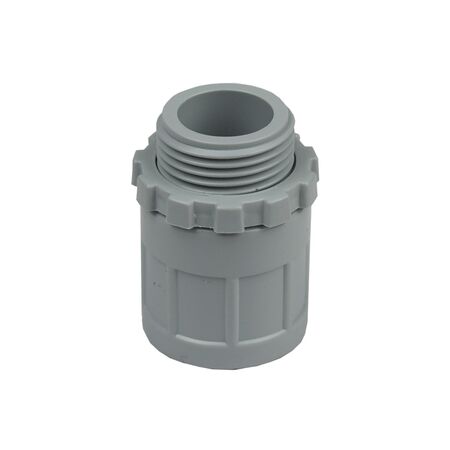
Every conduit run needs something to keep it together at the corners, lock it into the wall, cap it off at the end, and let a tradie back in when a cable needs pulling. That's what conduit fittings do. They're not the headline product on any job sheet, but get them wrong — wrong material for the environment, wrong IP rating for outdoors, wrong size coupling that won't seal — and you're pulling the run apart before the job's even done.
This guide covers the main types of conduit fittings used on Australian jobs, what each one is actually for, and which material to reach for depending on the environment. Product links throughout go to the live Schnap catalogue — everything listed is in stock and available for same-day dispatch from Kingsgrove NSW.
Not sure which conduit to pair your fittings with? See our guides on electrical conduit types, flexible conduit, and corrugated conduit first.
Before anything else, the material of the fitting has to match the environment and the conduit it's going onto. Using the wrong material is the fastest way to end up with corrosion at terminations, failed IP ratings, or a fitting that won't grip the conduit properly.
| Material | Best For | Watch Out For |
|---|---|---|
| PVC (grey or orange) | Standard indoor and outdoor surface wiring, residential and commercial | UV-resistant rating required for exposed outdoor use (check for UV stabilised label) |
| Hot-dip galvanised (HDG) steel | Heavy industrial, exposed outdoor, underground, mechanical risk environments | Not for coastal or high-chloride environments — use 316SS instead |
| 316 Stainless steel | Marine, coastal, food processing, washdown environments | Higher cost — specify only where the environment genuinely demands it |
| Nickel-plated brass | Flexible conduit terminations, industrial threaded fittings, IP-rated glands | Match thread standard to conduit (metric M-series vs imperial BSP) |
| Nylon / polyamide | Flexible corrugated conduit fittings, lighter-duty industrial, chemical resistance | Temperature rating — check spec sheet for sustained heat applications |
A coupling joins two lengths of conduit end-to-end. A solid coupling is sealed — once the conduit is through, there's no access. That's fine for straight runs where you're just extending length. A reducer joins conduit of two different sizes, useful when a run changes diameter at a junction or enclosure entry.
PVC couplings come in plain-to-plain, plain-to-screw, and screw-to-screw variants — match the coupling type to the conduit ends you're joining. The most common mistake is using a plain coupling on a screw-thread conduit end: it'll sit on without gripping properly and won't seal.
A bend changes the direction of a conduit run. The important distinction is between a solid bend and a sweep bend. A solid bend is a tight 90-degree elbow — cable pulling through it is harder because the radius is short. A sweep bend has a much longer radius, which makes pulling cables through significantly easier and is the correct choice for anything with a lot of cable or long runs. For most runs carrying more than a couple of cables, sweep bends are the professional standard.
Available in PVC (grey and orange) and hot-dip galvanised steel for heavier environments. The orange sweep bends are the standard choice for orange circular cable runs outdoors.
Saddles and clips secure conduit to the surface it's running along — walls, ceilings, cable trays, or structural steel. The difference matters: a saddle wraps fully around the conduit and holds it tight against the surface; a clip grips from one side and is faster to install but less secure under vibration or mechanical load.
AS/NZS 3000 specifies maximum support spacing for conduit depending on size and orientation — this is the most commonly ignored requirement on surface-run conduit. A conduit fixed only at the ends and sagging in the middle is non-compliant, regardless of how good the fittings are.
⚠ Compliance note: Under AS/NZS 3000, conduit must be continuously supported to prevent sagging. For horizontal runs, typical maximum spacing is 1.2m for 20mm conduit and 1.5m for larger sizes. Check the standard for your specific install conditions.
These two fittings are the pair you use every time a conduit enters a junction box, enclosure, or switchboard. The locating flange holds the conduit at the correct depth at the entry point. The adaptor lock nut (also called a conduit entry adaptor) threads onto the conduit from the inside of the enclosure and locks the conduit securely in place so it can't pull out. Together they create a secure, sealed conduit entry.
An inspection fitting — whether it's an elbow, tee, or bend — has a removable cover or lid that gives access to the inside of the conduit run after installation. This is the critical difference from a solid fitting: a solid elbow is sealed once the conduit is connected; an inspection elbow can be opened to pull cables through, add a new cable, or clear a fault without dismantling the conduit run.
AS/NZS 3000 requires cable access points at appropriate intervals in a conduit run — this is what inspection fittings are for. On long runs or runs with multiple direction changes, placing an inspection tee or elbow at strategic points is both a compliance requirement and a time-saver for anyone who needs to work on the run later.
An end cap or end plug seals the open end of a conduit run — essential wherever a conduit terminates in an open location rather than entering an enclosure. Without a sealed end, moisture, insects, and dust can enter the conduit and travel the length of the run, compromising both the cable inside and any enclosures at the other end. On outdoor or industrial runs, this is a compliance and longevity issue, not optional.
Flexible conduit — whether corrugated nylon or liquid-tight metal — uses a different fitting system from rigid PVC. The fitting needs to grip the corrugation profile of the flexible conduit securely while providing a sealed entry into the enclosure or junction box it's terminating at. Most flexible conduit fittings are IP-rated and designed with a locking mechanism that can't be pulled off under cable tension.
Adaptaseal and Adaptalok (Cabac) are the two systems most commonly seen on Australian jobs. Adaptaseal uses a sealing ring for IP-rated terminations into enclosures. Adaptalok uses a locking collar that grips the conduit and the enclosure wall simultaneously. Both come in a range of conduit-to-metric-thread sizes.
316 grade stainless steel fittings are specified where the environment will corrode standard galvanised steel — coastal locations, marine installations, food processing areas, and anywhere subject to regular washdown or chemical exposure. The Tobin IP69 range of stainless fittings is the go-to in Australian industrial applications: IP69 is the highest rating available, covering both high-pressure washdown and total dust exclusion.
A junction box at a conduit fitting point provides a sealed enclosure where conduit runs meet, branch, or change direction. The deep junction box (as opposed to a shallow box) is specified where the number of cables or the size of cable requires more internal space for safe termination. Three-way and four-way entry configurations cover most situations — a three-way box handles a T-junction in a conduit run; a four-way handles a cross junction.
Where a conduit penetrates a fire-rated wall or floor, Australian building and electrical codes require the penetration to be sealed to maintain the fire rating. A conduit collar (or firecollar) is fitted around the conduit at the penetration point. In a fire, the intumescent material inside the collar expands rapidly, crushing the conduit and sealing the opening to block the passage of fire and smoke through the penetration.
⚠ Compliance note: Penetrations through fire-rated construction must maintain the FRL (Fire Resistance Level) of the wall or floor. This applies to conduit penetrations under both the NCC (National Construction Code) and AS/NZS 3000. Collars must be installed per the manufacturer's tested system — not just pushed onto the conduit.
Q: What's the difference between a solid coupling and an inspection fitting?
A solid coupling seals two conduit lengths together permanently — no access once installed. An inspection fitting has a removable cover or lid that lets you access the inside of the conduit without dismantling the run. Use inspection fittings wherever the run might need cable access later.
Q: What's the difference between a sweep bend and a standard 90-degree bend?
A sweep bend has a long radius, which makes pulling cable through easier and reduces the risk of cable damage at the bend. A standard 90-degree bend has a short, tight radius — cable pulling is harder and the bend can kink the cable if forced. For most circuit wiring, sweep bends are the professional standard.
Q: Do I need both a locating flange and a lock nut when entering an enclosure?
Yes, both. The locating flange sets the conduit at the correct depth and prevents it from going too far into the enclosure. The lock nut threads onto the conduit from inside the enclosure and clamps everything in position. Using only the lock nut leaves the depth uncontrolled; using only the flange doesn't secure the conduit against being pulled out.
Q: What IP rating do I need for outdoor conduit fittings?
For standard outdoor exposure (rain, UV, dust), IP55 or IP65 is typical. For washdown environments (food processing, car wash areas), IP66 or IP67. For high-pressure jet washdown (abattoirs, industrial cleaning), IP69 is specified. The IP rating of the fitting must be equal to or higher than the IP requirement of the installation.
Q: When should I use 316 stainless steel fittings instead of galvanised?
316 stainless is specified where galvanised steel will corrode: coastal and marine environments within roughly 1km of saltwater, food processing and washdown areas, chemical environments, and anywhere with high humidity and corrosive atmospheres. For standard outdoor industrial use inland, hot-dip galvanised is generally sufficient and more cost-effective.
Q: What's the difference between Adaptaseal and Adaptalok fittings?
Both are Cabac systems for terminating flexible corrugated conduit. Adaptaseal uses a sealing ring that compresses around the conduit when the fitting is tightened, providing an IP-rated seal. Adaptalok uses a bayonet-style locking collar that locks the conduit in one action. Adaptaseal is the choice where IP-rated sealing is the priority; Adaptalok is faster to install where speed matters more than the highest possible seal rating.
Q: Does AS/NZS 3000 specify which fittings I have to use?
AS/NZS 3000 specifies performance requirements — IP rating, support spacing, access provision, fire penetration sealing — rather than listing specific products. AS/NZS 2053 covers the manufacturing requirements for conduit and fittings. Using fittings that comply with AS/NZS 2053 and are rated for the installation environment satisfies AS/NZS 3000 requirements.
Q: Do I need a licensed electrician to install conduit fittings?
In Australia, any conduit that contains or will contain energised electrical cable is part of a fixed electrical installation. Installation of fixed electrical wiring — including the conduit and fittings it runs through — must be carried out by a licensed electrician under AS/NZS 3000. This guide covers product selection, not a substitute for compliant installation.
Related Reading
Schnap stocks conduit fittings across the full range — PVC, galvanised steel, 316 stainless, brass, and nylon — covering everything from standard residential fittings to IP69 industrial systems. Same-day dispatch from Kingsgrove NSW.
Browse all Conduit Fittings at Schnap →
Related guides: What is Electrical Conduit? — Flexible Conduit Guide — Corrugated Conduit Guide — TPS Building Wire Guide
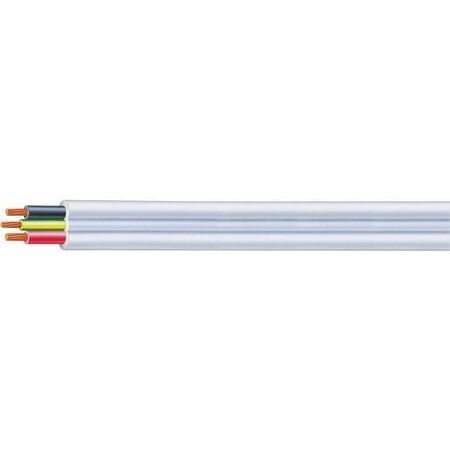
Ask ten apprentices what "TPS" stands for and you'll get a few blank looks. Thermoplastic-Sheathed cable — known on the tools as Twin and Earth, or T&E — is the flat fixed-wiring cable running through the walls and ceilings of almost every house in Australia. It's not glamorous. But get the size, rating, or colour wrong, and it's the difference between a job that sails through inspection and one that gets bounced back.
This guide covers what TPS actually is, how AS/NZS 3008 decides the right size, what the post-2000 colour codes mean on a renovation job, and where single-core building wire fits in as a different product for a different job entirely.
Already know the basics and just need stock? Schnap stocks TPS Twin & Earth cable and single-core building wire with same-day dispatch from Sydney.
TPS (Thermoplastic Sheathed) cable, manufactured to AS/NZS 5000.2, is a flat cable with two insulated conductors — active and neutral — plus an earth conductor, under a single PVC sheath. The flat profile is what makes it "TPS" rather than circular cable: it sits neatly against studs and joists and is the standard choice for fixed wiring inside wall cavities, ceiling spaces, and roof spaces.
It comes in two main insulation grades. V75 is the standard PVC rating for general indoor wiring with moderate temperature exposure. V90 (sometimes labelled V90HT) carries a higher temperature rating — better suited to ceiling cavities and roof spaces, where Australian summers routinely push ambient heat past what V75 is rated to handle long-term.
TPS isn't the only cable in the building wire family, and it's not always the right pick. For outdoor runs along walls or through garden beds, orange circular cable in conduit is the standard alternative — same current tables, tougher round sheath built for the outdoors. For submersible pump wiring, neither will do; that needs purpose-built submersible-rated cable. Splicing one cable type onto another to make up a shortfall isn't compliant and won't pass inspection — buy the correct length of the correct cable the first time.
For a broader overview of all cable types used in Australian homes, see our Electrical Cable Guide.
Twin & Earth (2C+E) is the standard configuration: one active, one neutral, one earth. This covers the large majority of general lighting and power circuits.
Triple & Earth (3C+E) adds a second active conductor, used for two-way switching circuits — light switches controlled from two locations — or other applications needing a third current-carrying core alongside the earth.
| Product | Configuration | Typical Use |
|---|---|---|
| Electra Cables TPS Twin & Earth 10mm² | 2C+E, V90, 450/750V | Sub-mains, high-load circuits, ducted AC |
| Electra Cables TPS Twin & Earth 16mm² | 2C+E, V90, 450/750V | Sub-mains, larger load circuits, longer runs |
| Electra Cables TPS Triple & Earth 1.5mm² | 3C+E, flat, PVC insulated | Two-way light switching, multi-core lighting circuits |
Picking a TPS size isn't a single lookup table — AS/NZS 3008 weighs up three factors together, and whichever is hardest to satisfy decides the final size.
Design current is the obvious starting point: what load is the circuit carrying.
Voltage drop is capped at 5% from point of supply to point of use under AS/NZS 3000. Most electricians work tighter than that in practice — around 3% on a final sub-circuit, leaving 2% in reserve for mains and sub-mains. Long runs and lighting circuits often get sized up for this reason alone, even when the current rating alone would allow a smaller cable.
Installation method is the one most often skipped at the counter. A cable in free air carries more current than the same cable bundled with others or buried in ceiling insulation. A 2.5mm² TPS rated around 27A in open conditions can derate to 16A or less once bundled and partially covered in roof insulation. Protecting that derated cable with a 20A breaker leaves no safety margin for fault conditions — and it's a direct compliance issue under AS/NZS 3000 and AS/NZS 3008.1, not a judgement call.
⚠ Compliance note: Derating for installation method isn't optional. A cable that passes a visual inspection can still be running hot under load if it wasn't sized against the actual installation conditions. Always check against AS/NZS 3008's installation method tables, not a generic published current rating.
As a general working guide for residential installs — always confirm against AS/NZS 3008 for the specific install:
| Cable Size | Typical Application |
|---|---|
| 1.0–1.5mm² | Lighting circuits |
| 2.5mm² | General-purpose power points |
| 4–6mm² | Ovens, ducted air conditioning |
| 10–16mm² | Sub-mains, heavier load distribution |
| 25mm² and above | Consumer mains — commonly 25mm² for an 80A single-phase main, longer runs may need 35mm² |
Australia's wire colour code shifted in the early 2000s to align with IEC 60446, and it's a common source of confusion on renovation and rewiring jobs where old and new cable show up side by side.
| Conductor | Current Colour (AS/NZS 3000:2018) | Legacy Colour (pre-2000) |
|---|---|---|
| Active | Brown | Red |
| Neutral | Blue | Black |
| Earth | Green/Yellow striped | Solid green |
The earth conductor must be fully insulated under AS/NZS 3000. On a multi-core cable with a bare or solid green earth, it needs to be sleeved at terminations so it's clearly identifiable as earth and not mistaken for something else.
⚠ Don't assume colour without checking. On any job touching wiring from before the early 2000s, a black conductor could be legacy neutral or could be a modern active core, depending on which era of cable it came from. Confirm with a meter before connecting — never assume from colour alone on mixed-era wiring.
Compliant TPS cable carries three things printed on the outer sheath at regular intervals: the manufacturer's name or registered trademark, the standard reference (AS/NZS 5000.2), and the conductor size. No markings, or markings that don't match the standard reference, is a red flag regardless of price.
Buying compliant cable is necessary but not sufficient on its own. AS/NZS 3000 also governs how it's installed — minimum burial depths, support spacing, protection through building elements, segregation from other services, and termination requirements. Compliant cable poorly installed is still a compliance failure at inspection.
TPS isn't the only building wire on the truck. Single-core building wire — sold by colour in 100m rolls — is a different product for a different job. Rather than running inside wall cavities as fixed circuit wiring, single-core wire is typically used for switchboard and panel wiring, looping inside enclosures, and other applications where conductors are run and terminated individually rather than as a pre-bundled flat cable.
A standalone green/yellow earth conductor — available from 1.5mm² up to 120mm² — is the other common single-core item on the van, used wherever an additional earth bond is needed independent of a multi-core cable, such as equipotential bonding or extending an existing earth run.
The practical distinction for anyone newer to the trade: wiring through a wall or ceiling to a power point or light is a TPS job. Wiring inside a switchboard, distribution board, or enclosure where each conductor terminates individually is usually a single-core job.
Related Reading
Q: What does TPS stand for, and is it the same as Twin and Earth?
TPS stands for Thermoplastic Sheathed cable. "Twin and Earth" describes the 2-conductor-plus-earth configuration, which is the most common TPS format — so the terms are often used interchangeably on the tools, though TPS also comes in Triple & Earth (3C+E) configuration.
Q: What's the difference between V75 and V90 insulation?
V75 is rated for general indoor wiring with moderate temperature exposure. V90/V90HT carries a higher temperature rating, better suited to ceiling cavities, roof spaces, and applications with sustained heat or higher continuous load.
Q: Can I use TPS cable outdoors or underground?
No. TPS is built for fixed indoor wiring in wall cavities, ceilings, and roof spaces. For outdoor runs or garden beds, orange circular cable in conduit is the correct product. For direct burial or submersible use, a purpose-built cable rated for that application is required.
Q: Why does the same cable size carry different current ratings on different jobs?
Current rating depends on installation method as much as cable size. A cable in free air carries more current than the same cable bundled with others or buried in thermal insulation. AS/NZS 3008 sets out specific installation methods, each with its own rating — always size against the actual conditions, not a generic published figure.
Q: What size TPS do I need for a sub-main?
It depends on load, run length, and installation method — there's no single answer. As a general guide, 10–16mm² covers many residential sub-mains, with 25mm² and above typically used for consumer mains around 80A single-phase. Always confirm the specific calculation against AS/NZS 3008.
Q: Do I need a licensed electrician to install TPS cable?
Yes. Electrical work in Australia must be carried out by a licensed electrician in accordance with AS/NZS 3000. This guide is a reference for product selection, not a substitute for a compliant, certified installation.
Q: How do I know if a TPS cable is compliant?
Check the outer sheath for the manufacturer's name or trademark, the AS/NZS 5000.2 standard reference, and the conductor size, printed at regular intervals. Missing or inconsistent markings are a red flag.
Q: Is it legal to mix old red-black-green wiring with new brown-blue-green/yellow cable on the same job?
Existing legacy wiring doesn't need to be replaced just because the colour code changed, but any new cable added to a job must follow the current AS/NZS 3000:2018 colours, and conductors must be correctly identified — not assumed — wherever old and new wiring meet.
Related Reading
Schnap stocks TPS Twin & Earth and Triple & Earth cable alongside single-core building wire and earth conductors, with trade pricing and same-day dispatch from our Kingsgrove NSW warehouse.
Related guides: Electrical Cable Types in Australia — How to Crimp MC4 Connectors — Solar Cable Ties Australia
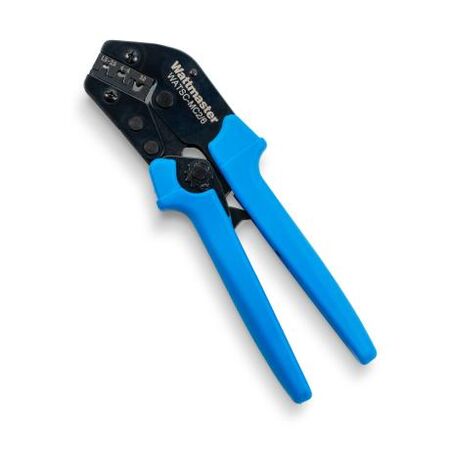
MC4 connectors are simple enough to install — but only if you do it right. Get it wrong, and you're looking at a high-resistance join that quietly heats up every time the sun's out. Do that long enough, and you've got a real fire risk on your hands.
This guide covers exactly how to crimp MC4 connectors correctly: what tools you need, the exact strip length, a step-by-step walkthrough, troubleshooting common problems, and the mistakes that show up most often on failed inspections. If you're doing any solar DC wiring in Australia — rooftop, ground-mount, or off-grid — this is worth reading before you pick up the crimper.
Already know the basics and just need gear? Schnap stocks MC4 crimping tools and MC4 connectors with same-day dispatch from Sydney.
A properly crimped MC4 connector is a gas-tight mechanical connection — the metal of the cable conductor and the contact pin are compressed together so tightly that there's no gap for oxidation or movement. Resistance is minimal. Heat doesn't build up. The connection stays stable for the 25-year life of the system.
A poorly crimped connector is the opposite. There's a tiny air gap. Resistance creeps up. On a DC string that's producing current all day in the Australian sun, that resistance becomes heat. Insulation softens. The connection loosens further. Eventually, arcing starts.
The Clean Energy Council has flagged poor crimping as one of the top causes of rooftop solar fires in Australia. This isn't a technicality — it's a safety issue. And it's entirely preventable with the right tool and the right technique.
Before touching any MC4 connector on a grid-connect system, it's worth knowing what compliance actually requires.
AS/NZS 5033:2021 — the governing standard for PV array installation in Australia — requires:
AS/NZS 3000:2018 (the Wiring Rules) covers all fixed electrical installations. Grid-connect solar falls under this, meaning all termination work must be done by a licensed electrician.
⚠️ Licence Requirement: All DC wiring work on grid-connected PV systems in Australia must be performed by a licensed electrician with CEC accreditation. The only exception is low-voltage off-grid systems (12V/24V) in caravans, 4WDs, and portable setups.
This is where most DIY crimps go wrong — using the wrong tool. Here's what you actually need:
| Tool | Why It Matters | What Happens Without It |
|---|---|---|
| MC4 ratchet crimping tool | Shaped specifically for MC4 contact pins — gives a gas-tight crimp every time | Generic crimper leaves gaps — high resistance, heat buildup, fire risk |
| Solar cable stripper | Strips to exactly the right depth without nicking conductor strands | Nicked strands = weak crimp. Wrong strip length = poor contact or exposed conductor |
| MC4 disconnect / assembly tool | Seats and releases connectors without damaging the locking collar | Screwdriver damage to locking collar = connector that won't stay seated or seal |
| Multimeter | Continuity and polarity check before connecting to the array | Polarity reversal on a live string damages panels and is dangerous to diagnose |
Schnap stocks MC4 crimping tools and MC4 crimper with guide — trade pricing, same specs used by licensed installers.
Not all MC4 connectors fit all cable sizes. Wrong combination = barrel too small to accept the conductor, or conductor too thin to fill the barrel and crimp properly.
| Cable Size | Typical Use | Max Current | Connector to Use |
|---|---|---|---|
| 2.5mm² | Small off-grid systems, short runs | 30A | MC4 rated for 2.5–4mm² |
| 4mm² | Standard residential rooftop — most common in Australia | 45A | MC4 rated for 4mm² (most common) |
| 6mm² | Long runs, commercial arrays, high-output panels | 57A | MC4 rated for 6mm² — confirm spec sheet |
Schnap stocks MC4 connector pairs and 1500V rated MC4 pairs for both residential and commercial installs.
Make sure your cable is the right spec. For any Australian rooftop or grid-connect system, you need dual-insulated, UV-resistant solar DC cable — typically 4mm² for residential, 6mm² for longer runs. Standard TPS building wire is not rated for PV use.
Also check you have enough of the same brand connector for the entire string. Mixing brands is a compliance issue under AS/NZS 5033. More in our full MC4 connector guide.
Remove exactly 7mm of outer insulation. Too short = conductor won't fill the barrel. Too long = bare conductor exposed past the pin, potential arc point. Check strands after stripping — tight and unbroken. Any nicked strands, cut back and re-strip.
Thread the end cap onto the cable before you crimp. Single most common mistake on the job. Once crimped, the end cap won't go over — you'll have to cut it off and start again.
Push the stripped conductor fully into the MC4 contact pin until flush with or just past the barrel end. All strands inside — none visible outside.
Polarity tip: Standard Australian convention is male MC4 on positive, female on negative. Always confirm against your panel's datasheet — not all manufacturers follow the same convention. A polarity reversal on a live string will damage panels.
Squeeze firmly until the ratchet releases fully — that's the crimp completing to the required force. Don't release early. A partial crimp is harder to detect than no crimp at all.
Tug test: grip the cable, pull firmly. Conductor should not move. If it pulls out, the crimp failed — cut back and start over.
Push the crimped pin into the housing until you feel and hear a distinct click. No click = not seated. The connector will pull apart under load.
Second tug test: pull the cable while holding the housing. Pin should not move.
Slide the rubber seal in place and tighten the end cap finger-tight plus a quarter turn. No more — overtightening splits the seal and kills your IP67 rating.
Click male to female. Before connecting to the array, check polarity with a multimeter. Polarity reversal on a live DC string won't trip a breaker — it damages panels and is dangerous to diagnose while energised.
⚠️ High Voltage Warning: Grid-connected rooftop solar systems operate at up to 1000V DC. All connection work in Australia must be performed by a licensed, CEC-accredited electrician. This guide is for educational purposes only.
| Problem | Likely Cause | Fix |
|---|---|---|
| Connector won't click together | Pin not fully seated, or wrong gender combination | Push pin deeper until it clicks; confirm male/female orientation |
| Conductor pulls out after crimping | Incomplete crimp or wrong tool | Cut off, re-strip to 7mm, re-crimp with correct MC4 tool |
| Connector feels loose after assembly | End cap not tightened, or cable OD too small for housing seal | Tighten end cap; if cable undersized for housing, use correct connector spec |
| Hot connector or discolouration | High-resistance crimp from bad tool or partial crimp | Isolate string, replace connector — do not re-use a heat-damaged pin |
| String output lower than expected | Polarity reversal, loose connection, or shading | Check polarity, inspect all crimps on affected string |
| Connector won't separate | Wrong tool or damaged locking collar | Use MC4 disconnect tool; damaged housing = replace entire connector |
| Water ingress into connector | Seal not seated, end cap loose, or cable OD mismatch | Disassemble, dry, inspect seal — replace if compressed or cracked |
Once MC4 connections are made and tested, cables need to be properly managed and secured. UV-rated solar cable ties are the right choice — standard nylon goes brittle within a season on a hot Australian roof.
Schnap stocks UV-resistant black cable ties for standard residential installs, stainless steel pawl cable ties for coastal or high-corrosion environments, and stainless steel solar cable clips for securing cables to racking.
For more: Solar Cable Ties for Australian Installs.
Q: Can I use a regular crimping tool for MC4 connectors?
MC4 contact pins need a specific jaw profile for a gas-tight crimp. Generic ratchet crimpers are designed for ferrules or ring terminals — wrong tool produces internal gaps that cause resistance buildup and eventual failure.
Q: How do I know if my crimp is good?
Tug test: grip the cable, pull firmly while holding the housing. Conductor should not move at all. The ratchet must also complete its full cycle — releasing mid-cycle means incomplete crimp.
Q: What tools do I need to disconnect MC4 connectors?
A dedicated MC4 disconnect tool. Using a screwdriver cracks the locking collar and compromises the IP67 seal. If a connector is stuck, confirm you're using the right tool for that connector brand.
Q: What's the correct strip length for MC4 connectors?
7mm is standard for most MC4 contact pins. Always confirm against your specific connector brand's spec sheet — some variants differ slightly.
Q: Which way is positive on an MC4 connector?
Standard convention: male MC4 on positive, female on negative. Always confirm with a multimeter before connecting to the array — not all panel manufacturers follow the same convention.
Q: Can I re-crimp a connector that failed the tug test?
No. The metal has deformed. Re-crimping changes the geometry and creates an unreliable connection. Cut off, trim past the stripped section, start fresh with a new pin.
Q: What happens if I get MC4 polarity wrong?
Polarity reversal on a grid-connect string won't trip a breaker. It causes reverse current through panels, damages bypass diodes, and permanently reduces output. Always check polarity with a multimeter before connecting to the array or inverter.
Q: Do I need a licence to crimp MC4 connectors in Australia?
For 12V off-grid (caravan, 4WD, portable) — no. For grid-connected or roof-mounted systems — yes. All DC wiring on grid-connect PV must be done by a licensed, CEC-accredited electrician.
Q: Can you connect MC4 connectors from different brands?
Under AS/NZS 5033, no — unless both manufacturers explicitly approve the combination. Connectors may physically click together but manufacturing tolerances differ, causing micro-arcing over time. Common reason for failed inspections.
Q: Do MC4 connectors need regular inspection?
Yes. Inspect for heat discolouration, housing cracks, UV degradation, and water ingress as part of routine solar maintenance. CEC-accredited installers typically recommend every 2–5 years — coastal and high-UV sites more frequently.
Q: Are MC4 connectors waterproof?
Yes — when correctly assembled. IP67 rating means dustproof and waterproof to 1 metre. The seal only works if the end cap is tightened correctly and cable OD matches the housing spec.
Q: What's the difference between MC4 and MC4-EVO connectors?
MC4-EVO2 is Stäubli's updated design with improved contact geometry and higher current ratings. Stäubli confirms MC4 and MC4-EVO2 are cross-compatible. All other third-party "MC4 compatible" brands should not be cross-mated without explicit manufacturer approval.
Q: How many times can you disconnect and reconnect MC4 connectors?
Typically 10–30 mating cycles depending on manufacturer. MC4s are designed for permanent connections, not repeated disconnection. If you're regularly disconnecting a circuit, a DC disconnect switch is more appropriate.
Related Reading
Schnap supplies licensed solar installers across Australia with MC4 crimping tools, MC4 connectors, UV solar cable ties, stainless steel cable ties, and stainless steel solar cable clips.
Trade pricing. Same-day dispatch from the Sydney warehouse.
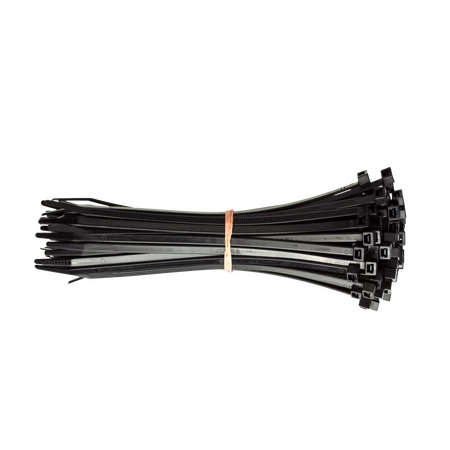
Cable ties are one of the smallest line items on a solar job — but they're also one of the most commonly get wrong. Pick the wrong type, and you're back on the roof 18 months later replacing failed ties and re-securing cables that have been chafing against racking rails the entire time.
Australia's climate is unforgiving. UV levels here are among the highest in the world. Rooftop temperatures regularly hit 70–80°C in summer. In coastal areas, salt air accelerates corrosion faster than most products are rated for. A cable tie that's perfectly fine in a European warehouse has no business being on an Australian solar install.
This guide covers everything you need to make the right call on solar cable ties — material selection, sizing, when to use stainless steel pawl vs plastic pawl, and what Australian Standards say about cable management in solar PV systems.
Most tradies have seen it: white or natural nylon cable ties that have gone brittle and snapped within a year or two of installation. Sometimes less. This isn't a batch issue — it's a material issue.
Standard nylon cable ties are made from PA66 (polyamide 66). PA66 is not UV-stabilised by default. Under prolonged UV exposure, the polymer chains break down — the tie becomes brittle, loses tensile strength, and eventually cracks under minimal load or thermal expansion.
The US Department of Energy flagged this specifically in their Solar PV cable management guidance: standard plastic cable ties used in solar PV arrays frequently fail prematurely due to heat and UV exposure, leading to safety hazards and performance issues including cable abrasion, electrical faults, and structural damage to the array.
In the Australian context, this is amplified. Our UV index is consistently higher than Europe or North America, and rooftop surface temperatures can exceed ambient air temperature by 20–30°C on hot days. A tie rated for "outdoor use" in a temperate climate may degrade in a fraction of the expected time here.
Rule of thumb: If a cable tie is white or natural-coloured nylon and doesn't specify UV stabilisation, it has no place on a solar installation. Full stop.
UV-stabilised black nylon is the baseline standard for solar cable management. The black colouration comes from carbon black additive, which acts as a UV absorber and significantly extends outdoor service life.
PA66 UV-stabilised ties — like the Bitek 200mm UV Resistant Cable Ties — are a cost-effective choice for standard residential rooftop installs where conditions are moderate. They're lighter, easier to handle in volume, and cut flush without leaving sharp edges.
PA11 (polyamide 11) is the premium nylon option. Compared to PA66, PA11 offers better UV resistance, wider operating temperature range, improved chemical resistance, and lower water absorption — which matters in humid coastal environments. If your install is in a high-UV or coastal zone, PA11 is worth the marginal extra cost.
This is where the Matelec SPCT range sits — and it's a product category that's often overlooked.
A stainless steel pawl cable tie combines a UV-stabilised nylon strap with a 304 stainless steel locking mechanism. The key advantage: the pawl is what takes the mechanical load when the tie is tensioned. A plastic pawl can creep under sustained tension — particularly at elevated temperatures. A stainless pawl doesn't.
This makes stainless pawl ties particularly well suited for:
The Matelec SPCT range available at SCHNAP covers four lengths — 100mm, 200mm, 300mm, and 370mm — all with stainless steel pawl and UV-stabilised black nylon strap, in 100-pack quantities suited to volume solar work.
For the harshest environments — coastal, industrial, high-salt-air, or any install where longevity over 20+ years is a hard requirement — full stainless steel is the answer.
Stainless steel cable clips (not traditional zip-tie style, but clip-mount style) are particularly useful for securing DC string cables along racking rails without the failure risk of nylon in high-heat conditions. The Matelec 4x4mm Stainless Steel Solar Cable Clips and the Right Angle variant are designed specifically for solar racking applications and won't corrode or degrade over the system's service life.
Full stainless is the go-to for:
Getting the size right matters. An undersized tie won't close properly over a bundle. An oversized tie wastes material and can be harder to tension correctly.
| Tie Length | Best For | Typical Cable Bundle Diameter |
|---|---|---|
| 100mm Matelec SPCT-100-30B |
Single DC cable securing to racking, small bundles, tight spaces near junction boxes | Up to ~18mm |
| 200mm Matelec SPCT-200-48B |
Standard DC string cable bundling, most common residential rooftop use | Up to ~50mm |
| 300mm Matelec SPCT-300-36B |
Larger cable bundles, securing multiple strings together, conduit bundling | Up to ~80mm |
| 370mm Matelec SPCT-370-48B / SPCT-370-70B |
Large bundle groups, securing cable looms, commercial installs with multiple string runs | Up to ~100mm+ |
AS/NZS 5033 is the Australian standard for installation and safety requirements for photovoltaic arrays. It sets requirements for DC cable management including support, securing, and protection from mechanical damage.
Key requirements relevant to cable tie selection:
Using non-UV-rated cable ties on a solar installation isn't just a quality issue — it's a compliance issue. If a tie fails and a cable abrades against racking, you have a potential DC arc fault. That's a safety and liability problem.
| Environment | Recommended Cable Tie | Reasoning |
|---|---|---|
| Standard suburban rooftop, inland | UV-stabilised black nylon or stainless pawl nylon | Good UV resistance is the primary requirement. Corrosion is lower risk. |
| Coastal (within 1–2km of ocean) | Stainless steel cable clips or coated stainless ties | Salt air accelerates corrosion in nylon pawl mechanisms over time. Full stainless is the safer long-term choice. |
| Metal deck rooftop (colorbond etc) | Stainless pawl nylon or full stainless clips | Rooftop temps can exceed 80°C. Stainless pawl resists creep at elevated temperatures better than plastic pawl. |
| Commercial ground mount | Stainless steel cable clips | Higher wind load, longer cable runs, 25+ year system life expectation. Stainless clips offer the most reliable long-term performance. |
| High UV zone (QLD, NT, WA outback) | PA11 nylon or stainless | PA11 outperforms PA66 under extreme UV. Worth the upgrade in high-UV regions. |
Using white nylon ties from the tradie van. These are PA66 without UV stabilisation. They'll look fine on install day and be brittle within 12–18 months. Don't do it.
Over-tightening. Cable ties should secure without compressing the cable insulation. Over-tightening can stress the insulation at the tie point and create a failure location. Tension to secure, not to compress.
Spacing too far apart. AS/NZS 5033 requires cables to be supported at intervals that prevent sagging. On racking rails, 300–400mm spacing is a common working guide. Too far apart and cables sag onto panel frames or racking edges — that's where abrasion damage starts.
Using the wrong size for the bundle. A 100mm tie around a 60mm bundle isn't going to close properly. Size up when in doubt — it's better to have a slightly long tail than a tie that won't seat correctly.
Not accounting for thermal expansion. DC cables move with temperature. A tie that's perfectly tensioned in the morning may be under stress by midday when the cable has expanded. Leave a small amount of play in larger bundles, particularly on long cable runs.
Q: Can I use standard black cable ties on a solar installation?
A: Only if they're specified as UV-stabilised. Standard black nylon ties may contain carbon black for colour but not for UV stabilisation — the spec sheet will confirm. If the product doesn't explicitly state UV-stabilised or UV-resistant with a rated service life, don't use it on a solar install.
Q: What's the difference between a stainless steel pawl and a plastic pawl cable tie?
A: The pawl is the locking mechanism inside the cable tie head. A stainless steel pawl maintains its locking strength under sustained tension and at elevated temperatures. A plastic pawl can creep — gradually loosening its grip — particularly in hot conditions. For solar work, stainless pawl is the more reliable choice for any tie that's under tension.
Q: Do I need to use stainless steel cable clips instead of cable ties?
A: Not always, but in coastal environments and on commercial installs with long expected service lives, stainless clips are worth it. They don't degrade from UV or corrosion, they don't loosen under thermal cycling, and they don't need to be replaced. For a system expected to run for 25 years, the small upfront cost difference is negligible.
Q: How far apart should cable ties be spaced on a solar installation?
A: There's no single mandated spacing in AS/NZS 5033, but the requirement is that cables must be supported to prevent sagging and contact with surfaces that could cause abrasion. A common working practice is every 300–400mm along racking rails. On longer unsupported cable runs, closer spacing reduces cable movement under wind load.
Q: Are the Matelec SPCT cable ties compliant for use on solar PV systems?
A: Yes. The Matelec SPCT range features UV-stabilised black nylon with stainless steel pawl — meeting the material requirements for outdoor solar cable management under AS/NZS 5033. They're a trade-grade product used by solar installers across Australia.
Related Reading
SCHNAP stocks a full range of solar-rated cable ties and clips for residential and commercial installations. All products available with trade pricing and fast Australia-wide dispatch from our Kingsgrove NSW warehouse.
Need more for your solar install? Browse the full solar installation accessories range including Dektite flashings, cable glands, and solar mounting hardware — or explore the complete cable ties and clips range for all jobsite applications.
In Australian electrical maintenance and infrastructure environments, technicians may be required to work on or near energised equipment under strictly controlled conditions. Under Work Health and Safety (WHS) regulations and AS/NZS 4836 requirements for safe work on low-voltage installations, insulating hand protection forms a critical layer of personal safety.
Rubber Safety Gloves provide a certified dielectric barrier between the technician and electrical potential. They are engineered specifically to resist current flow while maintaining sufficient dexterity for controlled, technical tasks.
The core protective principle of insulating gloves is dielectric resistance. When contact occurs with an energised conductor, the glove introduces high electrical resistance, limiting or preventing current flow through the body.
Rubber Safety Gloves are classified under AS/NZS IEC 60903 according to maximum working voltage. Common classes include:
Each glove is manufactured to meet strict dielectric performance standards and is proof-tested at higher voltages to verify insulation integrity. Selection must always match the maximum prospective voltage of the task.
Most insulating gloves are manufactured from natural rubber (polyisoprene) or synthetic elastomers engineered for electrical insulation. While these materials offer excellent dielectric properties, they are vulnerable to mechanical damage.
Sharp edges, abrasive surfaces, and puncture hazards can compromise insulation integrity. For this reason, compliant systems require the use of leather protector gloves worn over the rubber insulating glove.
The layered system provides:
Without leather protectors, even minor damage may result in dielectric failure.
Under AS/NZS 4836, insulating gloves must be inspected before every use. This includes:
Any glove showing signs of damage must be removed from service immediately.
In addition to daily inspections, gloves must undergo laboratory dielectric testing and recertification at prescribed intervals, typically every six months. Each glove carries a stamped test date and must not be used beyond its certification period.
Rubber insulating gloves are sensitive to:
Improper storage can accelerate degradation and reduce dielectric performance. Gloves should be stored in protective canvas or fabric storage bags, kept away from direct sunlight and high temperatures.
When integrated into work vehicles or plant rooms, protective storage prevents premature ageing and maintains compliance validity.
Rubber Safety Gloves are most effective when used as part of a comprehensive safe work system including:
Technicians installing or maintaining switchgear, distribution boards, and heavy-duty hardware from Schnap Electric Products benefit from combining compliant insulating gloves with insulated tools and structured isolation protocols.
The glove protects the hands, while system-wide compliance protects the entire work environment.
Because insulating gloves carry strict test-date limitations, inventory rotation is critical. Procurement through specialised electrical wholesaler ensures:
Maintaining testing registers and tracking expiry dates supports regulatory compliance and reduces risk of unintentional non-compliance.
Rubber Safety Gloves are a life-critical component of electrical personal protective equipment in Australia. Engineered to meet AS/NZS IEC 60903 requirements, they provide essential dielectric isolation when working on or near energised systems.
When correctly selected, inspected, tested, and paired with leather protectors and insulated tools, they form a reliable barrier against electrical current. In high-voltage and low-voltage maintenance environments, verified insulation integrity remains the foundation of safe electrical practice.
In Australian civil construction and utility maintenance environments, overhead powerlines present a persistent high-risk hazard. Whether operating cranes in metropolitan Sydney developments or elevating platforms near regional Queensland distribution networks, the proximity of plant equipment to energised conductors introduces severe electrocution and arc flash risk.
Under the Work Health and Safety (WHS) framework and utility authority clearance requirements, principal contractors must implement layered controls to prevent accidental contact. An Electrical Line Cover—commonly referred to as “tiger tails”—provides high-visibility hazard identification combined with secondary mechanical protection for overhead conductors within active work zones.
It is essential to clarify the operational purpose of an Electrical Line Cover. Standard line covers are primarily visual warning and mechanical deflection devices. They do not replace formal isolation procedures, nor do they convert a live conductor into a fully insulated working surface.
Their role is to:
These covers function as an administrative and visual engineering control, reinforcing safe approach distances rather than eliminating electrical hazard.
The distinctive yellow and black striping maximises contrast under varying light conditions. This colour combination is globally recognised as a hazard indicator and remains highly visible even in peripheral vision.
For crane operators, excavator drivers, and elevated work platform users, this visual enhancement significantly improves conductor awareness during lifting, positioning, or manoeuvring operations.
Clear visual identification reduces the risk of accidental encroachment into minimum safe approach distances required by supply authorities.
Australian environmental conditions expose overhead safety equipment to:
Electrical Line Covers are typically manufactured from high-density polyethylene (HDPE) or engineered thermoplastic polymers. These materials are selected for:
UV stabilisers and antioxidant additives are incorporated during extrusion to prevent polymer degradation. Without stabilisation, prolonged UV exposure would cause pigment fading and structural brittleness, reducing both visibility and mechanical integrity.
While not a substitute for insulation blankets used in live-line maintenance, the rigid cylindrical structure provides mechanical separation.
If scaffolding components, timber battens, or plant structures brush against the conductor, the cover acts as a physical buffer. This can help prevent direct contact between conductive materials and the bare conductor.
However, line covers must never be relied upon as primary electrical insulation. Safe approach distances and permit-to-work controls remain mandatory.
Professional-grade Electrical Line Covers feature longitudinal split profiles. These allow authorised personnel to install the cover using insulated hot sticks without requiring grid de-energisation.
The design typically includes:
By connecting multiple segments, crews can establish a visible protective corridor spanning the full width of a construction zone.
Electrical Line Covers function most effectively when integrated into a comprehensive site control strategy, including:
On sites utilising heavy-duty switchgear, cabling, and installation hardware from Schnap Electric Products, layered risk management ensures both overhead and ground-level hazards are controlled. Combining high-visibility conductor covers with compliant lockout stations and warning tags strengthens overall worksite safety governance.
Line covers must meet supply authority requirements and be suitable for the voltage class of the network. Contractors should confirm:
Procurement through specialised electrical wholesaler ensures access to compliant products, consistent sizing, and bulk availability for large infrastructure projects.
Regular inspection should verify colour visibility, structural integrity, and secure fit before and during use.
The Electrical Line Cover is a critical visual and mechanical safety control for Australian civil and utility worksites. By enhancing conductor visibility and providing secondary physical deflection, it supports safer machinery operation near energised assets.
When used in conjunction with regulated approach distances, permit-to-work systems, and compliant LOTO procedures, line covers strengthen overhead hazard mitigation strategies. In high-risk environments where plant and live conductors coexist, clear visual communication remains one of the most effective preventive safety mechanisms.

SCHNAP Electrical Wholesaler - clear, upfront pricing that professional electricians trust

Get what you need in seconds. SCHNAP electrical wholesaler makes ordering quick and simple

Fast delivery anywhere - that's guaranteed. SCHNAP electrical wholesalers ship nationwide with same-day dispatch

Track your order every step of the way. SCHNAP electrical wholesale keeps you updated from click to delivery

SCHNAP is Australia's premier electrical wholesaler and electrical supplies, marketing thousands of quality products from leading brands. Trusted for nearly two decades by licensed electricians, contractors, and engineers, our range covers everything from basic electrical components to complex industrial electrical equipment
Our key categories include: LED lighting, designer switches, commercial switchboards, circuit protection, security systems & CCTV, and smart home automation
All products are certified to Australian standards (AS/NZS), backed by our 30-day, no-questions-asked return policy. Our expert technical team helps you quickly source the right solution for any residential, commercial, or industrial project, with daily dispatch from our Sydney electrical warehouse delivering Australia-wide
SCHNAP offers the most comprehensive electrical product range, with full technical specifications, application details, installation requirements, compliance standards, and warranties — giving professionals total confidence in every purchase


